Dedicated to helping businesses and individuals prioritize safety, health, and compliance in the workplace. From small startups to large corporations, safety is essential, and we're here to make it easier.


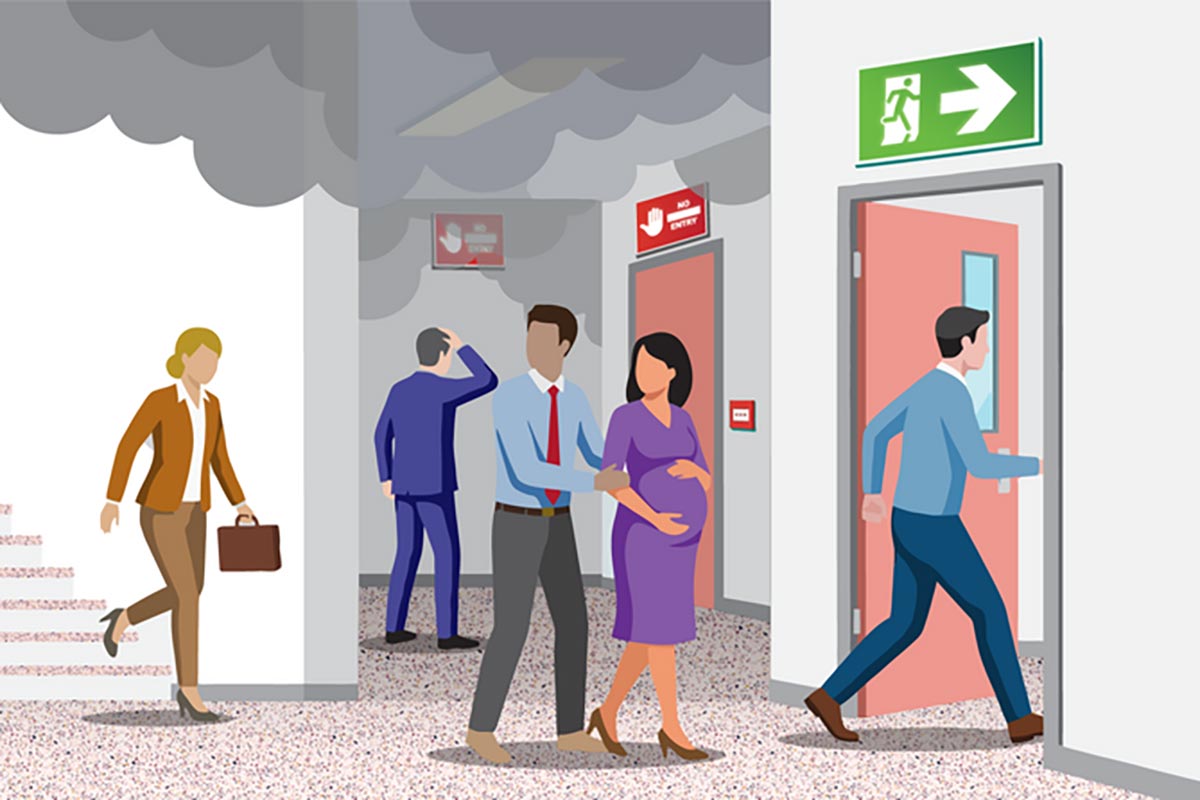
Researchers at the National Institute of Standards and Technology (NIST) have developed a new AI model called “Safe Step” that can redirect occupants to the safest evacuation route during a fire.
Described in the Journal of Building Engineering, the model assesses building conditions and works with electronic displays to show whether an exit is safe to use, redirecting occupants to their safest evacuation exit - all in real-time.
“Fires can grow and spread,” said Hongqiang “Rory” Fang, NIST research associate and first author of the journal paper. “Our model forecasts how the fire is evolving and can help update emergency exit displays to direct people toward the safest exit.”
Previous research proposed using traditional algorithms to find the shortest safe evacuation path. However, these algorithms depend entirely on current building conditions and do not consider cumulative hazards that evacuees may encounter along a route.
“We asked ourselves, ‘Can we build a better algorithm that predicts how the fire evolves, and in a way that helps save more lives?’” said Wai Cheong Tam, NIST mechanical engineer.
The new model forecasts how a fire will evolve and updates emergency exit displays accordingly.
Safe Step can be used in smart buildings, where sensors monitor real-time environmental conditions, such as temperature and air quality. Some of these buildings are testing a new technology - dynamic emergency exit displays - which can indicate that the exit is safe to use or point arrows to a safer route out of the building.
Safe Step uses reinforcement learning, a type of AI that determines optimal routes through trial and error.
Safe Step uses building layouts to learn evacuation routes, along with data from a NIST fire simulation tool to anticipate how a fire in the layout will develop and spread over time.
During training, the model learns to forecast how a fire will affect occupants and then guides them to safer evacuation routes.
In real-world use, the model does not need to run a simulation of the fire in real time. Instead, it would rely on live sensor data from the building to continuously adjust its recommendations as the fire evolves.
The algorithm needs numbers to determine whether it’s choosing the best route. NIST researchers used the fractional effective dose (FED) of toxic gases as a fire safety metric. This variable represents the severity of fire hazards to which a person is exposed over time.
The lower the FED, the lower the hazard exposure for the occupants. The model chooses the route with the lowest FED, accounting for how toxic gas exposure changes over time as an occupant moves.
Researchers then used the model in two test cases to compare with the traditional algorithm. They also used a more-complex single-level building structure and found that the model consistently gave safe evacuation routes.
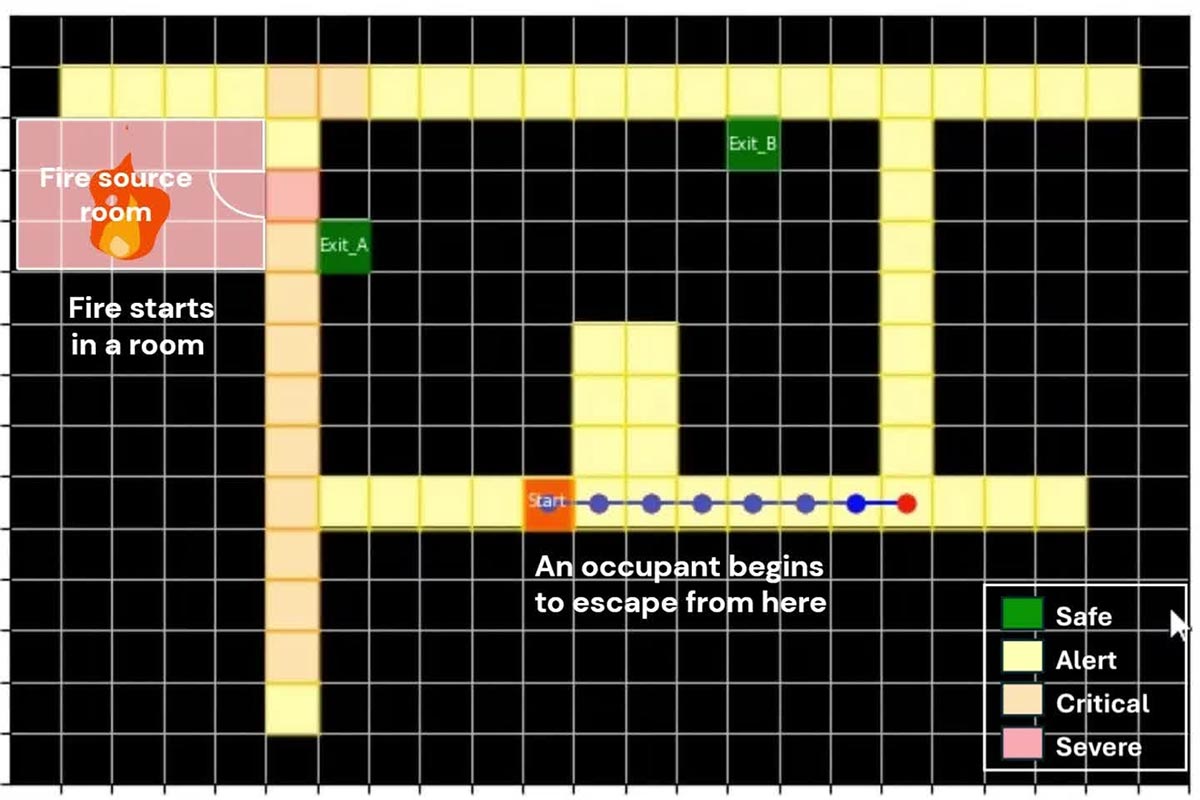
For example, suppose a fire starts in a room across the hallway, and a small amount of smoke spreads into the hallway. A traditional algorithm would guide the occupant to cross the hallway to get to the closest exit.
But what happens if the fire continues to grow and becomes extremely dangerous by the time the occupant crosses the hallway and approaches the exit? That nearest exit is no longer a safe option.
Safe Step can anticipate this change and provide data for dynamic exit signs to direct the occupant to a more distant but safer exit at the opposite end of the hallway.
The current model works for a single-story floor plan. Researchers’ next steps include improving the model’s capabilities to handle multilevel building structures, where an evacuee can go up or down a floor in addition to turning left or right down a hallway.
To most accurately model the evacuation of multiple individuals, researchers plan to build an AI system with multiple agents, with each agent corresponding to a different building occupant. Interactions among multiple agents will make the model more adaptable to real fire response and evacuation scenarios.
For instance, during a fire, congestion can build up at the building’s entrance as multiple people try to exit at the same time, creating a bottleneck.
With an improved algorithm, the model could direct evacuees to different exits while coordinating access points for firefighters to enter the building. This coordination would make it easier for firefighters to extinguish the fire or rescue vulnerable individuals, such as older adults, children, and people with disabilities.
NIST said it has more than a century of experience working with other organizations to advance fire safety research. In just the last several decades, by improving smoke alarms and firefighter gear, NIST’s fire research has played a crucial role in reducing fire-related deaths each year.
Researchers estimate that technologies like Safe Step could start appearing in five to 10 years, though widespread adoption will depend on regulatory approval, reliability testing, and integration with existing safety systems.
“This research is still in the early R&D stage, but it represents an important step toward intelligent firefighting where effective use of advanced technologies can protect property and save lives,” Fang said.
As AI comes to the forefront of decision-making roles in safety-critical environments, ANSI said the standards community must keep pace with frameworks to guide its responsible deployment.
International standardization work to support this development include:
Both standards are developed by the ISO/IEC Joint Technical Committee 1 - Information technology, Subcommittee 42 - Artificial intelligence, which is in the process of developing a series on AI functional safety.
ANSI-accredited standards developers are also contributing across various AI domains, including the IEEE 7000 series, which addresses ethical considerations in the design of autonomous and intelligent systems.
On the fire and life safety side, the physical infrastructure that AI models like Safe Step depend on is standards-supported.
UL 924 - Standard for Emergency Lighting and Power Equipment, has extra investigatory steps beyond general lighting certifications, qualifying equipment to the requirements of:
The NIST AI Risk Management Framework offers complementary, voluntary guidance for managing AI risks across its lifecycle.
All together, these standards support the broader ecosystem that makes AI-driven safety tools deployable - ultimately, with safer outcomes during fire emergencies.

Join our Safety Briefing newsletter and get safety news across logistics, warehousing, manufacturing, construction, and other high-risk environments. Get the latest regulatory updates, alerts, safety products, equipment and training, and analysis.
Don't miss a single news story, product review or safety resource. Subscribe to our newsletter for the latest safety news, updates, and exclusive offers.