Dedicated to helping businesses and individuals prioritize safety, health, and compliance in the workplace. From small startups to large corporations, safety is essential, and we're here to make it easier.


Founded in 1922, Canadian Tire is a retail company that operates in the automotive, hardware, sports, leisure and housewares sectors. Known for its range of products—from car parts and tools to sporting goods, camping gear and home improvement supplies—the company has 1,700 retail locations across Canada.
While revamping its flagship storefront recently, Canadian Tire also wanted to optimize its back-end operations and enhance worker safety in its new 75,000-square-foot warehouse. Lower back injuries were posing a challenge for warehouse workers due to the physical demand of the consistent lifting of goods and the increase in the volume of goods that must be handled.
While the facility had gone through a revamp of the storefront and automated machines were installed in the warehouse, Canadian Tire wanted to give the same attention to help improve employee conditions. Employees in the warehouse handle the majority of the physical tasks—including palletizing goods—so finding a new innovative solution to give support to employees during their daily tasks was a priority.
“The team in the back is responsible for handling all our goods. We updated our equipment by installing a powered conveyor system,” says Canadian Tire’s manager of store operations and process improvement, Jason Warwick. “Now we want to reinvest some of that into our team for their safety.”
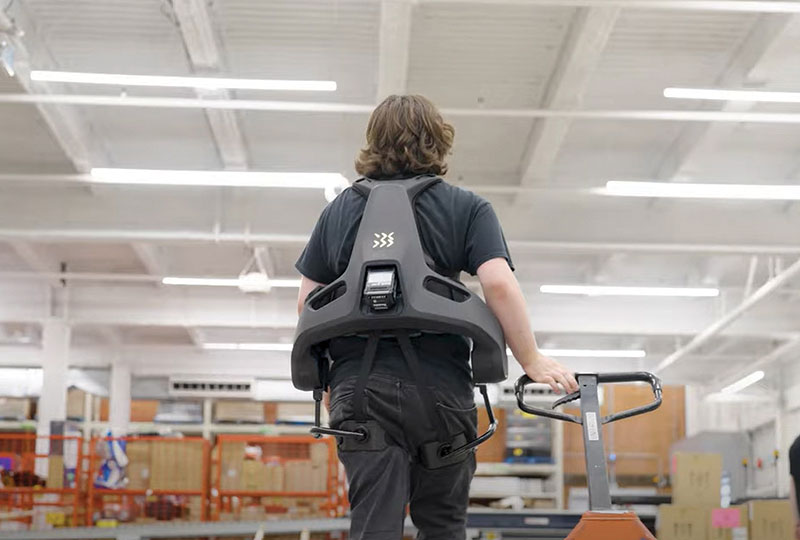
After exploring the available options, the Canadian Tire team in Welland, Ontario, decided to invest in an exoskeleton (German Bionic) called Apogee. This powered exoskeleton is designed to assist workers in physically demanding jobs by providing support for lifting, bending and walking. This technology leverages advanced biomechanics to reduce strain on the wearer’s back and legs, minimizing the risk of musculoskeletal injuries and improving overall workplace safety and efficiency.
The warehouse team at Canadian Tire’s flagship store uses the exoskeleton during periods of lifting and unloading goods. Worn like a backpack, the device provides up to 66 pounds of weight compensation for each lift, which is useful for handling the range of goods that the retailer sells. The exoskeleton’s ergonomic design and intuitive interface promote safer work practices and reduce the risk of accidents caused by fatigue or improper lifting techniques.
The exoskeletons assist workers in handling heavy items quickly and enable faster order fulfillment. Employees like the extra help the exoskeletons provide, as well as the mental and physical relief they experience when they use the devices during busy shifts.
By providing physical support and taking over the tasks most prone to causing injuries, the exoskeletons are also helping Canadian Tire achieve its workplace safety goals.
Other benefits include hybrid automation, smart augmentation that relieves up to 66 pounds per lift, real-time data, artificial intelligence-based learning, motivation on a display, prevention of work-related musculoskeletal disorders and accidents at work, as well as being both dust-proof and waterproof.


Bridget McCrea is an Editor at Large for Modern Materials Handling and a Contributing Editor for Logistics Management based in Clearwater, Fla. She has covered the transportation and supply chain space since 1996 and has covered all aspects of the industry for Modern Materials Handling, Logistics Management and Supply Chain Management Review. She can be reached at [email protected] , or on Twitter @BridgetMcCrea
Join our Safety Briefing newsletter and get safety news across logistics, warehousing, manufacturing, construction, and other high-risk environments. Get the latest regulatory updates, alerts, safety products, equipment and training, and analysis.
Don't miss a single news story, product review or safety resource. Subscribe to our newsletter for the latest safety news, updates, and exclusive offers.