Dedicated to helping businesses and individuals prioritize safety, health, and compliance in the workplace. From small startups to large corporations, safety is essential, and we're here to make it easier.


Automated material handling and intralogistics system provider Alstef Group announced a new Autonomous Industrial Vehicle (AIV) at MODEX 2026.
The trade show was hosted by MHI April 13-16 in Atlanta, Georgia.
The AIV is designed to meet increasing demands for flexibility, safety, and performance across warehousing and distribution environments.
As intralogistics operations become more dynamic and less predictable, automation systems must be capable of understanding and reacting to their surroundings in real time.
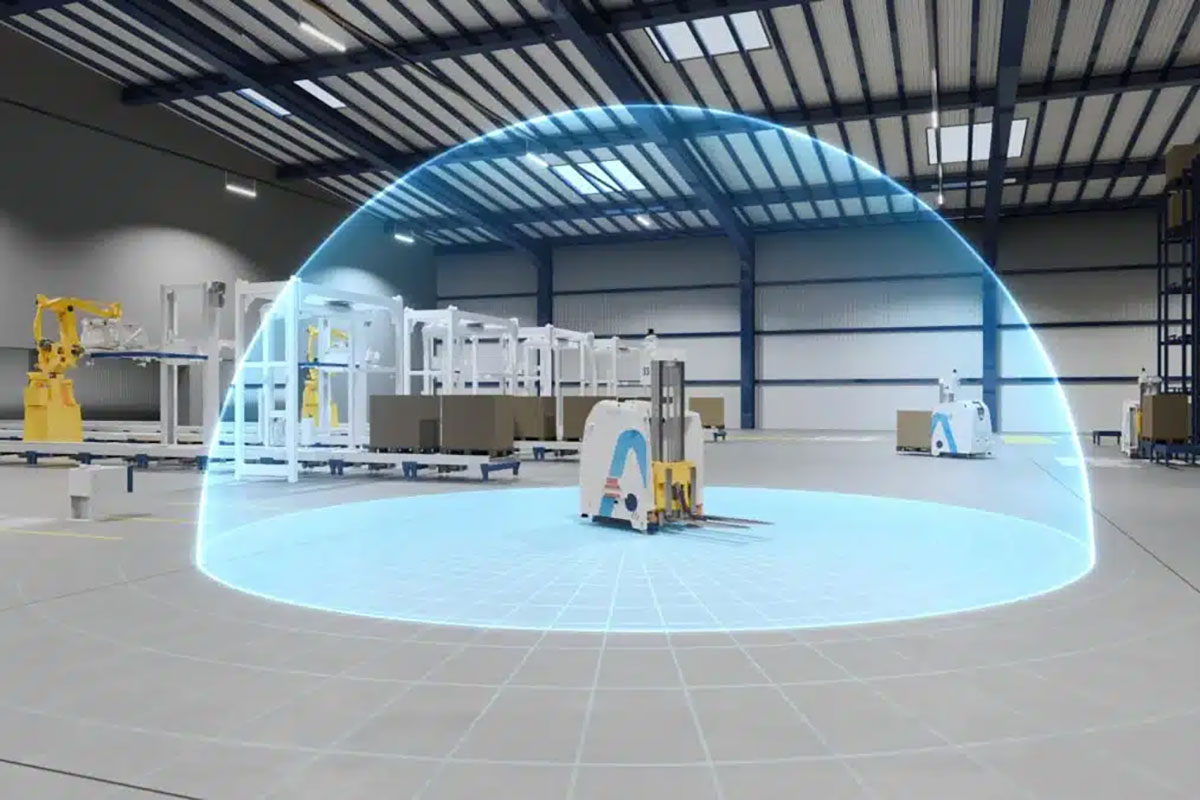
Alstef Group said its new AIV addresses this challenge through an advanced perception bubble - a continuously updated awareness zone that enables the vehicle to detect, interpret, and respond intelligently to people, equipment, and environmental changes within its operating area.
Within this perception bubble, the AIV goes beyond simple obstacle detection. By combining on-board cameras with AI models, the vehicle is able to classify objects in its environment. For example, it can distinguish between pedestrians, manual carts, pallets, and fixed infrastructure. This semantic understanding allows the AIV to adapt its behavior contextually, improving both safety and operational. efficiency in shared spaces.
Designed for brownfield and live operational environments, Alstef Group said its AIV can integrate seamlessly into existing facilities without requiring extensive infrastructure changes.
The perception bubble enables the vehicle to remain fully aware of its surroundings despite layout changes, temporary obstacles, or evolving workflows - making it particularly well-suited to sites where operational continuity is critical.
“True autonomy depends on continuous environmental awareness,” said Matthieu Crosnier, Alstef Group intralogistics sales director. “The perception bubble at the heart of our new AIV enables safer, more intelligent interactions between autonomous vehicles and their surroundings, while simplifying system implementation and improving user comfort.”
The perception bubble also simplifies system configuration and day-to-day operation.
Pedestrian crossings no longer need to be manually configured in the control system, as the AIV is able to recognize them automatically and adjust its speed accordingly, while emitting visual and audible signals to indicate its presence.
Similarly, the vehicle adapts its docking trajectory based on the actual position of a pallet, removing the need for precise manual placement or ground markings.
The perception bubble is available in two configurations:
The light version will be the first to be commercialized, with a roadmap that allows functionality to be expanded over time through software updates rather than hardware modifications.
Speed adjustment and obstacle avoidance are managed dynamically within the perception bubble, with information shared at system level to enable alternative routing where required, increasing overall equipment availability and reducing unnecessary downtime.
Additional intelligence enables the AIV to determine whether a pallet is empty or loaded and to calculate the appropriate destination autonomously.
Through continued investment in autonomous robotics, AI, and software-driven innovation, Alstef Group said it continues to strengthen its intralogistics portfolio and support the long-term transformation of material handling operations worldwide.


Join our Safety Briefing newsletter and get safety news across logistics, warehousing, manufacturing, construction, and other high-risk environments. Get the latest regulatory updates, alerts, safety products, equipment and training, and analysis.
Don't miss a single news story, product review or safety resource. Subscribe to our newsletter for the latest safety news, updates, and exclusive offers.