Dedicated to helping businesses and individuals prioritize safety, health, and compliance in the workplace. From small startups to large corporations, safety is essential, and we're here to make it easier.


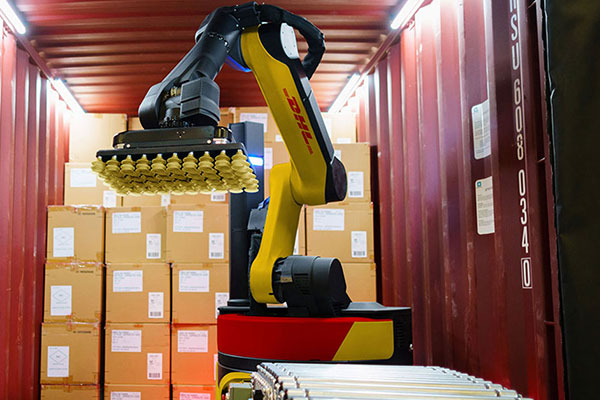
Case handling workflows can become a bottleneck in any supply chain, especially at the loading dock. Ocean containers from overseas manufacturers are often floor loaded to maximize capacity.
Unloading containers is a dull, dirty, and dangerous job. It’s ergonomically unfriendly, requiring frequent lifting, straining, and twisting. Without temperature control, shipping containers also magnify temperature extremes, becoming freezers in the winter and dangerously hot ovens in the summer.
“This is a perfect application for automation,” said Brian Gaunt, VP of Accelerated Digitalization for DHL Supply Chain. “Let's have a machine do an operation that is difficult to staff. It's miserable for our associates to do, it's hard on their bodies, and we can build a solution that can do this work for them.”
To help meet the needs of its customers, the global third party logistics (3PL) provider partnered with Boston Dynamics to develop a mobile case handling platform called Stretch. Boston Dynamics developed the technology, and DHL helped commercialize Stretch by connecting it with use cases.
“We had this robot called Handle, which was the first robot we made on wheels,” said Alex Perkins, a senior technical director at Boston Dynamics and chief roboticist for Stretch. “It still had legs, but it had wheels and had this wacky arm.”
Handle was tested at DHL warehouses across the U.S., lifting products of different shapes and sizes from tires to shampoo bottles.
“We learned - among other things - that a dynamically balancing robot isn't necessarily the best idea for a job like this,” Perkins said.
Evaluating Handle helped Boston Dynamics understand what applications a robot arm like Stretch would really excel at, along with corner cases that were not worth focusing on.
“The great thing about the 3PL space with DHL is that it is predictable enough that an automation solution can work, but it is not so predictable that you could just use traditional fixed automation to solve it,” Perkins added.
Distribution centers, like DHL’s warehouses, are often tasked with stacking mixed-case pallets for stock replenishment shipments bound for retail stores. In addition to loading and unloading trailers, Stretch was also initially designed for palletizing and depalletizing.
Stretch is a mobile manipulation robot (MMR), comprising a mobile robot base with a robot arm on top. The key descriptor is “M” for mobile.
Warehouse workers might start the day unloading trucks, pick orders in the middle of the day, and load out to trucks in the afternoon. Stretch is mobile so it can move from task to task just like people. The manually-driven mobile robot base is the same size as a standard pallet.

“It means anywhere in your facility that you can take a pallet, you can take a Stretch,” Perkins said. “We actually have a really cool non-holonomic drive system, so you can drive forward, back, left, right, and spin in circles.”
Stretch’s weight is constrained so standard forklift classes can lift it. The height is also limited so it can be shipped without requiring high-cube clearance.
“We have a seven degree-of-freedom arm, which is one more degree of freedom than you need,” he added, “It allows you to solve what in robotics are called the keyhole problems where you have to - in order to get under the racking - do some weird contortion with your arm.”
Stretch has improved safety and working conditions for DHL’s associates by reducing the need for them to move heavy boxes.
“Where possible, we try to eliminate those strains and stresses associated with manual handling of products,” Gaunt said. “Automation provides career growth and opportunity for them.”
Ideally, a robot operator performing fleet management drives the robot into a truck, starts it, and the robot calls the employee after an hour or two once it finishes unloading.
“The reality is that's not true, because there are some things that the robot is not designed to do,” Perkins said.
When Stretch encounters a situation it can’t handle, such as loose products on the floor, it uses computer vision to detect and document the situation, then calls for assistance.
“There's another class of exceptions, which is, ‘I interacted with the environment and something happened that I didn't expect,’” Perkins added.
AI-powered and machine learning allows Stretch to recover from dropping a box or a stack falling over without human intervention.
“Exceptions happen,” Gaunt said. “Stretch is quite intuitive. If the environment changes - if a box shifts off a place or drops to the side - its autonomous exception recovery is outstanding, and that is quite important in automation. ... If you need human intervention, you can really degrade your performance significantly because of the wait time for somebody to come and take action.”
Stretch can pick and place up to 50 pounds - perfect for appliances like microwaves or mini refrigerators and apparel like denim jeans or canvas jackets.
“A robot like Stretch really shines where the environment is miserable or where the product is miserable,” Perkins said.
Sensors weigh boxes as Stretch lifts them, allowing it to stop if a box is too heavy. Stretch’s motion control systems manage inertial loads, slowing the arm’s motion when lifting heavy boxes to prevent it from accidentally throwing them.

Stretch can also collect and analyze data about itself so it can learn and improve.
“The robot can report back to us saying, ‘Hey, this motor is working harder than it normally does to achieve these same moves,” Perkins said. “We can actually schedule our own preventative maintenance based on the signals the robot is sending back to us.”
Stretch’s cameras are housed in a perception mast mounted behind the robot arm.
“Having perception independent of manipulation lets you do two really cool things,” Perkins said. “One is you can look at what you're trying to touch. The other is I can look the other direction, and I don't have to worry about my arm being in the way.”
When Stretch turns to place a box on the conveyor, the perception mast captures an unoccluded view of the boxes in a trailer.
“As you're picking something, we actually go look at the conveyor to make sure that the conveyor is actually moving,” Perkins said. “There's lots of downstream automation, and lots of opportunities for that to back up.”
Stretch is designed for brownfield applications. Interoperability allows Stretch to communicate with pre-existing telescoping conveyors, allowing deployment without reconfiguration of existing systems. Perkins said integration with other warehouse systems like WMS are in the near-term development roadmap.
Stretch has helped DHL speed up both its downstream processes and yard management.
“It allows us to unload a trailer faster, which in turn allows us to turn dock doors faster, which allows us to bring in product faster,” Gaunt said. “As soon as we can get the product in and make it available and visible for our customers to place orders against that, then they're able to turn that product. All those things add efficiency to the overall workflow.”
Automation systems like Stretch help DHL ensure it can meet and exceed the service levels its customers forecast.
“We would not ever be able to meet the demands of the outbound orders without automation. It can move things so much faster than a person could, at a level of accuracy that is extremely high,” Gaunt said. “It's really an enabler for us, and ultimately a cost savings to our customer.”
Want to learn more about picking with robot arms and automation? This article was featured in the April 2025 Robotics 24/7 Special Focus Issue titled “Pick-and-place robots take on lifting applications.”


Donald Halsing is the Founding Editorial Director of Work Safety 24/7. He was formerly the Associate Editor of Robotics 24/7.
Don's experience spans the supply chain, logistics, and construction industries, having worked in both warehouse operations and land surveying. He is also a professional wedding photographer with his fiancée Ashley.

Join our Safety Briefing newsletter and get safety news across logistics, warehousing, manufacturing, construction, and other high-risk environments. Get the latest regulatory updates, alerts, safety products, equipment and training, and analysis.

Don't miss a single news story, product review or safety resource. Subscribe to our newsletter for the latest safety news, updates, and exclusive offers.