Dedicated to helping businesses and individuals prioritize safety, health, and compliance in the workplace. From small startups to large corporations, safety is essential, and we're here to make it easier.


Oh, boy. Here we go again.
In 2013, Jeff Bezos went on “60 Minutes” to talk about Amazon’s future use of drones to deliver orders to people’s homes. He put a five-year timeline on it.
Within just a few months people started talking about having drones deliver packages to their porches. Only trouble was, it never happened, unless in an isolated pilot—and still doesn’t happen a dozen years later.
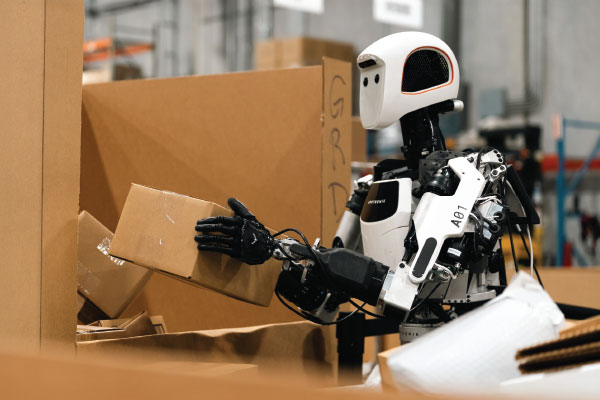
Brace yourself: A new distortion cycle is here. This time it’s with humanoid robots.
Last month, May 1 to be precise, Wired magazine ran this headline: “2025 is the year of the humanoid robot factory worker.”
Hyundai had just announced it would use the humanoid known as Atlas from Boston Dynamics at its Metaplant in Georgia. This is future tense, however. Hyundai acquired Boston Dynamics in 2021.
That same week, UPS announced it’s working with startup Figure AI to use its humanoids in facilities across the country.
This follows on Elon Musk’s fitful start with his Optimus humanoid on the Tesla assembly line. The demo last fall seemed to show that Musk’s humanoids were more human controlled than autonomously driven by AI, which is kind of a given in humanoid robots.
Musk has said several thousand humanoids will be built in 2025. But then seemed to pull back from that as tariffs hit.
Meanwhile, Bloomberg says Figure AI CEO Brett Adcock wrote on LinkedIn that he expects to ship 100,000 humanoids in the next four years.
Other prominent names associated with humanoids include Amazon, Mercedes and even Meta. This is nothing to sniff at regardless of current deployments.
However, all of this projected galactic progress is providential at worst, forward leaning at best.
Quite simply, humanoid robots in warehousing, distribution and manufacturing live much more in a land of promise than in present reality.
In fact, interviews for this story identified actual installations only at two companies, and some pilots. This is hardly a world of thousands of humanoids in a matter of months.
Just talk to Brian Gaunt, vice president of IT at DHL. The company has studied humanoids for seven years. And Gaunt says there’s not so much as a limited pilot of them at any of DHL’s 550 warehouses in North America. Quite simply, DHL has yet to find the right use case for humanoids that would deliver benefits to their customers.
Last month, DHL announced its expanded partnership with Boston Dynamics, signing a strategic agreement to purchase and deploy over 1,000 additional Stretch robots to support a broader range of applications, including case picking. But Boston Dynamics contends that Stretch looks more like an industrial robot and doesn’t resemble a human or animal.
That said, there will be no denying broad use of humanoid robots in warehouses, distribution and manufacturing after 2025.
Time for you to meet Atlas, Optimus, Digit, Figure, Reflex, Spot and others.
No doubt, this isn’t the first time you’ve heard of humanoid robots. You know, they kind of look like a person. But not so much in some cases. And that’s true for a good reason.
“It’s all because people anthropomorphize differently,” explains Melonee Wise, chief product officer at Agility.
Anthropomorphize. Now there’s a rare materials handling gem.
For some, human forms and characteristics on a nonhuman robot mean a head, shoulders and two arms.
Unless of course the legs are replaced by wheels on Reflex’s robots, explains David Schwebel, chief revenue officer at Reflex Robotics.
Many of these robots are human-like in their height (5-foot, 8-iches or so) and weigh in at a (trim) 150 pounds or so.
But Boston Dynamics also has Spot. It’s a quadruped, a body and something that looks like a head.
The body form for a humanoid robot gets even more diverse when you get to Stretch from Boston Dynamics. It has a base on wheels and a single arm with great reach. Experts interviewed for this article were quite split about whether Stretch is a humanoid or not.
But, almost on queue, Wise has an explanation. “All of these are mobile manipulators (MMRs). And that is a term everyone can agree with.” In fact, in the standards and safety work Wise does with different organizations, all use MMR as a common term.
That said, most everybody calls this form of advanced automation “humanoid robots,” no matter how many times Wise and others interject MMR.
So, humanoid it is. Which, by the way, even Wise uses, too.
Parker Conroy, director of product at Apptronik, summarizes humanoids this way.
“A humanoid is a natural progression from a mobile manipulator. A robot should look like a robot. It needs to have an ability to pick and place objects and be mobile autonomously. That generally requires a human-like physiology and plenty of artificial intelligence,” Conroy says.
Glad we got that controversy settled up front. But it’s not the only one surrounding humanoids. Read on.
Probably the most comprehensive catalog of humanoid robots comes out of Morgan Stanley. Earlier this year, it published its “Humanoid 100.”
This is a survey of public companies with an interest in humanoid robots. Fifty-two percent are currently involved with humanoids with the balance likely to get in the action over time. In addition, 56 of the 100 are China-based companies.
Morgan Stanley breaks the technology into three buckets – brain, body and integrators. Not every company offers the full product. The investment firm identifies Tesla, Xiaomi and Hyundai as leaders.
Warehousing and manufacturing figure prominently in the report. But they are only part of the application arena for humanoids.
In total, Morgan Stanley expects eight million humanoids to be at work by 2040. Meanwhile, research firm Interact Analysis offers an outlook to 2032 that registers in the tens of thousands robots. Quite the range.
So, what will they all be doing? That’s a really good question because Morgan Stanley has high expectations for their performance. The firm expects humanoids to have a direct impact on global GDP, how work gets done and on labor markets.
But first, there needs to be some answers as to what exactly can humanoids do better than people, or, for that matter, other forms of automation.
At this point, the answers aren’t obvious. Suppliers don’t even agree as to what humanoids do well.
In the April issue of Modern, a list of a dozen top uses for robots in general appeared. Here’s the list:
We asked those interviewed for this story to say “Yes” or “No” to each of those tasks for humanoids. Unfortunately, a simple yes/no was a challenge for most people and tasks. Plenty of qualifiers were added. As in, “yes but it depends on the size, shape and weight of the items.”
Furthermore, there was no single task that everyone agreed was currently doable by humanoids. But there was broad general agreement for yes/no across tasks. For the most part, companies couldn’t resist adding that qualifier.
Those tasks that generally received a favorable rating were: robotic picking, packing, sorting, put-away storage, order case picking, case/tote transport, order consolidation and palletizing/depalletizing.
A general unfavorable rating went to: truck load/unload, collaborative picking with people, unit load/heavy transport and cycle counting.
In other words, humanoid robots can perform eight of those top robot tasks. But even there, the devil is in the details.
For humanoid robots in warehousing, third-party logistics provider GXO Logistics appears to be the epicenter of activity.
Right now, it’s working closely with Agility, Reflex and Apptronik.
Almost exactly a year ago, Agility and GXO agreed to what they called “the industry’s first formal commercial deployment of humanoid robots and first robots-as-a-service (RaaS) deployment of humanoid robots.”
According to Wise at Agility, GXO has “a number” of Digit humanoids at work in its facility in Flowery Branch, Ga. The robots (see photo on page 35) are focused right now on picking up and moving totes between conveyors, storage equipment and autonomous mobile robots. The plan is to expand the number of humanoids and tasks over time.
Meanwhile, Reflex “has multiple RaaS agreements in discussions with GXO and other 3PLs.” Schwebel continues to say the company is developing an array of use cases for the robots. None are operating in a GXO facility at this time, however.
And Apptronik is conducting an early-stage proof-of-concept program with GXO, says Conroy.
What about humanoids in the future?
“There’s no reason why humanoids have to have two legs. They could well have a wheeled base instead,” says Kevin Heath, director of robotics at Dematic. “But they will have to be highly stable, able to move freely and fully mobile without human intervention. We’re just at the beginning now.”
A critical development area is the humanoids’ hands. The photos on page 33 show two quite different designs.
According to Dematic’s Heath, the target is to have at least 14 degrees of freedom in hand movement. The majority of hand design movement, he says, are close to 2 degrees with some as much as 7 degrees. In any regard, this is an area to watch as humanoids evolve.
By the way, Dematic does not offer a humanoid. But as a system integrator, it is already preparing for them. Heath expects the company to evaluate humanoids as part of the company’s solution portfolio.
And like Dematic, you don’t want to underestimate humanoid robots.
Even Gaunt of DHL says that while his company may not yet have a pilot in place, he’s already looking for offshoot benefits of humanoid robots. “I think it’s a lot like what happened with the space program in the Sixties,” says Gaunt.
He identifies advances in artificial intelligence and vision systems in particular. “This is a matter of learned behavior of robots fed back into other materials handling forms, even lift trucks,” he adds.
So, if a guy who still doesn’t have a use case after seven years thinks that, what else could be on the horizon for humanoid robots?


Gary Forger is an editor at large for Modern Materials Handling. He is the former editorial director of Modern Materials Handling and senior vice president of MHI. He was also the editor of the Material Handling & Logistics U.S. Roadmap to 2030.

Join our Safety Briefing newsletter and get safety news across logistics, warehousing, manufacturing, construction, and other high-risk environments. Get the latest regulatory updates, alerts, safety products, equipment and training, and analysis.

Don't miss a single news story, product review or safety resource. Subscribe to our newsletter for the latest safety news, updates, and exclusive offers.