Dedicated to helping businesses and individuals prioritize safety, health, and compliance in the workplace. From small startups to large corporations, safety is essential, and we're here to make it easier.


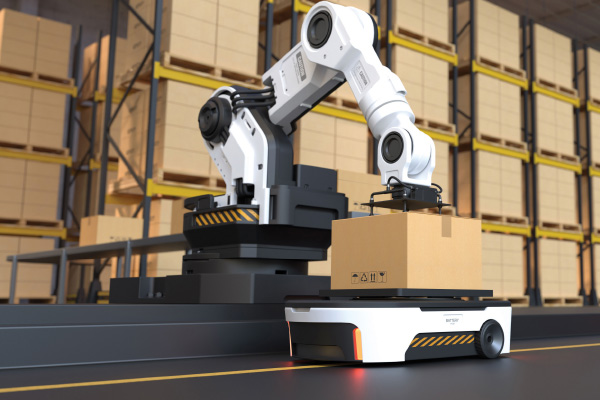
The race to integrate more robotics and automation in the intralogistics setting-companies’ own internal supply chains—is underway in full force. The ongoing warehouse labor shortage, demands of the booming e-commerce channel and the need to “do more with less” have created an environment where adding robotics to the equation just makes sense.
Whether it’s automatic guided vehicles (AGVs), robotic picking systems, automated storage and retrieval systems (AS/RS), or humanoid robots, these and other solutions can help streamline material flow, speed up throughput, improve accuracy and even make workplaces safer.

Sure, there’s an upfront cost that comes with adding robotics to an operation, but the long-term benefits like lower operational costs, faster throughput and improved inventory management have been known to offset initial outlays fairly quickly.
To better understand how organizations are using and plan to use robotics in their operations, Peerless Research Group partnered with MHI and The Robotics Group to produce the fourth annual Intralogistics Survey. The numbers reveal a tectonic shift since the survey was first conducted in 2022, a time when many companies were just starting to dip a toe into the intralogistics robotics waters.

For example, when Peerless published the first survey, 40% of respondents said they had no plans to use robots in the future and only 23% of respondents said they were currently using robotics. Fast-forward to 2025 and 48% of companies (an increase from 46% in 2024) are already using one or more robots in their operations, and 32% want to start using them within the next three years.
As you’ll see in this year’s survey results, the data reveals a rapid and decisive shift, signaling that robotic integration has transitioned from being a “future possibility” and into a “present day imperative” for growing DCs and warehouses.

For the 2025 report, subscribers to Modern Materials Handling and sister publications Logistics Management and Supply Chain Management Review were surveyed over email between January and February 2025.
This year’s respondents are employed at a variety of different organizations, including manufacturing (43%), other non-manufacturing (17%), transportation or warehousing services (17%), and retail trade (7%). Their roles include corporate management (32%), plant management (13%), distribution center director or manager (7%), and materials handling director or manager (7%).
The majority of survey participants (53%) work for companies that have less than $50 million in annual revenues, with the next largest group (9%) working for organizations with revenues ranging from $100 million to $250 billion. The rest of the companies posted revenues ranging anywhere from $100 million to $2.5 billion or more.

Thirty-eight percent of the 217 respondents are potential buyers or current users of robotic automation systems and/or services, while 13% provide robotic automation consulting and systems integration services, and 9% are sellers of robotic automation systems and/or services. Nearly half of companies (48%) are already using robots, and 32% plan to take this route within the next three years.
Not surprisingly, roughly half of the companies surveyed already use other forms of automation. “These could be simple conveyor systems all the way up to large-scale systems,” says Dwight Klappich, research vice president and Gartner Fellow in Gartner’s logistics and customer fulfillment team.
Companies are facing challenges like high and rising labor costs (No. 1 concern); poor productivity and efficiency (No. 2); and physical space constraints (No. 3). “Labor costs are still the No. 1 issue, but it’s interesting that labor availability issues are lower down on the list (ranked No. 5),” Klappich observes, noting that warehouse capacity is a newer concern that’s helping to justify the investment in robotics and automation.
“It now costs over $200 per square foot for new warehouse space, which equates to a $20 million outlay for 100,000 square feet of space. If automation could help improve capacity utilization, it would justify the investment in numerous robots."
In terms of labor challenges, a direct correlation can be found between labor availability and the pursuit of robotics by DC and warehouse operators. Ranked this way, companies put labor challenges first on the list, followed by the need to improve labor productivity, increase throughput and improve safety.

Asked about the current state of their robotic strategies, the majority of respondents (78%) say they’re currently educating themselves, in the knowledge-gathering stage, or formulating their strategies and visions. Six percent are piloting robotics programs, and 6% are finalizing and implementing their programs.
Cumulatively, 96% of respondents are either planning to deploy robots or are in the pre-deployment phases.
When seeking assistance and information about advanced robotics, companies turn to their vendors (48%), materials handling suppliers (44%), industry peers (33%) and industry trade associations (26%). Klappich says this finding dovetails with what Gartner hears from its own customers.
“Industry peers are also a good source if they can find people to talk to,” Klappich points out. “However, this highlights a gap where systems integrators and consultants who are often the trusted sources for this type of information are still not a ‘go to’ source for help.”

Klappich goes on to explain that this may largely be because the consultants and integrators didn’t recognize their role in the robotics space (versus the large-scale automation projects they usually work on). “This is slowly changing,” Klappich adds, “but this survey result proves there’s still a long way to go.”
In ranking processes that are ripe for improvement in their DCs, respondents singled out cycle counting, order consolidation and putaway as their top problem areas.
Interestingly, Klappich says robotics aren’t generally used for these three activities. However, he sees good potential in using flying drones for cycle counting; autonomous lift trucks to put pallets away in high bay storage; and AS/RS for putting away and storing cases, totes and items.
“What’s most interesting with this data is that items with high labor requirements and the best and most proven use cases for robots like basic transport are low on the list,” Klappich says. “Truck loading and unloading and sorting are increasingly viable, and that has rightfully moved up the list (to No. 5).” Klappich also points out that because robotics generally offer very specific use cases, the best buying approach is always to “focus on the right technologies to fit your business needs.”

In terms of priority, companies list robotic picking (at 33%), truck loading and unloading (33%), packing (29%), and collaborative picking (25%) as their primary goals. Klappich says these results reveal a disconnect between the need for improvement and companies’ top priorities. For example, picking is at the top of the priority list, but landed at the middle of the pack in terms of importance.
“Cycle counting was at the top of the list of importance, but near the bottom of the list of priorities,” Klappich says, adding that cycle counting is generally easier and more doable than robotic picking. “The key takeaway here is that companies should look at better aligning their ‘important issues’ with their ‘priorities,’ and then consider which robotics use cases are most viable.”

This year’s survey turned up some interesting insights into companies’ state of mind when it comes to investing in and implementing robotics.
For example, 64% of companies say they either already have the robotics funding in place or are currently working on it, while 32% say they don’t have the funding in place yet.
“The fact that 32% already have funding and another 32% have a funding process underway indicates that the companies moving in this direction are not tire kicking,” Klappich says, “and that 64% of them will likely make the move within their fiscal period (within the next 23 months).”
In assessing the business case factors associated with robotics selection, companies point to safety, data/insights, total cost of ownership and return on investment (ROI) as the most important points. Klappich is surprised that 83% of respondents view safety as their top concern, ranking it as either extremely or somewhat important.
“I would have expected ROI to be at the top of the list, but it’s actually almost 20 points lower in terms of ‘extreme importance,’” he says. “I’m also surprised that investment and cyber risk were notably lower on the list.”
Companies are generally satisfied with their initial robotic investments, with 84% of them saying they’re either extremely or somewhat happy with the overall experience. Actual system performance is meeting expectations for 84% of companies, and 69% of respondents are satisfied with their choice of a robotic vendor.
“This shows that companies are largely happy with their investments,” says Klappich. Singling out the 30% of companies are either “neutral” or “dissatisfied” with the total cost of their robotic investments, Klappich says this suggests that “customers like what the solutions have done for them, but in the end they feel it cost more than they expected."
This year, most companies (66%) are either going to increase or maintain their robotic automation budgets. Klappich says this “speaks to the commitment” that organizations have made on the warehouse robotics front and points out that 15% of them plan to decrease their robotics budgets in 2025.
Ultimately, ongoing labor constraints and the need to be more productive with fewer human resources will continue to drive growth in the intralogistics robotics market. For example, 55% of companies are adopting the solutions to improve worker productivity, 50% point to ergonomics and worker safety as a key driver (namely, helping with heavy loads), and 50% say they’re looking to increase throughput with the same number of employees.
“These results speak positively as to how robotics can help with labor and improve throughput, and that it’s not just there to slash head count,” Klappich says. “The bottom line is that robotics should be considered part of an employee engagement strategy that helps improve worker satisfaction, reduce turnover and improve productivity.”


Bridget McCrea is an Editor at Large for Modern Materials Handling and a Contributing Editor for Logistics Management based in Clearwater, Fla. She has covered the transportation and supply chain space since 1996 and has covered all aspects of the industry for Modern Materials Handling, Logistics Management and Supply Chain Management Review. She can be reached at [email protected] , or on Twitter @BridgetMcCrea
Join our Safety Briefing newsletter and get safety news across logistics, warehousing, manufacturing, construction, and other high-risk environments. Get the latest regulatory updates, alerts, safety products, equipment and training, and analysis.
Don't miss a single news story, product review or safety resource. Subscribe to our newsletter for the latest safety news, updates, and exclusive offers.