Dedicated to helping businesses and individuals prioritize safety, health, and compliance in the workplace. From small startups to large corporations, safety is essential, and we're here to make it easier.


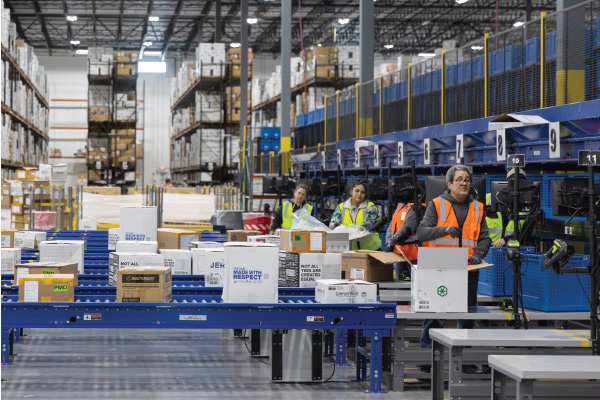
Counting the robots in use at S&S Activewear’s fulfillment center near Chicago is a bit of a moving target. One simple reason is that the type of robots deployed at the apparel distributor’s DC in Lockport, Ill., are moving most of the time.
These autonomous mobile robots (AMRs) are a key element of a “shelf-to-person” style robotics system in which AMRs slide under mobile racks to deliver goods in totes to ergonomic workstations.
The other reason it’s tough to keep a tally on the number of robots is that S&S Activewear has scaled up the solution rapidly and repeatedly. The system, which first went live at Lockport in mid-2023 with 220 robots, is already on its fourth expansion.
By this spring, 600 robots will be transporting inventory stored on 3,200 racks. Additionally, the system has been deployed at another three DCs in S&S’s network, with a fifth site going live with the system in Q2 of this year.
Lockport has served as the proving ground for the robotics system (Geekplus), with the deployment assisted by a solution provider (Infios, formerly Körber Supply Chain Software, a global integrator for Geekplus), including the PopPick system S&S uses. By replacing the previous manual process that relied on operator travel up and down warehouse aisles, along with other productivity enhancing tweaks in the solution design, the system has more than tripled picking productivity at Lockport.
That 3x gain mitigates the risks of trying to ramp up manual picking for a high-growth business, says Brian Beale, chief technology and transformation officer at S&S Activewear. While S&S’s growth already had prompted the company to investigate automation pre-Covid, the experience of the pandemic, when warehouse labor was extremely hard to find and keep, made it clear automation was needed- sooner rather than later.
“We’d been looking at automated approaches going back a decade, but in 2022, when we were in this latest round of looking at options, we weren’t sure there was going to be enough labor available to actually do what we needed to do as a business, because of the effects of the pandemic on labor availability. We had to find the best solution to keep up with volume and quality,” says Brian Beale, chief technology officer at S&S.
High on S&S’s wishlist was scalability-the ability to add capacity to a system easily without a huge capital expenditure on fixed, hard-to-move assets.
“We’ve seen where traditional automation can work really well for some companies, but also cases where a company can get into a bind if it’s not scalable enough,” says Beale. “As a result, scalability was the high bar any solution we looked at would have to clear.”
The solution S&S went with is scalable due to its use of AMRs and mobile racks, as well as modular picker workstations that can be added to increase throughput capacity. For example, the system went live with 24 workstations, but now they have 50, including two “auto-induct” stations that automatically replenish the mobile racks.
The legacy process at Lockport, by contrast, relied on manual picking from static locations. The pickers were directed by S&S’s custom-built warehouse management system (WMS), and WMS logic optimized pick routes. Beale estimates between 50% to 60% of picker time was spent traveling to inventory locations, driving up and down aisles either on stock chasers or orderpickers, and repeatedly getting off and on the equipment to execute picks.
To ramp up for peak times under the legacy process, explains Beale, S&S had to train new people not only on how to use the WMS and mobile devices, but also on safe operation of warehouse vehicles.
“We would start hiring people several months in advance of peak demand seasons to train them on all aspects of picking and safety,” Beale says.
Now, associates do their order picking at workstations, with the goods presented to them. Additionally, the associates pick directly into shippable cartons. And rather than having to find and select cartons, a specially designed put wall with pick-to-light (PTL) technology running behind the workstations enables other associates to position the cartons for the pickers. Such design features have driven additional efficiencies at Lockport, over and above the base robotics.
The rollout strategy was to prove out the system at the company’s largest DC, start enhancing and scaling it, while also rolling it out to additional sites, and then scaling use up networkwide. It’s been an ambitious undertaking, says Beale, but the result is a robotics foundation that can scale to match S&S’s growth, which over the past 10 years has included multiple acquisitions.
“We do know from our history that we need to be able to react super-fast to changing business dynamics,” says Beale.
Imprintable apparel distribution
Founded in 1988 with headquarters in Bolingbrook, Ill., S&S Activewear is a leading, technology-enabled apparel and accessories distributor in North America. S&S offers more than 100 brands, and has more than 5 million square feet of warehouse space. The Lockport DC, at 750,000 square feet, is the largest site and is close to company headquarters.
S&S services a broad range of customers, including retail brands, e-commerce companies, garment decorators, promotional products distributors, lifestyle brands, and web-based platforms for apparel customization. Using a combination of its DC network and its technology, S&S can promise and follow through on one- or two-day deliveries, and offers next-day delivery to 48 states.
In terms of technology, S&S has its own WMS, complete with radio-frequency communication, overall management of warehouse orders, receiving, labeling and shipping as well as business intelligence functionality. The system uses a modern integration architecture with REST APIs (Representational State Transfer programming interfaces), to simplify integration, though the WMS can tie into systems with multiple older mechanisms.
This WMS integrates with the PopPick system in a granular way, says Beale, meaning that as orders and inventory flow into and out of PopPick, the WMS and S&S have full visibility into order progress including real-time knowledge of when orders are picked complete, so the WMS can trigger labeling and shipping tasks, and customer service can have insight into fulfillment progress.
Beale says one of the reasons S&S decided to prove out the solution at Lockport, besides its size, was that many of its software developers are located there, allowing them to be hands-on building the integration, which took about two months to perfect.
“The approach we took made the development of the integration a little more complex, but it provides us with more flexibility for the future,” says Beale.
Core system advantages
The solution is known as a shelf- or tote-to-person design, in that the AMRs slide under mobile racks and deliver them to workstations where human pickers stay&put and do the picking. At the end of each workstation, a gantry-style mechanism with a suction gripper automatically retrieves needed totes from the racks and “pops” them into the workstations.
This robotic zone takes up about 180,000 square feet of the DC and is where the 3,200 racks are located. To anyone viewing the warehouse, the edges of this zone look like robotic dance floor, with AMRs maneuvering to deliver needed racks to specific workstations. The Geekplus software also has logic to dynamically reslot racks based on order history, so the next shift’s retrievals involve minimal distances.
“This dynamic ability to keep the rack positions optimized helps with the lines-per-hour we can achieve through the system,” says Beale.
Another benefit of the shelf-to-person paradigm is that all the traffic previously needed to get to pick faces has been eliminated. Electric lift trucks are still used for pallet moves into reserve, and vehicles are used to transport finished orders to outbound sortation, but in general, there is far less traffic.
“We had a lot of people driving around on carts, and forklifts and orderpickers, so creating a safer environment was a primary concern with this project, along with scalability,” says Beale.
Tailoring key elements
Some key solution features were custom configured for S&S, including the auto-induct stations, which use the same gantry and suction gripper capabilities found at the workstations, but running in reverse to autonomously restock totes into the mobile racks, after decanting and system check-in processes. Of the 50 workstations at Lockport, two of them are auto-induct stations and the other 48 are for picking.
Another key adaptation is the PTL- enabled put wall for carton selection. Associates at this put wall follow light directives to select and position the right cartons for the pickers.
“Having that light-directed process on the backside of the stations keeps everything running smoothly and allows us to keep our pickers focused on the most value-added task, which is the picking,” says Beale.
Inventory characteristics drove some design elements, including larger custom-molded totes and automated weighing and dimensioning points within the decanting area and conveyance to the auto-induct stations.
For starters, most goods S&S receives do not come with bar codes at the individual item level. Additionally, some items, such as hoodies, are relatively bulky, making it impossible decant a full case of certain SKUs into one standard-sized PopPick tote.
To address the situation, early on in assessing how to use PopPick, S&S collaborated with Infios and Geekplus to design a tote that is about 4 mm taller than the standard tote, which would still fit into the mobile racks and would accommodate a one-to-one decant for most SKUs.
This tote change may sound simple, but it needed some supporting features to ensure smooth functioning of the system. For instance, a dimensional check point in the decant area ensures no items are protruding from totes and avoids any glitches in tote replenishment.
This dimensional checkpoint is located within the multi-level conveyor run that takes away full totes from the decant lanes and transports them to the auto-induct stations, and on another level, moves empty totes back to decant. It also provides buffering, so a steady flow of inventory and containers feeds the PopPick system.
This conveyor system also has in-motion weigh scales to capture the precise weight of full totes headed into racks, as well as to measure the weight of empty totes. This was needed because while the custom totes are the same size, three different molds were used to create them, with slight variations in weights.
Plus, since the totes are a tad taller than standard PopPick totes, and the workstations are designed to keep associates at an ideal ergonomic work height, S&S configured the stations with slightly higher flooring to maintain ideal ergonomics. Another integrator involved with the project devised conveyor controls and real-time signaling between the conveyor system and the PopPick robotics, which has proven to be highly reliable.
Coming up with these tweaks took design thinking and effort, says Beale, but the result is a smoothly working system. The weighing and dimension checks provide an automated accuracy function, as they ensure each tote has the correct SKUs and quantities.
Under the legacy method, errors would crop up because pickers would handle a pack of non-bar coded items to select the needed quantity, but might inadvertently return unneeded items to an adjacent cubby, leading to mis-picks later on.
The former workaround to this issue was a manual quality check on picked containers, but this consumed additional labor resources. “Now with the accuracy of the automation, it is no longer necessary to double check anyone’s picking accuracy,” Beale says.
Another adjustment made for worker ergonomics was in the upstream restocking process, where previously, the case handling burden for goods coming out of reserve storage areas was distributed among many workers. The new robotics solution was centralized for efficiency, however, this meant just a couple of workers were under more physical strain from case handling, so vacuum lift assist equipment was added to minimize the strains.
“Once we centralized it, and had just a couple of people doing all these lifts, we knew we needed to mitigate the repeated strains,” says Beale.
Learn, improve & scale
In terms of productivity per picker, rates have leaped up from 40 picks per hour under the legacy process to 150 picks per hour at the new system’s workstations. Additionally, S&S calculates that turnover is down by 75%, attributable to the safer work environment.
The second and third S&S sites that went live with the solution last year are located in Reno, Nev., and Reading, Pa., while a fourth site, in the Dallas-Fort Worth metro, went live with the robotics system this January. A fifth site in Georgia is expected to go live in Q2. At that point, says Beale, the robotics across the five DCs will include 200 PopPick stations, 2,200 robots and about 600,000 totes.
Proving the approach out at the largest DC, expanding it there, then rolling it out to the other sites, has made each rollout easier, even if taken as a whole, it represents a major effort.
“When we went live in Texas in January, it only took a week to get the level of system use that took us about a month to get to in Lockport,” says Beale. “Our team is now more comfortable with this solution, and we’ve added project management resources along the way to document best practices or any issues that can slow us down. We now have a repeatable runbook on all the things we need to do to deploy this system or expand it as smoothly as possible.”
Beale says after the current phase of rollouts and expansion is finished, they don’t have an immediate plan to add asixth DC running the solution, though some expansion may happen after a network assessment later this year. All told, in a roughly 30-month time span since signing up for robotics, S&S will have installed the solution at five DCs, with 12 distinct rollout or expansion projects.
These efforts put S&S in a good place for now. As Beale concludes: “We will have five DCs covering our five primary markets running this solution, which puts us in a great position.”
Lockport Ill.
Products handled: Imprintable apparel and activewear
SKUs: 50,000 SKUs
Number of employees: Usually about 225 associates
Number of shifts: 2 to 3 shifts per day, 6 days per week
Square footage: 750,000 square feet in total
Throughput: 100,000 lines per day; approximately 15,000 orders
The flow behind S&S’s 3x productivity gains S&S Activewear, a leading distributor of imprintable apparel, has deployed a shelf-to-person robotics solution that brings totes of goods needed to fill orders to ergonomic workstations for order picking, eliminating the warehouse travel that used to be involved with its previous method of picking items from static storage. The solution tripled the productivity of its largest DC in Lockport, Ill., and is now live at three other DCs with a fifth set to go live with the solution in Q2.
The Lockport DC receives goods at its receiving docks (1) either floor-loaded in containers or on trailers in pallets. The site uses a vacuum-lift assist solution with attached mobile conveyor section to unload cases, and electric lift trucks to unload pallets. Once unloaded, data identifying the inbound goods is scanned into S&S’s warehouse management system (WMS), which manages the site’s overall fulfillment processes.
Once goods are verified and received, they are moved to one of three reserve storage areas (2), by lift truck. A case reserve storage area (3) is serviced with orderpicker trucks.
The shelf-to-person robotics solution occupies 180,000 square feet of DC. To restock the system, goods held in reserve are picked to pallet and brought by lift truck to the system’s decanting area (4), which has multiple lanes. Vacuum-lift assist equipment also is used here to reduce the strain of inducting cases onto the decant lanes.
A multi-level conveyor system (5) in the decant area incorporates a quality control (QC) station for automatically checking weights and dimensions transports the totes to the solution’s two auto-induct stations (6), which automatically grips and place the totes into the system’s mobile racks.
From there, the system’s mobile robots take over, autonomously moving the racks into the open floor storage zone or grid for the PopPick system (7). While it’s called a PopPick Grid, the mobile racks remain completely mobile and are dynamically repositioned by the robots to the outer edges of the grid to minimize processing time in bringing racks to picker workstations. When racks are needed to fill orders, the mobile robots move them to one of 48 picker workstations (8) located along two sides of the PopPick grid.
At the stations, pickers view the workstation’s user interface to pick orders directly into shippable cartons or bags. A light-enabled put wall system runs along the backside of the stations. Other team members working along this put wall use the light guidance to select and slide cartons into the workstations when needed, enabling the pickers to focus on picking.
Once orders are picked complete, shipping documents are inserted, the cartons are sealed and labeled, and the finished orders are pickup by associates on stock chasers, who transport them the DC’s shipping sorter (9), where they are inducted and conveyed to the correct outbound shipping dock (10) and loaded for shipment to customers.

System suppliers
Solution design and integration: Infios (formerly Körber Supply Chain)
WMS: Internally developed
Shelf-to-person mobile robotics: Geekplus
Conveyor controls: Precision Warehouse Design (PWD)
Vacuum-assisted lift equipment: TAWI
Lift trucks and orderpickers: The Raymond Corp. (at this DC)
Stock chaser vehicles: Pack Mule


Roberto Michel, senior editor for Modern, has covered manufacturing and supply chain management trends since 1996, mainly as a former staff editor and former contributor at Manufacturing Business Technology. He has been a contributor to Modern since 2004. He has worked on numerous show dailies, including at ProMat, the North American Material Handling Logistics show, and National Manufacturing Week. You can reach him at [email protected].

Join our Safety Briefing newsletter and get safety news across logistics, warehousing, manufacturing, construction, and other high-risk environments. Get the latest regulatory updates, alerts, safety products, equipment and training, and analysis.

Don't miss a single news story, product review or safety resource. Subscribe to our newsletter for the latest safety news, updates, and exclusive offers.