Dedicated to helping businesses and individuals prioritize safety, health, and compliance in the workplace. From small startups to large corporations, safety is essential, and we're here to make it easier.


The Pipeline and Hazardous Materials Safety Administration (PHMSA) today announced it has published a Notice of Proposed Rulemaking (NPRM) to update liquefied natural gas (LNG) standards for the first time in two decades.
The NPRM incorporates the 2026 edition of the National Fire Protection Association’s (NFPA) 59A Standard for the Production, Storage, and Handling of LNG.
This rulemaking also responds to congressional mandates directing PHMSA to integrate risk-based regulatory approaches for certain LNG facilities.
The proposed rule will codify advanced, cost-saving technologies that will enhance safety by allowing operators to seamlessly adopt modern innovations like pipe-in-pipe (PIP) systems, single-walled ASME containers, and membrane storage tanks.
“As the world’s largest LNG exporter, the United States’ regulations for LNG facilities are the gold standard,” said Paul Roberti, PHMSA Administrator. “But we have let those regulations stagnate, relying on an outdated version of an industry standard from more than twenty years ago. Today’s long-overdue proposal recognizes the innovation that has transformed the industry over the last ten years and enhances safety by streamlining regulatory requirements and incentivizing the deployment of cutting-edge technologies.”
In April 2025, the DOT announced an Advance Notice of Proposed Rulemaking (ANPRM) to inform a rulemaking proposal to update decades-old regulations for LNG facilities.
PHMSA said leveraging these technologies will generate $100 million in savings annually, and that the update will fast-track new LNG infrastructure projects, lower energy costs, expand export capacity, and grow the small-scale LNG market.
“America has the natural resources, innovative spirit, and private sector might to be the world’s number one energy powerhouse. The only thing standing in our way is outdated red tape,” said Sean P. Duffy, U.S. Transportation Secretary. “By overhauling these basic rules to embrace modern technologies, we can safely unleash America’s energy dominance, lower costs, and generate millions in economic opportunity for the men and women powering our energy sector.”
When PHMSA issued its first Federal safety standards in 1970, the U.S. LNG industry comprised mostly relatively small “peak-shaving” facilities used to liquefy and store natural gas for delivery to local markets during times of peak demand.
The handful of large-scale LNG facilities at that time were primarily built to import natural gas for domestic consumption. The U.S. LNG industry did not have a significant role as an exporter of natural gas.
Market conditions have changed dramatically since the 1970s. U.S. natural gas production has increased significantly, particularly in the past two decades as technological advancements in the oil and gas industry have led to the development of energy resources from the Nation’s shale plays. Domestic natural gas demand has continued to grow, and an increasing number of U.S.-based facilities are exporting LNG to foreign markets.
These changes have created a need for the construction of new LNG facilities and for the expansion of existing LNG facilities.
Modern operational and maintenance practices within the LNG industry are considerably more sophisticated and robust, reflecting many thousands of hours of experience since the 1970s. New technologies have emerged, such as:
PHMSA’s LNG regulations are largely based on the 2001 edition of NFPA 59A and have not been updated since 2006. NFPA 59A-2001 is now seven editions out of date, and multiple stakeholders have called on PHMSA to update its regulations to account for the latest practices in the siting, design, construction, operation, and maintenance of LNG facilities.
For example, in the Protecting our Infrastructure of Pipelines and Enhancing Safety (PIPES) Act of 2016, Congress directed PHMSA to develop regulations for permanent, small-scale LNG facilities, an issue specifically addressed in the more recent editions of NFPA 59A.
In the PIPES Act of 2020, Congress directed PHMSA to develop alternative, risk-based O&M requirements for large-scale LNG facilities, an approach consistent with modern regulatory frameworks that apply in other industries.
The Government Accountability Office (GAO) has also advised PHMSA to update its regulations to align better with current editions of consensus industry standards.
To address these concerns, PHMSA proposed a comprehensive revision to its safety standards for LNG facilities. These changes will promote the use of new technologies, reduce unnecessary barriers to investment, and provide regulatory certainty for interested stakeholders.
PHMSA’s proposals will also address outstanding Congressional mandates and GAO recommendations and advance the Trump Administration’s commitments to “unleashing American energy,” sustaining U.S. defense operations, and ensuring the energy security of the U.S. and its allies.
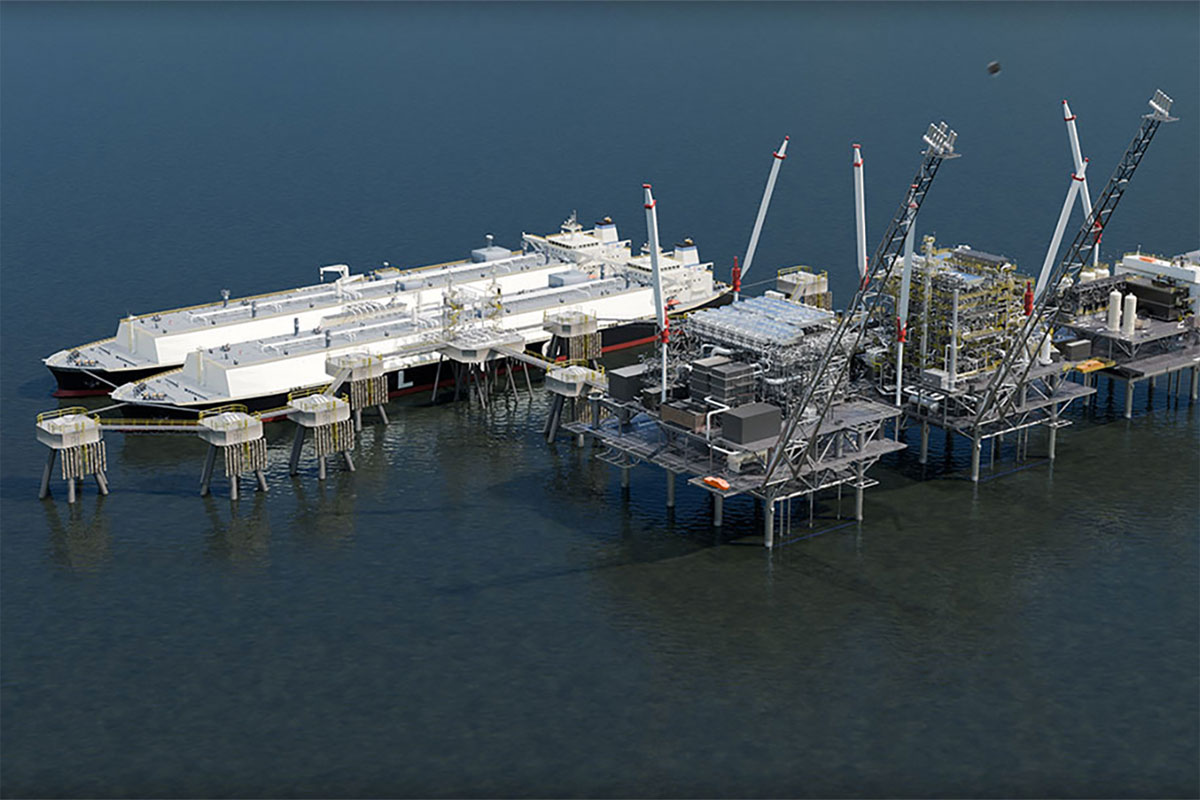
The Maritime Administration (MARAD) today also approved a deepwater port license application for ST LNG, LLC. The announcement builds on two Trump Administration executive orders: Unleashing American Energy and Restoring America’s Maritime Dominance.
The $8.2 billion deepwater LNG port will:
In January, MARAD took on oversight of deepwater port licensing from the U.S. Coast Guard, a move which the DOT said accelerated environmental reviews, accelerated license approvals, and will lower domestic energy costs.
Through this streamlined approach, MARAD finalized the Final Environmental Impact Statement (FEIS) for ST LNG in just 410 days. The report was completed nearly 3.7 years faster than the historical average, at a 70% reduction in review time, and is the fastest deepwater port license review in more than two decades.
The milestone was achieved by streamlining the decision-making process, eliminating duplicative administrative procedures, and improving interagency coordination - all without compromising safety.
Throughout the comprehensive review, MARAD partnered with the Coast Guard, key federal agencies, and the State of Texas to ensure the project meets strict safety and security standards. This decision approves the construction and operation of a critical facility that MARAD said will expand American LNG exports and deliver domestic energy to U.S. allies without reliance on foreign supply chains.
“Thanks to President Trump and Secretary Duffy’s leadership, MARAD is replacing outdated regulations with record-breaking results,” said Stephen M. Carmel, MARAD Administrator. “Approving the ST LNG deepwater port license - our third approval under the Trump Administration - proves we can accelerate the safe development of crucial energy infrastructure that will strengthen our supply chains and drive down energy prices.”
The ST LNG deepwater port will be built approximately 10.4 miles offshore Matagorda, Texas. Construction is expected to begin in 2027, with the port coming online in 2029. At full capacity, the port will include 20 platforms, four LNG floating storage units, four mooring systems, and 7.7 miles of pipeline. The port location is expected to move vessel traffic away from more congested onshore areas, reducing vessel collisions and safety risks.
The feed gas for the port will come from the Tres Palacios Natural Gas Storage and Trading Hub and the Williams Markham Gas Processing Plant through an existing Transco pipeline approximately 5.6 miles northeast of the port.


Donald Halsing is the Founding Editorial Director of Work Safety 24/7. He was formerly the Associate Editor of Robotics 24/7.
Don's experience spans the supply chain, logistics, and construction industries, having worked in both warehouse operations and land surveying. He is also a professional wedding photographer with his fiancée Ashley.
Join our Safety Briefing newsletter and get safety news across logistics, warehousing, manufacturing, construction, and other high-risk environments. Get the latest regulatory updates, alerts, safety products, equipment and training, and analysis.
Don't miss a single news story, product review or safety resource. Subscribe to our newsletter for the latest safety news, updates, and exclusive offers.