Dedicated to helping businesses and individuals prioritize safety, health, and compliance in the workplace. From small startups to large corporations, safety is essential, and we're here to make it easier.


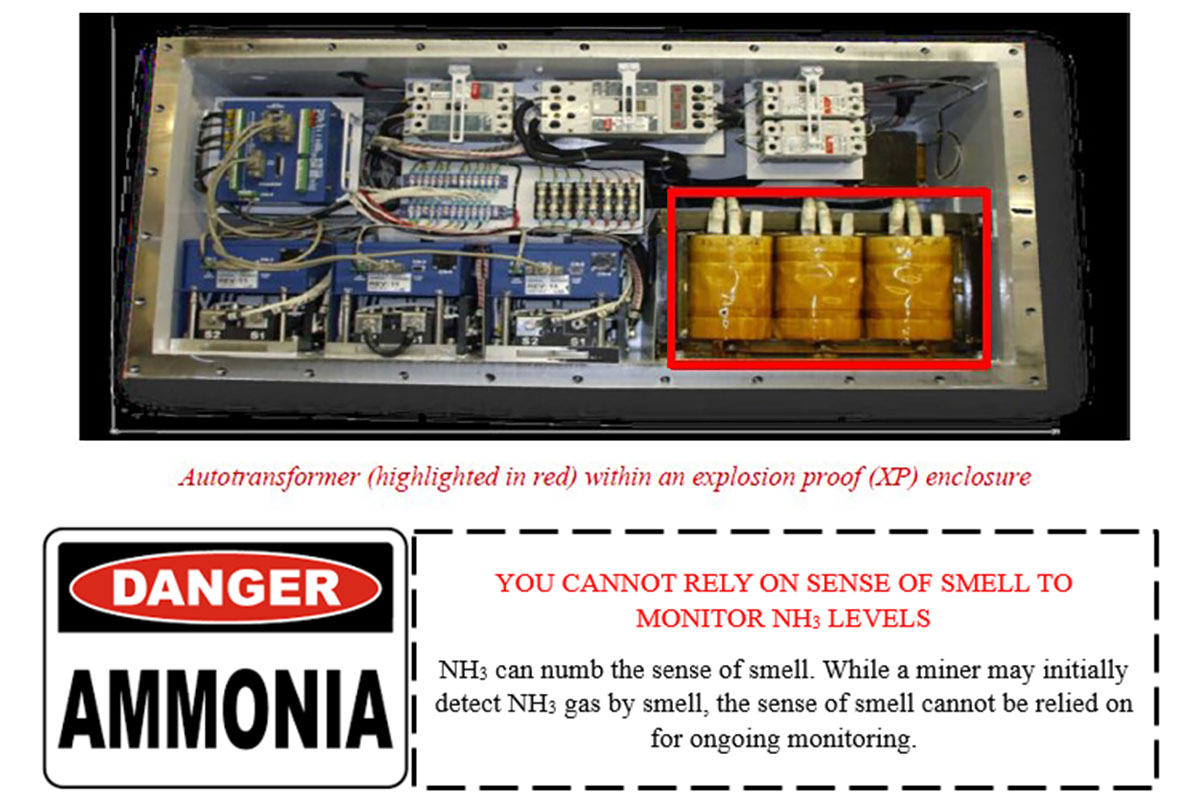
The Mine Safety and Health Administration (MSHA) recently issued safety alerts for autotransformers and ammonia.
These alerts provide reminders of regulations, dangers, and best practices to ensure safety when operating in and near equipment that uses autotransformers, as well as methods to reliably detect and protect against ammonia gas exposure.
Autotransformers being used by machine manufacturers pose a potential ground fault hazard. It is hazardous when a ground fault within the autotransformer occurs and goes undetected by the ground fault protection circuit.
Miners and electricians have reported being shocked when contacting shuttle cars. Shuttle cars equipped with autotransformers may cause a ground fault condition that goes undetected.
These hazards exist when an autotransformer ground fault occurs, and the ground fault protection circuit is inadequate because the ground fault current is too low to be detected.
Exposure to high levels of ammonia can cause serious health effects involving the eyes, lungs, and skin.
Miners working with or around ammonia should take caution. Use engineering controls, such as ventilation, and if respirators are in use, ensure that an ammonia-specific filter cartridge is used.
Ammonia is used on mine sites for chemical processing, refrigeration systems, emissions, and as a neutralizing agent. Exposure can occur due to equipment malfunctions, leaks, chemical mixing, or improper handling. Ensure proper ventilation in mines where ammonia is naturally occurring.
Ammonia has a sharp, pungent smell that can be detected at levels as low as five parts per million (ppm). However, smell alone cannot be relied upon for detection and appropriate warning. Industrial hygiene sampling equipment should be used to monitor levels of ammonia and personal exposure.
The Threshold Limit Value-Time Weighted Average (TLV-TWA) for ammonia is 25 ppm. Ammonia is Immediately Dangerous to Life and Health (IDLH) at 300 ppm.
If ammonia gas is inhaled, relocate the person to fresh air. If liquid ammonia contacts the body, remove contaminated clothes and rinse with water for at least 15 minutes. Immediately seek medical aid.
Stay informed on your required site-specific hazard awareness training including hazardous materials, warning signals, and evacuation procedures.


Join our Safety Briefing newsletter and get safety news across logistics, warehousing, manufacturing, construction, and other high-risk environments. Get the latest regulatory updates, alerts, safety products, equipment and training, and analysis.
Don't miss a single news story, product review or safety resource. Subscribe to our newsletter for the latest safety news, updates, and exclusive offers.