Dedicated to helping businesses and individuals prioritize safety, health, and compliance in the workplace. From small startups to large corporations, safety is essential, and we're here to make it easier.


Automotive plants are known for running like clockwork, with production cells that make use of industrial robots to assemble vehicles with metronomic steadiness, aided by automatic guided vehicles (AGV) to deliver components to production cells on a just-in-time basis.
But in the world of automotive service parts packaging and fulfillment, can automation be applied in a similar way to gain both labor efficiency and a steady but consistently high throughput?
That’s a question leadership within Ford’s Parts Supply and Logistics organization under the Ford Customer Service Division (FCSD)—which is responsible for distributing parts to dealers and other authorized outlets—examined closely when it reassessed its network a few years back.
Previously, Ford relied on 14 external facilities to repackage parts into suitable branded packaging. In a bid to improve service levels and find efficiencies, FCSD decided to invest in a new, internally run parts packaging facility and DC in Southeast Michigan.
The new Monroe Packaging Center, or MPC, is in Monroe, Mich., between Detroit and Toledo, Ohio. The MPC’s role is to take in parts from raw materials suppliers and repackage them into Ford or Motorcraft branded packaging for distribution to a network of 28 hub DCs and smaller regional sites, who then fulfill parts orders to dealerships or authorized outlets for Ford’s Motorcraft parts. The MPC also parcel ships a small volume of parts overnight to dealerships for vehicles requiring urgent repair.
The 1.1-million-square-foot facility replaces most, but not all, of the 14 third-party manual facilities that used to handle this role. When Ford decided to in-source the packaging function with the MPC, which opened in March 2024, it opted to automate many key packing tasks such as carton creation as well as the transport of completed loads to make the site internally efficient and nimbler in terms of enhanced cycle times for downstream distribution.
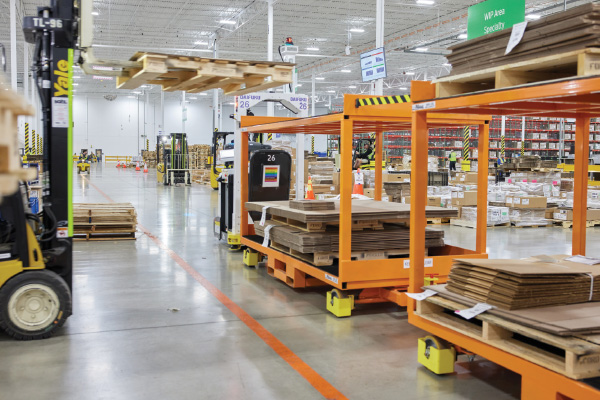
The MPC features a fleet of 19 platform AGVs and an autonomous mobile robot (AMR) tow-tractor system (both from Daifuku) as well as various automated packaging systems to automate repetitive tasks like erecting and sealing cartons.
Taken as a whole, says Brent Osterland, director of Packaging Operations and Engineering Services for FCSD, the internal efficiencies from the automation translate into greater speed and responsiveness for the entire network and ultimately, improved parts availability.
“We certainly invested in automation for efficiency, but the overriding driver was protecting our fill rate performance and taking control of the dealer and customer experience,” says Osterland. “That was the main reason we launched MPC.”
The automation systems deployed at the site, including the AGVs, enable a fast but steady throughput based on replenishment schedules for the downstream DCs, adds Alex Miller, Operations Strategy and Automation manager for FCSD, who was instrumental in the business strategy and overall systems design for the site.
“We were after systems that allow us to keep parts steadily moving through the facility,” says Miller. “We wanted to eliminate any bottlenecks and reasons why parts might get delayed from flowing through the packaging process.”
The average cycle time the new facility achieves is clocking in at four days (with plans to hit three days by mid-2025) from the arrival of parts at receiving to when those parts are fully processed, consolidated as allocations, and ready to ship.
By comparison, the legacy packaging network would typically take eight days, and that shot up to more than 20 days during Covid when challenges in corrugate supply and other issues proved problematic.
Parts and accessories don’t come into Monroe ready for downstream distribution. They typically arrive unpackaged or in plain protective packaging, so repacking needs to take place, while “allocation” or replenishments need to be prepared.
A key objective was to speed up cycle time to create a leaner, more responsive distribution network, says Osterland, which is why the project was dubbed “Project Velocity.”
“We really wanted to speed the velocity of parts through our entire supply chain,” says Osterland. “By moving parts out to our network faster, we can achieve lower inventory levels at the stocking locations. And, every day of inventory we can eliminate from our cycle stock or inventory plan at the network level is millions of dollars. The faster we can get that raw material repackaged and through our facility, ultimately the less inventory we need to carry at our downstream DCs and RDCs.”
The pandemic disruptions further accelerated the need for a new approach. While pre-Covid, the third-party packagers had been able to support a fill rate of near 98% (the percentage of parts the network could ship next day), that fill rate fell by roughly 10% during the worst of Covid when the packaging partners were struggling with bottlenecks, often due to delays in getting pre-made cartons and labor shortages.
Now that the MPC and its systems have been up and running for a year, that fill rate is now regularly exceeding 98%.
The vertical integration isn’t absolute. Ford maintains partnership with a handful of packing partners who can augment what MPC can do on its own.
“We didn’t in-source everything, retaining some capacity with external packagers that we can flex to them if needed for volume spikes or unforeseeable disruptions,” says Osterland.
Additionally, the downstream DC network follows a hub-and-spoke model through which Ford can allocate some additional stock for the larger hubs. It’s based on replenishment planning, to achieve a suitable service level without having to overstock at the smaller DCs. But the speed and efficiency of the network starts back at Monroe with a steady and productive flow of work.
“The foundational principle here at MPC is to keep parts and processes steadily moving through the facility to hit our low cycle time target,” says Osterland.
The automation in use at Monroe creates a “steady drip” of material flow and work processes to get outbound allocations packed and shipped quickly, explains Miller.
This involves several types of automated systems working collaboratively, including the AGV fleet to automate the pickup of larger allocations on pallets and trays from packaging cells serviced by the AGV fleet.
Other conveyor-connected packaging cells are dedicated to repacking and preparing smaller allocations onto trays, as well as kitting up parts.
Throughout the cells, multiple types of automated packaging systems are used to handle repetitive tasks such as carton erecting, carton sealing, application of labels and sealing bags. The automation, along with the design of the new facility, help keep material flowing from one step to another with rapid completion of specific allocations in mind, says Miller.
Steady operation is aided by a custom digital stack light software solution that alerts supervisors, maintenance and others when a process failure happens, to keep work on track.
“The steady drip concept centers on the prevention of any bottlenecks at any point in the operation,” says Miller. “It’s the thinking that materials should always be in a constant state of motion or ready to move right into the next phase of processing.”
The FCSD and its parts and supply organization use enterprise-level software from SAP, including replenishment planning software, to plan allocations for the downstream DC network.
Additionally, both the downstream DCs and the Monroe site use warehouse management system (WMS) software from SAP, while the MPC also uses a value-added services, or VAS, module from SAP to manage its packing workflows and packing cells.
Miller adds that Ford’s internal SAP support team has made many useful customizations to the VAS module to drive operational efficiencies and quality. The Monroe site also uses a yard management system (YMS) to govern yard operations and dock schedules.
A significant difference between the MPC’s scheduling and the way the previous third-party sites processed work is that the Monroe operation schedules tasks and moves inventory at the allocation level, rather than processing full pallets of an entire SKU and sorting everything out to specific allocations later.
“Our method allows operators to send depot allocations as they are packaged, preventing potential backups downstream at sortation and consolidation, to maintain low cycle times,” Miller says. “This process also helps with packaging quality by reducing the potential for sortation errors or risk of parts damage due to over stacking of material.”
The use of on-demand carton creation at Monroe also lessens the chance of supply disruption, as various carton sizes can be built on demand.
“One of the reasons third-party packagers would struggle with cycle time is that they would sometimes be waiting on corrugate material deliveries to package items,” Miller says. “We took that into consideration as we built this facility to help eliminate any reason why a part may be delayed through the packaging process.”
The Monroe site was designed for efficient material flow from one end of the facility to the other.
There are 90 packing cells that need parts and packing materials to prepare allocations, roughly half of them are dedicated to larger orders and parts on wooden pallets and trays, and the other half of the cells are dedicated to packing up small orders, kits and parts.
The automation includes:
The AGV fleet can complete more than 1,200 missions per shift. At the packing cells, operators build loads onto pallets and trays held on AGV stands, designed to keep load building at an ergonomic work height. The AGVs drop off completed loads at the site’s automated shrink-wrapping machines, while tray loads are dropped off at one of the in-feed points to the site’s MDR conveyor system.
Miller says the platform-style AGVs have the ability to position pallets or trays at a comfortable work height in the AGV packing cell.
“The wide-ranging lift stroke supports our need to have two distinct working heights for our operators, since our standard pallet height is 18 to 36 inches, and for tray loads, it’s 18 inches high or less,” says Miller. “To achieve best-in-class ergonomics, we want to keep our operators between 36 to 53 inches of work height, and letting the AGVs do that vertical stretch or lift, so to speak, keeps our operators within that ideal ergonomic zone.”
To help design the AGV system and cells, Miller says FCSD reviewed concepts with automation experts from Ford’s manufacturing division and also engaged with consulting firm Ducker Carlisle, for advice on vendor selection and on best practices on AGV stands and cell design, including how to set up packing machinery.
“Basically, we tried to minimize operator walk distance, while also avoiding sharp twisting of the body,” says Miller. “For example, anytime an operator needs to turn to carry out a task, we built in room for them to take at least one full step to eliminate too much twisting of the body. It was also important for us to design the packing processes to keep weights under 20 pounds, with operator ergonomics in mind.”
Multiple types of conveyor packaging cells are in use at Monroe, with some configured with auto baggers, as well as highly automated cells used to create master packs of 12 to 20 packages of a product. These cells will automatically erect the carton, while a polybag with parts data is automatically printed and fed into a station where the part is inducted by the operator.
The bags are automatically sealed and elevated into an automated counter that counts and drops the correct number bagged parts into the carton. The carton then gets sealed, a label is automatically printed and applied, and the carton is placed onto a tray by the operator, to be conveyed away by the MDR conveyor.
The AGVs deliver a flexibility benefit. Initially, the design for Monroe looked at fixed conveyor to move larger allocations, explains Miller, but the AGVs provided more flexibility to move loads to multiple points downstream.
“We quickly realized that given our need for flexibility in the operation and the high variability of our business with the potential to package up to 200,000 unique SKUs, that we needed an alternative solution for larger and heavier parts. Our main MDR conveyor is great for its low-noise and ease of maintenance, but it can only accommodate allocation weights of up to 200 pounds,” Miller says. “Our AGV fleet is capable of lifting up to 3,000 pounds per pallet and can also transport smaller allocations to that same MDR conveyor line to go through standardized sortation and consolidation processes.”
Additionally, it’s not just automation that enables speed—it’s also the material flow baked into the design of the site, with parts and bulk corrugate coming in one side, packing cells in the middle, and finished allocations in branded packaging coming out by shipping.
As Miller sums up, “With our materials handling strategy, everything is always moving from one end of the facility to the other, always in one direction with the highest safety and quality standards in mind.”


Roberto Michel, senior editor for Modern, has covered manufacturing and supply chain management trends since 1996, mainly as a former staff editor and former contributor at Manufacturing Business Technology. He has been a contributor to Modern since 2004. He has worked on numerous show dailies, including at ProMat, the North American Material Handling Logistics show, and National Manufacturing Week. You can reach him at [email protected].

Join our Safety Briefing newsletter and get safety news across logistics, warehousing, manufacturing, construction, and other high-risk environments. Get the latest regulatory updates, alerts, safety products, equipment and training, and analysis.

Don't miss a single news story, product review or safety resource. Subscribe to our newsletter for the latest safety news, updates, and exclusive offers.