Dedicated to helping businesses and individuals prioritize safety, health, and compliance in the workplace. From small startups to large corporations, safety is essential, and we're here to make it easier.


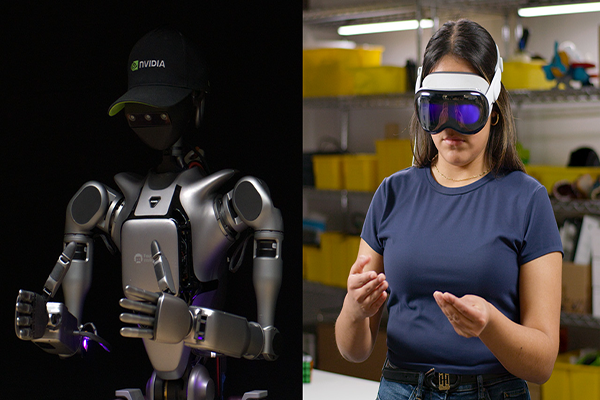
Accelerated computing platform provider NVIDIA recently announced robot providers KUKA, Standard Bots, Universal Robots (UR) and Vention are showcasing hardware and robots powered by NVIDIA Omniverse and Isaac at Automate 2025.
In addition, companies showcasing NVIDIA AI Blueprint for video search and summarization (VSS) at Automate include Siemens, Connect Tech, DeepHow, InOrbit, and KoiReader.
The trade show is being hosted by the Association for Advancing Automation (A3) May 12-15 at the Huntington Place Convention Center in Detroit, Mich.
As the manufacturing and supply chain industries faces challenges - such as labor shortages, reshoring, and inconsistent operational strategies - AI-powered robots present an opportunity to accelerate industrial automation. NVIDIA said its platforms can help manufacturers everywhere automate and optimize their production lines.
At Automate, Deepu Talla, NVIDIA VP of robotics and edge AI, delivered a keynote on physical AI and industrial autonomy.
“The manufacturing industry is experiencing a fundamental shift, with industrial automation and AI-powered robots increasingly changing how warehouses and factories operate worldwide,” Talla said. “NVIDIA’s three-computer architecture - enabling robot training, simulation, and accelerated runtime - is empowering the entire robotics ecosystem to accelerate this shift toward software-defined autonomous facilities.”
Embodied AI systems, which refers to the integration of AI into physical systems, must be trained with real-world data - which is traditionally a complex and resource-intensive process. Each robot typically needs its own custom dataset due to differences in hardware, sensors, and environments.
NVIDIA said synthetic data can offer an alternative and help speed up robot development pipelines. The company announced the latest version of its open-source robot learning framework - Isaac Lab 2.1 - at Automate 2025.
Isaac Lab provides developers with tools to accelerate the robot training process using the NVIDIA Isaac GR00T Blueprint for synthetic motion generation.
Built on NVIDIA Omniverse, a physical AI simulation platform, and NVIDIA Cosmos world foundation models, the blueprint provides a reference workflow for creating vast amounts of synthetic and robot manipulation data, making it easier and faster to train robots - like mobile manipulation robots (MMRs) and humanoids - for a variety of tasks.
Robot systems engineers are building the next generation of robots, tapping into NVIDIA technologies to train, power, and deploy physical AI in industrial settings.
Universal Robots (booth 4023) introduced the UR15, its fastest cobot yet, featuring improved cycle times and advanced motion control. Using UR’s AI Accelerator - developed on the NVIDIA Isaac platform’s CUDA-accelerated libraries and AI models, and NVIDIA Jetson AGX Orin - manufacturers can build AI applications to embody intelligence into cobots.
Vention (booth 4432) announced MachineMotion AI, an automation controller designed to unify motion, sensing, computer vision, and AI. The system taps into the NVIDIA Jetson platform for embedded computing and NVIDIA Isaac’s CUDA-accelerated libraries and models, enabling compute-intensive AI tasks such as real-time vision processing, bin picking, and autonomous decision making. NVIDIA said this technology shows the value AI brings to the manufacturing floor for practical deployment of robotic solutions.
Standard Bots (booth 6423) unveiled its manipulator robot with a 66 pound (30 kilogram) payload and 78 inch (2 meter) reach that can be used for heavy-duty tooling and moving large objects in the automotive, aerospace, and logistics industries. With NVIDIA Isaac Sim, a reference application built on Omniverse, robots can be taught tasks through demonstrations, reducing the need for traditional coding or programming to free up developers for higher-value tasks. Standard Bots also announced teleoperation capabilities via a tablet device, which can efficiently collect training data.
KUKA (booth 4032) unveiled its KR C5 Micro-2, a small robot controller integrated with an NVIDIA Jetson extension for AI-ready applications. It will provide future KUKA robots with better AI vision and AI-based control tasks powered by NVIDIA’s software stack.
In addition to robots, manufacturers everywhere are increasingly turning to AI agents capable of analyzing and acting upon ever-growing video data.
The NVIDIA AI Blueprint for VSS - part of the NVIDIA Metropolis platform - combines generative AI, large language models (LLMs), vision language models (VLMs), and media management services to deploy visual AI agents that can optimize processes.

The platform is suitable for optimizing processes such as visual inspection and assembly, which can help enhance worker safety in factories and warehouses.
NVIDIA said adopting AI agents can help reduce manual monitoring and enables rapid processing and interpretation of vast amounts of video data, helping businesses drive industrial automation and make data-driven decisions.
Robot developers can now use their own video data to try the AI Blueprint for VSS in the cloud with NVIDIA Launchable.
Exhibitors at Automate 2025 are using the blueprint for VSS to enable advanced video analytics and computer vision capabilities across domains.
Siemens (booth 3232) is showcasing its Industrial Copilot for Operations, a generative AI-powered assistant that optimizes workflows and enhances collaboration between humans and AI. Using the tool, shop floor operators, maintenance engineers, and service technicians can receive machine instructions and guidance quicker, using natural language. The copilot uses NVIDIA accelerated computing and NVIDIA NIM and NeMo Retriever microservices from the AI Blueprint for VSS to add multimodal capabilities.
Connect Tech (booth 6734), an edge computing company, is analyzing drone footage with the blueprint for VSS running on NVIDIA Jetson edge devices to enable real-time Q&A and zero-shot detections for hazards like fires or flooding in remote areas.
DeepHow (booth 8032), a generative AI-powered video training platform provider, is using the blueprint to create smart videos that capture key workflows and convert them into structured training content, improving shop floor operator efficiency.
InOrbit AI (booth 546), a software platform for robot orchestration, is showcasing its latest improvements in InOrbit Space Intelligence, which harnesses physical AI, computer vision, and the VSS blueprint to analyze robot operations and optimize real-world workflows.
KoiReader Technologies (booth 746), a provider of vision and generative AI-powered automation systems, is using the blueprint to enable true real-time operational intelligence from events occurring in supply chain and manufacturing environments.
[Editor’s note: this article was adapted from a blog post by Akhil Docca, NGC at NVIDIA senior product marketing manager.]


Join our Safety Briefing newsletter and get safety news across logistics, warehousing, manufacturing, construction, and other high-risk environments. Get the latest regulatory updates, alerts, safety products, equipment and training, and analysis.

Don't miss a single news story, product review or safety resource. Subscribe to our newsletter for the latest safety news, updates, and exclusive offers.