Work Safety 24/7

Dedicated to helping businesses and individuals prioritize safety, health, and compliance in the workplace. From small startups to large corporations, safety is essential, and we're here to make it easier.

Work Safety 101: OSHA 300 Injury and Illness Reporting

Who, when, and how to submit annual injury reports to OSHA

Work Safety 101: OSHA 300 Injury and Illness Reporting
Source: Work Safety 24/7 | Peerless Media and OSHA
Learn how to follow OSHA’s annual injury and illness reporting process, or OSHA 300, including who must report, due dates, exemptions, and additional requirements for certain injuries.
By Donald Halsing 
January 19, 2026

Each year, U.S. businesses must submit their federal injury and illness logs to OSHA. This process is commonly referred to by the form used to collect data: OSHA 300.

OSHA collects this data to help identify establishments with specific hazards so it can initiate enforcement and provide outreach activities to address and abate hazards. This same data also allows OSHA to better analyze trends related to specific industries, processes, or hazards with an ultimate goal to reduce occupational injuries and illnesses.

This installment of Work Safety 101 explains how to follow OSHA’s annual injury and illness reporting process, including who must report, due dates, exemptions, additional requirements for certain injuries, and how to submit.

What is OSHA 300?

Federal injury and illness record keeping is regulated by 29 CFR §1904 - Recording and Reporting Occupational Injuries and Illnesses. There are three important forms:

  • OSHA 300 - Log of Work-Related Injuries and Illnesses - A running list of injuries and illnesses that are reportable to OSHA.
  • OSHA 300A - Summary of Work Related Injuries and Illnesses - A count of reportable injuries and illnesses for different categories for each year that some businesses must submit to OSHA annually and post in their establishment(s).
  • OSHA 301 - Injury and Illness Incident Report - Individual incident reports for each injury or illness case which are used to create the 300 Log and 300A Summary, required for establishments with 100 or more employees in designated industries.

Important dates

  • Jan. 2 - Businesses can start submitting their injury and illness data for the previous year
  • Feb. 1 - An 300A annual summary must be physically posted in each establishment
  • March 2 - Electronic submissions of the previous year’s data are due
  • April 30 - The 300A annual summary no longer needs to be posted

Does my company need to submit our data to OSHA?

While all businesses must keep their own internal injury and illness records in compliance with 29 CFR §1904, not everyone is required to electronically submit data annually. Only establishments within these three categories must submit data:

Employees during
previous calendar year
Industries
included
Submit data
from forms
250 or more All not exempted (see below) 300A
20-249 Appendix A 300A
100 or more Appendix B 300, 300A, 301
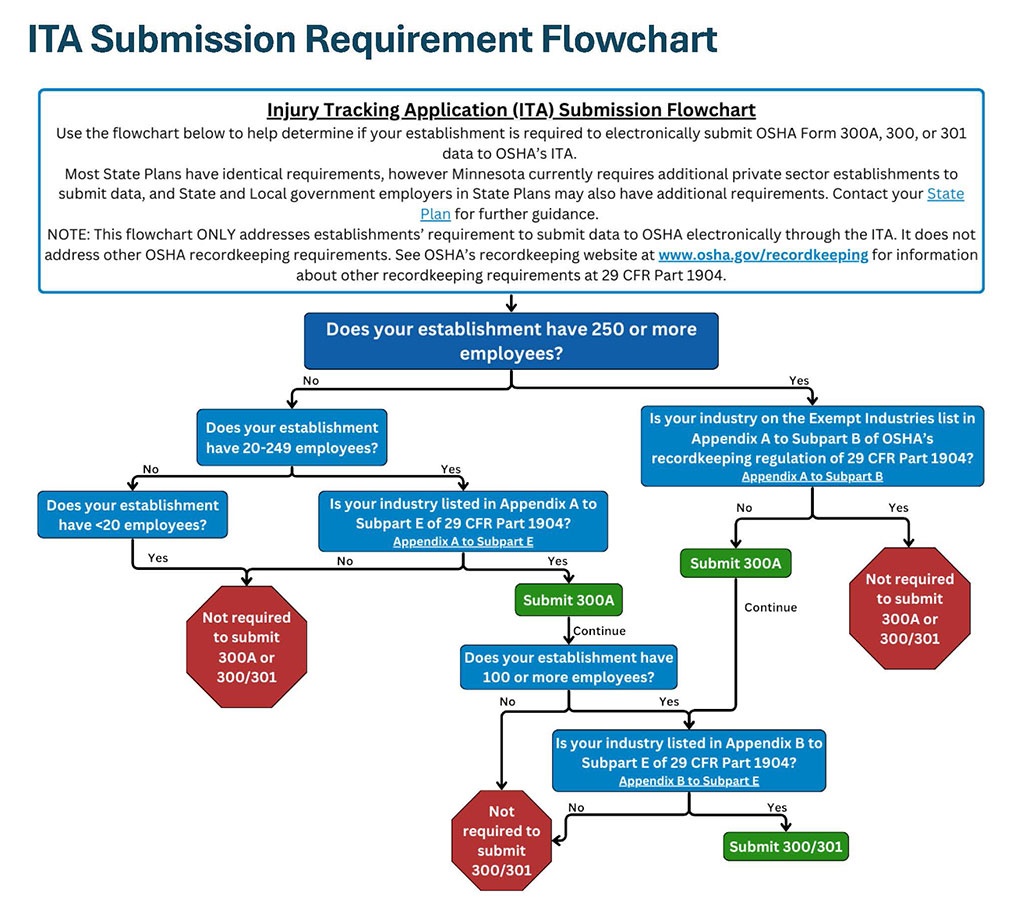
Covered establishments must submit their annual 300A, 300, and 301 data to the Injury Tracking Application (ITA) if they meet the criteria in this flow chart. Source: OSHA

Appendices A and B include, but are not limited to:

If any part of your business does not fall into any of these three categories, then you must submit information only if OSHA requests individual data collection.

Firm vs. Establishment

Under OSHA’s regulations, an "establishment" is a single physical location where business is conducted or services/industrial operations are performed. A "firm" may comprise one or more establishments.

If a company has several business establishments engaged in different classes of business activities, some establishments may be required to keep records, while others may be exempt.

A firm with more than one establishment must submit injury and illness data specific to each establishment that meets the size and industry reporting criteria, but can do so using one account.

Exemptions

Unless OSHA or the Bureau of Labor Statistics (BLS) informs you in writing that you must keep records, the following criteria exempt establishments from reporting:

  1. 10 or fewer employees at all times during the last calendar year for the whole company
  2. Specific industries in Subpart B Appendix A, which include retail stores and automotive dealerships, restaurants, office jobs, and pipeline transportation of oil and gas.
  3. Already keeping records for a different government agency that contain the same information

All employers must report to OSHA any workplace incident that results in an employee's fatality, in-patient hospitalization, amputation, or loss of an eye regardless of exemptions.

What if...

  • If you sold an establishment during the reporting year, you do not have to report data for it.
  • If you bought an establishment during the reporting year, you are required to submit data for the portion of the year that you owned it.
  • If an establishment closed permanently, you do not have to report data for it.
  • If an establishment had zero recordable injuries, you still have to report 300A data, but do not need to submit 300 or 301 data (if applicable).

What is considered an injury or illness?

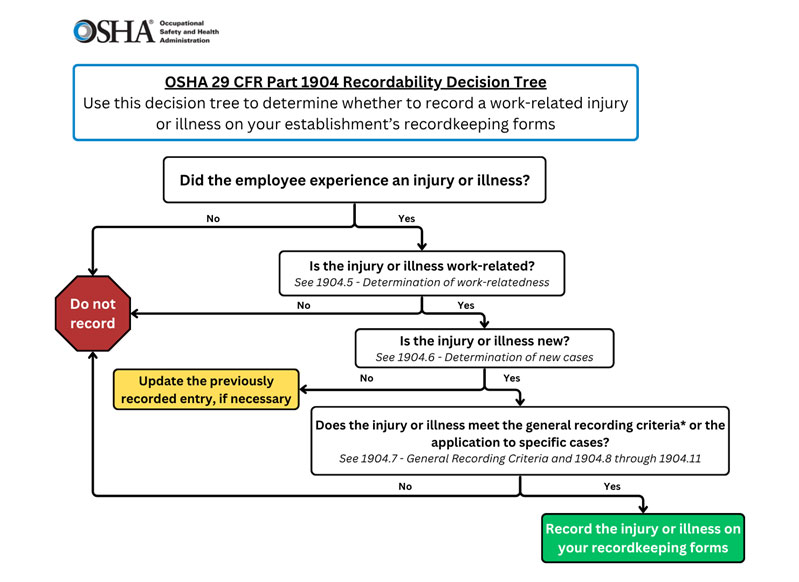
Under the regulation’s general criteria, injuries and illnesses are recordable if they result in:
  • Death
  • Days away from work
  • Restricted work or transfer to another job
  • Medical treatment beyond first aid
  • Loss of consciousness
  • Significant injury or illness diagnosed by a licensed healthcare professional, including cancer, chronic irreversible diseases, fractured or cracked bones, and punctured eardrums
OSHA-recordable injuries and illnesses decision tree. Source: OSHA

Additional information is required for:

  • Injuries involving needles and sharps that are contaminated blood or other potentially infectious material
  • If an employee is medically removed under medical surveillance. Not all OSHA standards have medical removal provisions, while many that cover specific chemical substances do.
  • If an employee experiences work-related Standard Threshold Shift (STS) in hearing in one or both ears with a total hearing level 25 decibels or more above audiometric zero.
  • Occupational exposure to tuberculosis (TB) that results in the employee developing a TB infection

How to submit data electronically

Covered establishments must submit their annual 300A, 300, and 301 data to the Injury Tracking Application (ITA). OSHA does not accept completed paper forms by mail or electronic forms by email.

While the PDF forms on OSHA’s website can be used to meet recording requirements, they cannot be submitted to the ITA. You must enter the information through the ITA web form, create a CSV file in the required format, or use an application programming interface (API).

If you are submitting data for one or only a few establishments, OSHA recommends that you use the 300A web form rather than using the CSV upload option.

What not to submit

OSHA does not collect:

  • Names of employees, supervisors, or other individuals
  • Social Security numbers
  • Telephone numbers
  • Home addresses
  • Email addresses
  • Healthcare provider information

Establishments should remove non-mandatory information that could reasonably be expected to identify individuals from the narrative fields in forms 300 and 301 before submitting them to the ITA.

How long to keep records

Covered employers must save forms 300, 300A, 301, and the privacy case list (if one exists) for five years.

If requested, copies of these records must be provided to current and former employees, or their representatives, as well as to OSHA.

Don’t forget to post your annual summary

Separate from the ITA submission, Form 300A must be physically posted in a conspicuous place in each establishment from Feb. 1 through April 30 of the year following the year covered by the records.

Learn more about OSHA recordkeeping requirements
 

More about OSHA

Latest in OSHA

About Donald Halsing

Donald Halsing

Donald Halsing is the Founding Editorial Director of Work Safety 24/7. He was formerly the Associate Editor of Robotics 24/7.

Don's experience spans the supply chain, logistics, and construction industries, having worked in both warehouse operations and land surveying. He is also a professional wedding photographer with his fiancée Ashley.

Follow Work Safety 24/7
on Facebook
on Linkedin

Related Topics

Regulatory   Government Regulations   News   Features   Work Safety 101   Amputation   BLS   Fatalities   Hazard Identification   Illness   Injuries   OSHA   OSHA 300   SIF   All topics
 

Subscribe

Subscribe to our FREE magazine, FREE email newsletters or both!

Join our Safety Matters newsletter and get safety news across logistics, warehousing, manufacturing, con­struc­tion, and other high-risk environments. Get the latest regulatory updates, alerts, safety products, equipment and training, and analysis.

Subscribe today


Editors’ Picks

U.S. Appeals Court denies claim against OSHA citation of affiliated entity
The U.S. Court of Appeals denied UHS of Delaware’s petition against the OSHRC because it shared a common worksite and integrated safety operations under the same…
NHTSA recalls over 5,000 new USPS trucks for missing brake pin
After a USPS Next Generation Delivery Vehicle lost brake function, NHTSA and Oshkosh recalled all NGDVs produced because the brake pedal mounting pin and retaining…
MSHA issues alerts for ammonia & autotransformers
The Mine Safety and Health Administration encourages operators to examine all equipment with autotransformers currently in service and review safe handling of and…
Dangerous wildfires, sub-zero windchill, and winter weather across U.S. and…
The U.S. National Weather Service (NWS) and Environment Canada have issued warnings for high winds, wildfires, dust storms, heavy snowfall, freezing rain, and…