Dedicated to helping businesses and individuals prioritize safety, health, and compliance in the workplace. From small startups to large corporations, safety is essential, and we're here to make it easier.


Editor’s Note: This article appears in the April 2025 edition of Modern Materials Handling, a Peerless Media publication. Subscribe today!
Mobile robots aimed to enhance human efficiency and productivity have become more attainable over the last decade as technology has improved allowing for larger-scale automation and better cost efficiency.
Their ability to adapt and collaborate with other people and systems is further driving demand at a time when companies are no longer willing to sacrifice flexibility for performance.
“The trade-off between flexibility and performance is no longer appealing,” said Jeff Larson, director of solutions design for Ocado Mobile Robot Systems, Ocado Intelligent Automation. “In fact, warehouses now require an additional third element: adaptability. That’s where mobile robotics comes in.
Also driven by labor shortages, high turnover and safety concerns, mobile robots are most commonly used across four major market segments: third-party logistics, healthcare, industrial and retail. Many different types of mobile robots are available, but at the heart of the solution is the end goal of creating more efficient workflows.
“Our role is to help make humans more efficient in buildings,” said Rick Faulk, CEO of Locus Robotics, who adds that their solutions can double the efficiency of a human by reducing walk time and taking over manual, repetitive tasks.
“We effectively make that whole process a lot easier, a lot more efficient, and frankly, make the lives of workers a lot better as well,” Faulk says.
The automation of 10 to 15 years ago was mostly limited to conveyor-based systems. Companies who could afford it would also add in a shuttle system, but what these fixed systems all had in common was a lack of flexibility.
While they delivered great performance, Larson said they created tough decisions for operators who had to decide between running a manual operation that could flex over time or committing to an expensive system that locked them into a fixed process for the next decade.
As technology has advanced and costs have come down, mobile robots are eliminating that dilemma.
“Mobile cobots work alongside people, integrate with other automation systems, and scale up or down as needed,” Larson said. “More importantly, they provide true adaptability, meaning businesses can modify workflows, change pick paths or reconfigure their operations on the fly as their needs evolve.
A third-party fulfillment company recently worked with Ocado Intelligent Automation to deploy autonomous mobile robots (AMRs) to work alongside associates as a workforce multiplier. They were experiencing limitations in fulfilling a high volume of orders for its retail e-commerce clients, but after three months of AMR use, the client’s picking rates tripled.
Many different types of mobile robots are available, but the end goal is creating more efficient workflows.
“What mobile robots do best is increase productivity without sacrificing flexibility,” Larson said. “Robots execute repetitive, physically demanding tasks, including handling pallets and quickly transporting cases over large warehouses.”
Scalability is another key driver of mobile robots, making the above scenario realistic and affordable for more than just industry leaders.
“Fifteen years ago, it would be very hard to build a robot that had an ROI because the cost of these component parts was very expensive,” Faulk said. “The cost profile has come down over the last seven, eight or nine years to enable us to produce a robot, build it and sell it for a price where I can actually get an ROI. The technology, that cost curve, the Moore’s Law thing that you hear about is in effect.”
And unlike conveyors, which can take years to design and install, Larson said mobile robots can deploy in a matter of weeks or even days in some cases.
“Whether an operation needs to quickly add robots to meet seasonal demand or adjust workflows to accommodate changing order profiles, mobile robotics provide that agility,” he added.
The ability to scale also allows facilities to operate hundreds of robots together in any space - even brownfield builds that were never designed to be automated.
“We now have very sophisticated sensors that allow us to navigate,” Faulk said. “We have some buildings that have over 700 robots…in the early days, it was a challenge getting three robots running, and now we have buildings that have hundreds and hundreds of robots running in them.”
With automation, it almost always comes down to labor challenges, and the demand for mobile robots is no exception. The challenge is two-fold, with warehouses and manufacturing facilities across the country continuing to struggle to both attract and retain labor.
“Turnover in a lot of these facilities is measured in double digits a month, so once they get the labor, it turns over,” Faulk explains.
Mobile robots help bridge that gap by assisting employees and taking on repetitive and manual tasks, which allows them to focus on high-value and more rewarding work. The productivity benefits are obvious, but Larson said warehouses that deploy mobile robots also see higher employee satisfaction and retention rates.
For Locus, deploying mobile robots directly solves these challenges by making the workers and management of operations more efficient.
“The whole goal is to take what is a manual operation, where if you were working in a building today, you would walk 13 to 15 miles a day in probably un-air-conditioned space…and our goal is to make to you a lot more efficient and make your life a lot easier,” Faulk said.
Mobile robots have also become more accessible in recent years. Where once employees tasked with interacting with robotics require advanced technical knowledge, the industry is moving toward more approachable solutions so that every employee can operate and troubleshoot a robot.
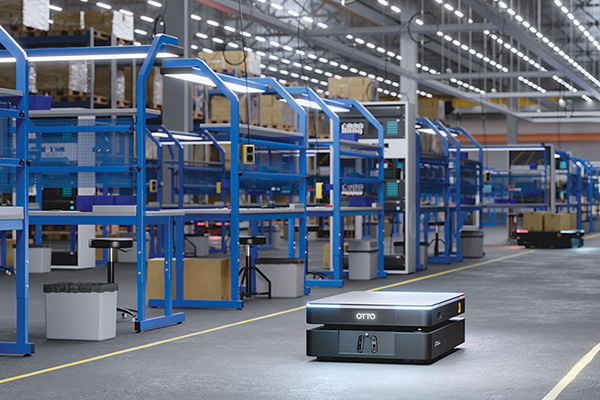
One way OTTO Motors is doing this is by simplifying the user interface using a touchscreen tablet with minimal buttons and options that require almost no training.
“Making those sorts of interfaces that are tailored to the people who are going to be using it is a way of connecting the approachability of interacting with these robots and not having that technical depth that could be a barrier,” said Jason Okerman, staff software product manager at OTTO Motors.
Advancements in software are driving the next generation of mobile robots, and safety is a big part of that.
Advancements in software are driving the next generation of mobile robots, and safety is a big part of that. Today’s robots are equipped with advanced vision systems, machine learning and light detection and ranging (lidar) technology, all working together to improve robot decision-making and autonomy.
Ocado Intelligent Automation introduced Porter AMR, which is designed to handle heavy-duty tasks such as crossdocking or bulk-item picking and effectively reduce the strain on human employees.
“Solutions like Porter enable pallet picking and movement at ground level and help reduce the risk of injury by removing workers from dangerous tasks,” Larson said. “Its lidar system and onboard cameras provide a full field of view, so it safely navigates warehouses while transporting large, heavy loads.”
Okerman adds that when we look at autonomous forklifts or similar use cases there’s a proven track record for automation systems being safer than their equivalent.
“You can have a case where doing that substitution and taking out some of the forklift operations gives more confidence to the people working who would like to be paying attention to what they’re doing, instead of trying to pay attention to make sure they don’t cross paths with a forklift that’s driving by,” Okerman said.
As we move away from robots being niche to being everywhere, challenges around safety still remain. Emerging obstacles include increasing interoperability, working with mixed fleets and balancing flexibility with predictability.
“We want robots to be as predictable as possible around humans, so that their movements and when they stop and what they’re doing is intuitive,” Okerman added. “That has classically been a challenge that if you’re going to have the robots be more flexible, then they’re not predictable.”
Flexible robots are not fixed. They don’t drive the same route over and over. Ensuring that what the robot does intuitively makes sense to human bystanders is still an area Okerman said the industry still has room to grow.
Beyond just moving goods, mobile robots also generate valuable data that provides actionable insights to help logistics managers make decisions in real time. The introduction of AI has enabled even more sophisticated decision-making, allowing mobile robots to operate in buildings in a completely new way.
“AI will drive better optimization and decision-making,” Larson said. “It will improve forecasting and predictive analytics, allowing businesses to better prepare for peak demand periods. It will enhance (more than it already does) collaborative robotics, making robots not just work near humans, but truly collaborate with them.”
Locus is already creating its AI framework, which Faulk said allows users to visualize data in ways they never could before.
“Our robots now use AI to recognize obstacles, for example,” he explained. “As they’re driving around, they recognize a human, they recognize a forklift. If they see a forklift, they’ll take a different action than they would if they saw a human.”
Locus also uses AI to improve operations and workflows. Take their client Ulta Beauty for example.
Ulta gets hundreds of thousands of orders each week, and Locus is able to use their AI engine to look at all those orders and optimize them based on what units were ordered, where they are in the building, what the labor is in the building standing there at that time, based on the form factor and cubes of those items, and then induct the right orders on a robot to actually minimize the steps of a human in that building.
“The impact of artificial intelligence on mobile robotics is just beginning to take off,” Larson said. “Some organizations are better positioned than others, but the true potential of AI is yet to be unlocked.”


Amy Wunderlin is a freelance supply chain and technology writer. She has written for several weekly and daily newspapers, in addition to trade publications such as Supply & Demand Chain Executive, Food Logistics and Building Operating Management, among others. She is a 2013 graduate of the University of Wisconsin-Whitewater, where she earned her B.A. in journalism.

Join our Safety Briefing newsletter and get safety news across logistics, warehousing, manufacturing, construction, and other high-risk environments. Get the latest regulatory updates, alerts, safety products, equipment and training, and analysis.

Don't miss a single news story, product review or safety resource. Subscribe to our newsletter for the latest safety news, updates, and exclusive offers.