Dedicated to helping businesses and individuals prioritize safety, health, and compliance in the workplace. From small startups to large corporations, safety is essential, and we're here to make it easier.


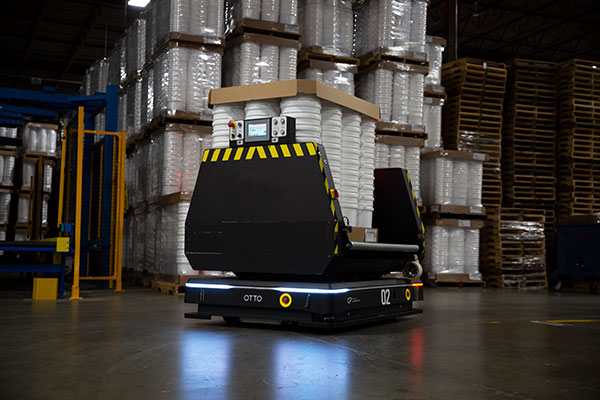
OTTO by Rockwell Automation produces a lineup of four autonomous mobile robots (AMRs), an autonomous lift truck and a software suite to manage its robot fleet in a manufacturing facility.
The OTTO 100 and 1500 bookend the company’s AMR portfolio, managing the lightest (100) and heaviest (1500) load capacities, representing the smallest and largest mobile robot from the provider.
While the lifting capacity and robot footprint range significantly in conjunction with the payload, the technology inside the AMRs remains largely the same. OTTO developers and engineers needed to build these robots with the ability to move smoothly across the warehouse without sidestepping safety.
At MODEX 2024 in Atlanta, the company showcased the OTTO 100 AMR at its company booth. The “small” AMR’s footprint of 29.1 x 21.7 x 12.1 in. can handle load capacities of up to 331 lbs. and moves at a maximum speed of 4.5 mph.
“The OTTO 100 was engineered to be dexterous and nimble, but at the same time it should not surprise people,” said Sayantani Ganguly, product manager at OTTO. “If you ever visit us in one of our trade shows, the 100 can safely creep up on you and you won't even realize it until you look back. It had to be designed in such a manner that it's safe around people even though it's small in footprint.”
This engineering challenge required OTTO staff to design an AMR capable of handling payloads safely and effectively, without expanding its footprint.

“As the 100 was being developed, we had to optimize the payload it could handle along with the fleet size that is required at a customer's site for handling a specific workflow,” Ganguly said. “We also had to balance the footprint of the AMR so it could navigate the narrower alleys. It's supposed to navigate nimbly at this payload rating. One metric that really stood out for the customers was ‘how can we use this robot to optimize our productivity?’”
The resulting robot is capable of moving boxes, bins, carts and more in a range of person-to-person workflows in the warehouse.
At the other end of the AMR spectrum is the OTTO 1500, the big boy of the OTTO portfolio. The 1500’s footprint of 72.3 x 50.5 x 13.9 in. can handle load capacities of up to 4,190 lbs. while moving at the same maximum speed of 4.5 mph as its smaller counterpart.
“Anybody can design a safe robot or anybody can design a fast robot,” said David Northup, director of product management at OTTO. “It's being able to do both that is the real challenge in the industry. I think the 1500 taught us a lot about doing both of those things in an optimal balance for the best throughput and safety in a facility.”
From an engineering perspective, the 100 and 1500 are largely the same under the hood, albeit with the caveat that the OTTO 1500 is over twice as large and can carry over 10x the payload as the 100. Safety was at the forefront of the larger AMR’s design, considering the huge weight capacity that it can move around objects - and people - in the warehouse.

“You're really ramping up the total energy in the system when you're talking about a very heavy robot moving a very heavy payload,” Northup said. “We actually apply the same methodology to the 100 that we do to the 1500… There are some shared components between the OTTO 100 and the OTTO 1500. They use the same 3D perception cameras. They use the same but slightly varied computers even though the 1500 is maybe 10 times the payload capacity.”
The larger footprint of the OTTO 1500 also meant larger sensors and components for the robot, which created a juggling act for design and cost.
“It's not as if I can buy components that are one-tenth the size to put in my smaller robot,” Northup added. “You start running into that problem of how do I fit everything into a smaller robot, all the components, batteries, motors and sensors, that's one of the main challenges on a smaller vehicle. Whereas the larger vehicles become how do I do this cost effectively? How do I have enough strength and rigidity in my platform? It's a different set of engineering challenges, but each one is unique and varied, but there's probably a sweet spot somewhere in the middle.”
One of the OTTO 100’s distinguishable features is its integrated lift. The lift feature adds 2.44 in. of height to the AMR, without removing any payload capacity.
The lift feature was incorporated early in the 100’s design, playing a major role in adding another capability to the robot without changing its footprint.
“The lift became a critical enabler of our cart workflow,” Ganguly said. “It allowed the robot to autonomously engage or disengage with the cart for seamless material handling.”
But, when robots add an extra two inches while maintaining a heavy load, the operating software alters its physics equation to ensure that loads are balanced and carried safely.
Enter the stability triangle, a visual representation of this complex physics equation that showcases how the AMRs can safely handle loads while operating across a facility.
“In this triangle, on top of the robot represents the space in which you can put the center of gravity of the payload,” Northup said. “And as you can imagine, lower down, it can be pretty offset from the center of the robot itself. But as you move up, the physics dictate that, at the very top of this stability triangle, this is the only place where you can put the full center of gravity of that payload and maintain stability of the vehicle.
“This isn’t unique to OTTO. Many AMR manufacturers produce something like this,” Northup added. “The shape and characterization of that stability triangle is unique to each manufacturer in how they define it, how they design the robots, the suspension geometry and other things to optimize that. This is critically important to ensure that we deliver a solution to our customers that we can say is safe over a variety of different payload types and placements.”
A nimble, safe robot that handles a variety of payload capacities is the overarching feature of each AMR in the OTTO portfolio. The resulting range of robots handling weights of 330 to over 4,000 lbs. ensures organizations of all types can consider OTTO AMRs for their manufacturing needs.
Want to learn more about mobile robots? This article was featured in the February 2025 Robotics 24/7 Special Focus Issue titled “Mobile robots of all shapes and sizes.”


Tim is the Editorial Director of Robotics247.com. His mission is to provide valuable information and insights to robotics professionals and decision-makers, and to help them solve business challenges. He is a creative, deadline-driven, and detail-oriented storyteller. In addition, he is a sports broadcaster and public address announcer.

Join our Safety Briefing newsletter and get safety news across logistics, warehousing, manufacturing, construction, and other high-risk environments. Get the latest regulatory updates, alerts, safety products, equipment and training, and analysis.

Don't miss a single news story, product review or safety resource. Subscribe to our newsletter for the latest safety news, updates, and exclusive offers.