Dedicated to helping businesses and individuals prioritize safety, health, and compliance in the workplace. From small startups to large corporations, safety is essential, and we're here to make it easier.


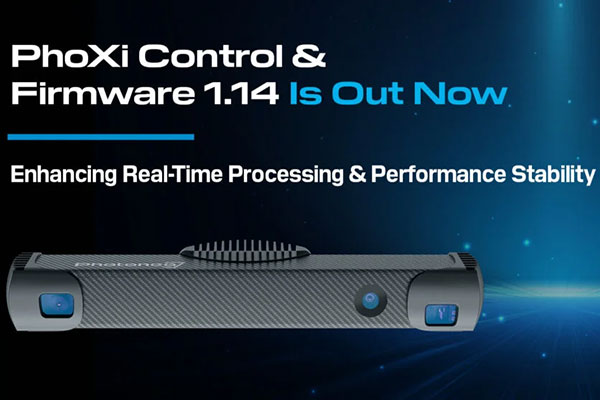
3D computer vision hardware and software systems provider Photoneo, a Zebra Technologies company, recently released PhoXi Control & Firmware 1.14 update for its 3D sensors and scanners.
This firmware update provides improvements to system performance and support capabilities. It tackles core system processes and allows the user to adjust the logging level, which Photoneo said can result in a 15% boost to real-time performance stability for smoother, more predictable operation, which can help optimize workflows.
Updates include:
By introducing a number of tweaks and empowering users to selectively disable non-essential logging functions like temperature monitoring and diagnostic tracking, Photoneo said it has reduced data processing delays and performance bottlenecks to improve efficiency.
Consistent frame rates and fast responsiveness are crucial for high-speed industrial applications, such as robotic pick-and-place systems or conveyor-based inspection lines. Frame rate inconsistencies could hamper the tracking of fast-moving objects.
Now, with optimized data streams, Photoneo’s AI-powered motion systems can make faster, more accurate decisions to help minimize production delays and maximize throughput.
Consistent, high-speed data acquisition can reduce frame rate fluctuations, reduce errors, and speed up production on automated assembly lines, helping to increase throughput in manufacturing.
In industries such as automotive manufacturing or electronics assembly, reduced frame rate fluctuations mean fewer errors and increased throughput.
PhoXi’s latest update can allow robotic pick-and-place robot arms, which are crucial for packaging and material handling, to operate with greater reliability, minimizing downtime and maximizing efficiency.
In the logistics sector, the ability to track and manage fast-moving objects with accuracy is equally critical. High-speed sorting systems in distribution centers rely on precise object recognition and tracking.
Photoneo said the stable data streams provided by PhoXi Control & Firmware 1.14 can help reduce sorting errors and process packages faster, contributing to a more streamlined, efficient, and reliable supply chain.
Stability is also vital for automated guided vehicles (AGVs) navigating dynamic warehouse environments. With more reliable data, AGVs can make safer, faster, more accurate decisions, improving navigation and reducing the risk of collisions.
Integration of an RGB camera into Photoneo’s MotionCam-3D product line has expanded the capabilities of its 3D sensors, enabling new applications across industries like medical, pharmaceutical, food processing, and logistics.
These sectors leverage the RGB high-accuracy point cloud data captured by the company’s technology for their AI processing needs.

With Firmware 1.14, Photoneo has made enhancements to the RGB acquisition pipeline, improving speed and stability while offering users the option for higher-resolution RGB 3D scans with minimal performance impact.
This advancement can be beneficial for high-demand applications requiring sharper textures, such as text, QR code, or barcode SKU recognition.
Furthermore, the company said its new approach to RGB data acquisition eliminates previous limitations, ensuring that no black areas disrupt the accuracy of AI processing. After selecting a specific field of view, users now get a texture from an image as sharp as 8 megapixels
Additionally, the introduction of the 2D region of interest feature allows for tailored data capture, optimizing efficiency by ensuring only relevant data is processed and transmitted. This process can help ensure Photoneo’s devices maintain performance and adapt to the specific needs of diverse applications.
Integrated sensor diagnostics - monitoring temperature, humidity, and environmental conditions - provide Photoneo’s support team insights for troubleshooting.
The company said PhoXi Control & Firmware 1.14 can deliver faster, more accurate diagnoses and reduced downtime.
Support specialists can access detailed internal data to pinpoint the root cause quickly, reducing the need for extensive on-site investigations.
Photoneo said diagnostic data access can lead to shorter response times, more effective fixes, and ultimately, a smoother, more productive experience.
Photoneo introduced a new “Custom Camera” mode, which reprojects 3D data into the perspective of a custom external camera. This external camera can be, for instance, a high-quality color camera, a special multi-spectral camera, or an infrared camera.
One example application is picking only items that have already cooled down in hot metal parts handling. Robot system engineers can install an additional infrared camera to check for the metal temperature in a single setup.
The “MarkerOrthoCamera” mode reprojects 3D data, including the associated depth map. The reprojection simulates the data as if it were captured by an orthogonal (or telecentric) camera. This simulated camera is positioned perpendicular to a designated marker board within the scene.

A primary application of this mode is obtaining a depth map relative to the marker’s coordinate system (marker space). Photoneo said this representation can be particularly useful for distinguishing differences in z-height among various elements present in a scene.
Unlike a standard perspective camera that captures a scene from a single viewpoint, the orthogonal camera mode represents the scene as if captured uniformly across a plane parallel to the marker board. Instead of having a camera capturing the scene from one single point, the camera captures the scene as if it was a plane parallel to the scene.
Photoneo made the following changes in PhoXi Control & Firmware 1.14:
Finally, Photoneo introduced enhanced device information in Network Discovery (including the FIle Cameras). Added a new “Configuration” field, detailing hardware specifications of the Photoneo devices running firmware 1.14. and higher.
Users can now check:
It is also reflected in pho::api::PhoXiDeviceInformation in PhoXi API, with the specifications stored in the Features attribute and verifiable via the CheckFeature() function.


Zebra Technology's extensive portfolio of marking and printing technologies include RFID and real-time location solutions. Zebra illuminates mission-critical information to help customers take smarter business actions.

Join our Safety Matters newsletter and get safety news across logistics, warehousing, manufacturing, construction, and other high-risk environments. Get the latest regulatory updates, alerts, safety products, equipment and training, and analysis.

Don't miss a single news story, product review or safety resource. Subscribe to our newsletter for the latest safety news, updates, and exclusive offers.