Dedicated to helping businesses and individuals prioritize safety, health, and compliance in the workplace. From small startups to large corporations, safety is essential, and we're here to make it easier.


A common thread on the show floor at A3's Automate in Detroit last week was the pressing need to stand up high-performing robotic solutions quickly, and make them easily adaptable over time. Sure, there were new robots being touted, but many exhibitors stressed deployment speed and system flexibility, over and above new robots.
The exhibitors I met with are doing this in multiple ways: software with digital twin capabilities, a new generation of artificial intelligence (AI) technology and AI chips, most notably from NVIDIA, as well as many other types of software capabilities and features, with much of the functionality aimed at fast, effective rollout of solutions.
Why the need for speed and adaptability? The collective wisdom is that with continued tariff uncertainty, the trend toward reshoring is likely to continue, and so robotics solutions need to be extremely easy to stand up and use from day one, and easy to change or relocate.
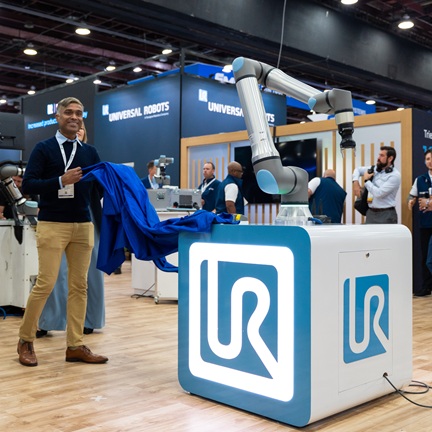
In introducing a new cobot arm from Universal Robots (UR) at a booth press conference the first day of Automate, Ujjwal Kumar Group President of Teradyne Robotics, which includes both UR and Mobile Industrial Robots (MiR), said UR’s latest cobot takes rapid solution development by partners to a new level. While UR has traditionally made cobots easy to configure, Kumar said underlying AI technology from Teradyne Robotics partner NVIDIA makes it even easier to develop advanced collaborative applications which leverage AI. That is important, he adds, since current pressures on industry are forcing industrial companies to be nimbler and more resilient, even if they aren’t Fortune 500 enterprises with in-house robotics teams.
“Across every link of the industrial value chains, we have labor shortages, shifting demand cycles, increased volatility, and a growing requirement for resilience in how we move [goods] and make things,” Kumar said. “In that context. Automation isn't just a competitive lever anymore, it's a foundational requirement for the industry. The solutions can't be rigid … or designed only for the elite few with massive engineering budgets. [Robotics] has to be scalable, it has to be safe, and it has to work for the people on the floor today.”
The new cobot UR highlighted at Automate is the UR15, touted as UR’s fastest cobot ever. For pick-and-place applications, the UR15 delivers up to 30% cycle time improvements compared to other UR models. The new cobot uses UR’s AI Accelerator, a robotics tool for rapid development of AI applications by integrators, which was developed on NVIDIA’s Isaac platform, including that platform’s libraries and and AI models, and leverages NVIDIA’s Jetson AGX Orin AI compute modules.
Kumar explained that this AI foundation makes cobots both higher performance at their tasks, and easier to develop advanced solutions with. Other innovations that help with flexibility, he added, include mobile systems that place a cobot arm on an autonomous mobile robot (AMR) base, which enables easy repositioning of a system to another task location.
“Early automation was all about throughput and standardization,” Kumar said. “But today the real advantage lies in adaptability. It's no longer just about how much you can produce: it's about how fast you can change.”
At the ABB Robotics booth, ease of configuring applications was a focal point in my discussion with Ben Perlson, ABB’s segment manager, Consumer Industries, who showed me ABB’s new AI-powered Robotic Parcel Inductor (RPI). Designed for rapid deployment, the RPI functional module comes pre-integrated, minimizing commissioning time, operational errors, and setup complexity, with commissioning possible in as little as one week. Perlson explained the solution does this by pre-integrating the elements such as vision technology with the robotic arm. For RPI, the vision and robot are tuned to handle unknown and randomly arranged items common with parcel picking and sorter induction, where parcels are typically coming down a conveyor jumbled in random directions, often overlapping each other.
“It is a variant of our item picker family that we provide as a function package--so it’s a robot with specific skill to make it ready to more easily streamline and integrate for our integration partners, so that they can deliver a solution to an end customer,” said Perlson.
Software capabilities everywhere
In warehouse and fulfillment operations, high-speed robotic arms are the main hardware element for robotic palletizing and depalletizing systems, but they aren’t the whole solution. For the cells to work well, the cell needs to be designed correctly, and perhaps most importantly, cases need to be fed into the system in sequence, and with the proper buffering and material flow to enable the solution to perform as expected. At the Mujin booth at Automate, I met with Josh Cloer, VP of sales and marketing for Mujin’s U.S. operations, who explained how Mujin’s software platform enables simulation and control over the elements that go into a smart, mixed-case robotic palletizing or depalletizing cell.
Mujin isn’t a robot manufacturer, though it is a robotics technology company. Its core products are its Mujin controller, which controls and manages robotic arms and AMRs, and the Mujin OS, a software platform that provides partners with a foundation for deploying and simulating robotic systems like palletizing and de-palletizing cells. At Automate, Cloer demonstrated how these simulations allow an integrator or end-users to visualize how a robotic cell will function, including the infeed and outfeed movement of cases (on AMRs, or via conveyor), where to optimally locate pallet stands, or to test different scenarios for throughput or new SKUs/pallet builds.
Since the simulation ties into Mujin’s controller technology, the output mirrors what a live system will achieve, Cloer said, and results in a digital twin for dynamically testing out a new or expanded systems with high confidence. “The OS truly acts as operating system for the robotics solutions,” Cloer said. “It's a platform that allows partners to more effectively deploy different applications for robotics.”
Much of the focus at Automate when it comes to warehouse robotics was on autonomous, pick-and-place systems using cobots or industrial robots with articulating arms, though AMRs where also featured at numerous booths. While some AMRs are designed for fairly straightforward materials transport from Point A to Point B, others are used for collaborative, in-aisle picking alongside warehouse associates.
At Zebra Technologies booth, I met up with Matt Wicks, VP and GM of Zebra Robotics Fulfillment. Zebra offers up a vast array of devices, brands in robotic vision/cameras, wearables and other technologies, including software and robots to run assistive-pick AMR fleets. They call their fulfillment system Zebra Symmetry Fulfillment, which centers on capabilties for collaborative order picking, inventory slotting, and use of wearables involved in picking goods within a tight zone of warehouse space onto a location on an AMR. It even involves baker-rack type wheeled carts. Yes, simple mobile racks are a thing with robotics, because Zebra's software can use them as a work-in-process pick location asset.
AMRs are really just one ‘agent’ within a fulfillment system that is a blend of human (picker) resources, the AMRs, dynamically slotted storage locations, assets like mobile carts for batching of orders, wearables, and fleet and fulfillment management software, Wicks explained. In this context, a mobile robot is just one agent in the mix.
“There are multiple agents involved in achieving high utilization and throughput,” Wicks said. “One of the main levers we pull is our Team Intelligence logic. So, Team Intelligence is our software that directs workers to team up with mobile robots, in a collaborative way. The software considers the best pick paths, as well as the order profiles, to determine how to best pick orders onto the robots. We aim for efficiency of both the picker and robot fleet as the pickers are going through a zone.
“Another lever that we pull is the fact that our robots can couple and decouple from a cart,” Wicks continued. “So, when the system drops off a cart at packout, we don't have a robot that's just sitting there waiting to get unloaded. Basically, we drop the cart off, the robot detaches and then goes picks up another cart.”
Making “cobot” palletizing cells faster to deploy via software was the focus at OnRobot’s Automate press conference. OnRobots’ D:PLOY software configures all the key elements needed for a palletizing solution in a streamlined way, according to James Taylor, CCO at OnRobot, who demoed the solution at Automate with help from integrator partner DOIG Corporation. While cobots have always been relatively easy to work with, OnRobot’s software makes for a more “off the shelf” set-up for cobot-based solutions such as end of line palletizing, Taylor explained. “We’re making automation a low-risk, high-reward effort,” Taylor said.
It’s the software
When I get to report at Automate, I’m always impressed with the robot hardware (nothing like watching a large car assembly being zipped around a booth by an oversized industrial robot), but typically, I find it is the underlying software that makes a difference, or other supporting technologies like work-in-process charging approaches for AMRs, or safety overlay software aimed at keeping AMR fleets running at max speed through dynamic obstacle avoidance (check out such an offering from 3Laws; an Automate exhibitor that was nominated for an innovation award at the show).
Also, as some exibitors stressed, it’s often the underlying AI-based navigation and exception handling technology that makes the difference with AMRs. They all sort of look like hockey pucks, so the challenge is to assess the uptime and performance benefits of the underlying AI when it comes to fleet performance. Can it work from Day 1 and resolve edge cases on its own? That’s a software thing; not robot hardware.
For example, at the Intel booth at Automate, I met with Christian Bersch, CEO and co-founder of Cartken. Their AMR has that basic hockey-puck shape, but uses NVIDIA chip technology as well as Intel’s RealSense camera sensing, and specifically targets automated materials transport between buildings with its AI smarts. Bersch explained that Cartken’s interbuilding solution benefits from the fact Cartken got its start with last-mile delivery AMRs, so the company and its AI software and robots have long history navigating outdoor environments.
Cartken uses this pool of data in its AI software for AMR navigation. An edge case here could be a patch of snow on a sidewalk between a factory and a test/lab building, which the underlying AI is tuned to understand, so that the robots don’t get hung up when doing their work.
“Outdoor-capable wheels have been around for a long time, so that is not the innovation,” Bersch said. “The core piece is really the AI-based navigation that can handle the workflow environment. Traditional AMRs assume the world—the factory floor--is flat; that it doesn't rain, and there are never any adverse lighting conditions. Our AI navigation system is much closer to what you would see in a self-driving car than in the typical indoor AMR.”
Of course, humanoid robots also drew attention at Automate. They are expected to catch on in the coming years, as their speed and dexterity improves and as hardware costs come down as more units get sold and deployed. At Agility Robotics booth at Automate, I heard how safety technology and software integration for Agility’s Digit humanoids lessens barriers to production rollouts.
As Melonee Wise, Chief Product Officer at Agility Robotics, explained, the V4 version of Agility's Digit robot has an integrated PLC controller, an e-stop button, with such features being consistent with an emerging safety standard for humanoids, known as ISO 25785-1. Wise said Agility also has integrated its “Arc” fleet software with AMR fleet software from three major AMR providers (MiR, Zebra, and Ocado Intelligent Automation/Six River systems) using open interfaces and protocols, and is working on integrations with others. All these efforts, Wise pointed out, support rapid rollout of humanoid robots for materials handling tasks like automating the transfer and handling of totes/containers, in concert with other systems.


Zebra Technology's extensive portfolio of marking and printing technologies include RFID and real-time location solutions. Zebra illuminates mission-critical information to help customers take smarter business actions.

Roberto Michel, senior editor for Modern, has covered manufacturing and supply chain management trends since 1996, mainly as a former staff editor and former contributor at Manufacturing Business Technology. He has been a contributor to Modern since 2004. He has worked on numerous show dailies, including at ProMat, the North American Material Handling Logistics show, and National Manufacturing Week. You can reach him at [email protected].

Join our Safety Briefing newsletter and get safety news across logistics, warehousing, manufacturing, construction, and other high-risk environments. Get the latest regulatory updates, alerts, safety products, equipment and training, and analysis.

Don't miss a single news story, product review or safety resource. Subscribe to our newsletter for the latest safety news, updates, and exclusive offers.