Dedicated to helping businesses and individuals prioritize safety, health, and compliance in the workplace. From small startups to large corporations, safety is essential, and we're here to make it easier.


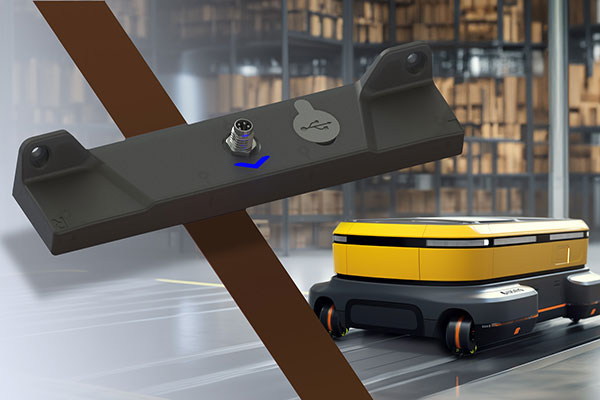
Warehouse robot navigation systems provider Naviq recently introduced its MTS160, a magnetic guide sensor for autonomous mobile robots (AMRs).
The MTS160 features patented angle measurement capabilities with one-degree precision and position accuracy within 1 millimeter. Naviq said this dual functionality can provide exceptional orientation and positioning precision, improving the navigation capabilities of mobile robot systems.
Naviq’s MTS160 is available from stock for $495 each, with substantial discounts for OEM orders.
Magnetic guidance involves placing adhesive magnetic tape on the floor, which the robot senses and follows. Naviq said magnetic guidance is among the most precise guidance techniques and is often combined with laser systems for high-accuracy positioning.
Magnetic guidance is inherently safe - if a robot veers off track, it can easily detect and stop, the company said. It’s also significantly less expensive than laser or machine vision navigation systems, by nearly an order of magnitude.
The simplicity of magnetic guidance systems is one of their greatest strengths, requiring minimal maintenance and being less susceptible to environmental changes such as lighting variations or obstacles that might disrupt other navigation systems. Modifying the path is as simple as moving the tape, a task requiring no special skills.
Unlike traditional magnetic line-following sensors that only detect position along a single dimension, the MTS160’s angle detection allows robots to assess the curvature of the track. This enables the robot to distinguish between minor trajectory adjustments needed on straight paths and more proactive steering for navigating curves.
This improved path-tracking precision allows robots to follow designated paths with enhanced accuracy, even at higher speeds when navigating bends, Naviq said.
Another feature is the sensor’s ability to detect point-source disk magnets along both the X and Y axes with millimeter accuracy. By installing magnets at precise locations, the robot can accurately evaluate its position and orientation, which Naviq said is ideal for precise positioning at charging or docking stations.
The MTS160 also offers advanced marker detection, supporting magnetic tape markers with reversed polarity strategically placed along the track. These markers can signal areas requiring speed adjustments, upcoming forks and merges, and proximity to stop areas like charging or docking stations.
Additionally, the company said its AI algorithm for managing merges and forks can ensure smooth direction changes at junctions, enhancing the robot's operational efficiency.
Naviq said its MTS160 can function as the primary guidance sensor in cost-effective robots on fixed paths, or serve as a supplementary component in robots with laser or vision navigation systems for precise, last-millimeter positioning.
The MTS160 features an M8 4-pin watertight connector for power and signal transmission, and supports CAN bus and RS232 interfaces, ensuring compatibility with numerous programmable logic controller (PLC) brands and microcomputers. The company said its compact design, measuring only 165 x 35 x 25 millimeters - about 6.5 x 1.4 x 1.0 inches - makes it easy to incorporate into any robot design.
The sensor is designed for user convenience, featuring RGB status LEDs for visual feedback on tape and marker detection. A web-based software utility requires no installation - the sensor can be connected to a smartphone or PC via its USB port for configuration, testing, logging, and monitoring. The utility also supports automatic firmware updates. Additionally, an automatic self-test of internal circuitry can ensure safe operation and reliable performance.
Want to learn more about mobile robots? This article was featured in the February 2025 Robotics 24/7 Special Focus Issue titled “Mobile robots of all shapes and sizes.”

Join our Safety Briefing newsletter and get safety news across logistics, warehousing, manufacturing, construction, and other high-risk environments. Get the latest regulatory updates, alerts, safety products, equipment and training, and analysis.
Don't miss a single news story, product review or safety resource. Subscribe to our newsletter for the latest safety news, updates, and exclusive offers.