Dedicated to helping businesses and individuals prioritize safety, health, and compliance in the workplace. From small startups to large corporations, safety is essential, and we're here to make it easier.


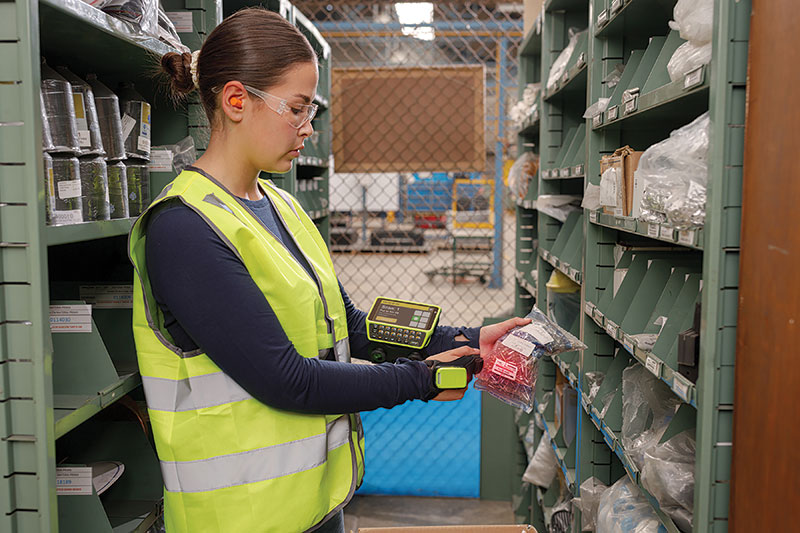
Time to suit up. We’re goin’ pickin’.
But we’ve got some choices to make before we get out on the floor. Several, actually.
On the ergonomic side are exoskeletal suits. This emerging option helps with the heavy lifting. And the suit is fitted to you individually. Your warehouse tailor, so to speak.
Then you have a broad range of technologies and form factors for wearable devices that collect and manage data and routes. As a class, they make order fulfillment easier, faster and highly accurate. These include wrist-, finger- and head-mounted devices typically with a direct connection to the warehouse management system (WMS).
Now this class of wearables is well established. But there’s more going on here these days. Just as a heads-up (not the wearable type), think process. More in a bit.
And while there probably isn’t anyone in a warehouse anywhere in the world who wears several of these options at one time, it’s a possibility. We’re just not there yet. But we may be before long. For (many) good reason(s).

The use cases for all types of wearables are compelling. Consider these.
Derrick Vanover, director of IT at third-party logistics (3PL) provider BR Williams, talks about a 30% productivity boost and shorter bar code scan times by 8 seconds. For every scan. He implemented Rufus Labs’ wearable, hands-free scanners and tablets across six facilities in Alabama.
Meanwhile, a Toyko-based medical supplies distributor slashed picking times by 50% using an RFID glove scanner from AsReader. Better yet, it reads tags individually even when that item is not separated from others.
And, yes, you read that correctly. An RFID wearable. Details later.
Yet another wearable story is playing out over at DHL. Wearable scanning from ProGlove “increases the transparency and the reliability of our services. In an industry where time is everything, it all comes down to shipping more, minimizing errors and enhancing process quality.” That’s according to Simon Deyman, vice president of operations for DHL’s German parcel hubs. The technology is used at 38 facilities.
Then, there’s the matter of those exosuits. The idea is to assist order pickers in the manual handling of large items with an exoskeleton suit fitted to the wearer.
A recent ergonomic study done for HeroWear quantifies what’s possible, explains Mark Harris, CEO. He says the study shows productivity increases by 8% while decreasing worker discomfort by 25%. Work-related fatigue also decreases 25%. Harris adds that users at four facilities reported zero injuries in the same time period when more than 10 injuries would have occurred historically.
That’s a powerful lineup of benefits to making these types of wearables part of your workforce. And while the technologies are anything but new, they continue to penetrate deeper into the warehouse ecosystem.
What follows is a rundown on what’s new in both spheres of wearables.
You’ll likely notice little mention here of voice and glasses. For those details, you’ll want to take a look at December 2024’s story “A new take on voice.” We had to break the wearable story into two to make the breadth of it all manageable. Wearables really are a big deal.
Data-driven wearables come in lots of different form factors, as Peak Technologies’ executive chairman David Green points out.
The list includes: scanners, computers, printers, voice systems, smart glasses and augmented reality devices. The first four dominate the landscape. While smart glasses and augmented reality devices are having a true start/stop/start relationship with the warehouse.
Green says, in general, wearables offer up to a 20% productivity increase compared to traditional handheld devices. Additional benefits, says Green, include improved operational efficiency, reduced errors, improved metrics and decision-making, worker safety and an optimized user experience. And then he adds the ease of training.
“There’s a broad user acceptance of using wearables. People are comfortable with them,” says Wes Coleman, Zebra’s warehouse industry principal.
In 2024, Coleman says he visited about 25 different warehouse sites. And he was surprised by how many were not using wearables.
“But when I talked to these warehouse managers, the story was always how much more productive they could be with wearables. It’s a matter of people becoming more educated on wearables and taking a holistic view of how to manage and improve workflows with them,” says Coleman.
Suzana Tasic, Proglove’s senior product manager, takes it one step further. “In 2025, expect wearables and related software to become sufficiently sophisticated that warehouse managers and frontline workers will use them to drive real-time decision making on how to run the warehouse.”
In other words, now is no time to underestimate the power of wearables.

Optimizing warehouse processes and workflows on the fly is the new hot spot for wearables. We’re well past the stage of just receiving and collecting data.
The story is now bigger. Much bigger.
The future of wearables is in their ability to collect data not just about individual tasks, but the cumulative impact of those tasks on process workflow. And it includes the actual frontline worker in decision making, says Coleman.
Some of that new set of abilities will come from how wearables are teamed to maximize not just the flow of data, but its availability to frontline workers and warehouse managers. That’s a matter of routing data between devices, workers, warehouse management systems and the like.
There’s also the matter of data analytics, says Gabe Grifoni, CEO and co-founder of Rufus Labs. In addition to its wearable hardware, the company has just introduced a software AI tool that analyzes data from user activity, SKU and product tracking, time-based analysis, to name four key sources.
Grifoni says Rufus AI also monitors individual and team performance as well as various metrics from total steps to total scans. The software also helps to ensure that processes are followed and workflow optimized.
“Using the power of generative AI, Rufus AI helps to optimize peak planning, manage labor requirements and streamline overall warehouse efficiency,” adds Grifoni. See the graphic above for more details.
Rufus Labs is not alone here, either. AI will be a part of the wearable solution going forward. Both Zebra and Peak Technologies also talked about AI in 2025.
In a nutshell, it’s all about analytics of the entire picking operation not just a worker’s last and next picks.
While AI is one approach to improving workflow with wearables, two others are emerging.
One is the RFID wearable mentioned up top. You might call it workflow improvement on steroids.
Traditionally, if you were looking to read a specific tag in a pile (or pallet load or shelf or any other warehouse formation), it required special handling, which only slowed the workflow.
But as Paul Whitney, AsReader’s chief operating officer and vice president explains, the RecoHand reads individual tags at a 2 cm distance. He says it is the only ultra-near-field RFID reader anywhere. AsReader partners with Teijin Frontier on the RecoHand.
As a result, no tag requires special handling to be immediately read using a hand-mounted wearable. “The wearable finds and reads an individual tag even when that tag is surrounded by other tags. The wearable merely needs to be waved within 2 cm of the single, desired tag and will read it alone. This is a watershed moment for RFID workflow,” adds Whitney.
The other is from an unlikely source: KardexRemstar, supplier of carousels and vertical lift modules (VLMs). It’s one thing to pick directly from that equipment into order totes. But for high-volume operations, those batch picks go into totes on carts that travel through the banks of automated equipment.
A wearable task assistant manages this operation, explains Doug Card, director of systems and integrators sales. Instead of traditional light-guided systems, a wrist-mounted task assistant guides the worker through the process.
Card says the wearable shows what to pick, where to place it, verifies the pick and verifies the order, greatly simplifying traditional process management. “It’s all about accuracy, portability and commonality that boosts productivity at least 50%,” says Card.

Speaking of process, few are less people-friendly than bending, picking and moving heavy items. And the story isn’t much different for even moderately heavy parcels.
Thomas Leliveld, head of global sales at German Bionic, says the central use case for exoskeletal suits in general is lifting and moving inventory weighing at least 8 kilos (or around 17 pounds), 30 or 40 times an hour.
“It’s not just the weight being moved, but the repetitiveness and the bending actions that take their toll on people,” Leliveld says. His keywords are safe, secure and fatigue reduction.
Harris of HeroWear says exosuits are all about removing 20% to 40% of the strain off the user’s back muscles. He talks about one user of HeroWear’s Apex 2 suit who says “my performance is better now, I’m less tired after work, and my back is not tired at all.” Not a bad baseline.
But let’s face it, exoskeletons are new and sometimes a little scary to users. Leliveld says 60% of first-time users love them, another 25% are willing to try them, and 15% will wave them off altogether.
Harris reports that more than 80% of those who try the suits are willing to continue after the first run.
That said, the suits offered by German Bionic and HeroWear may perform the same task but are quite different.
Apex 2 suits from the latter are non-powered suits that fit the workers backside from the shoulders to upper thighs.
Harris explains that elastic bands stretch across the person’s back muscles during movements then recoil as muscles contract during a lift. “The bands move with the user and reduce forces on the spinal muscles and discs when the person bends forward or squats down,” says Harris.
The bands are non-powered, unlike the battery powered Apogee line of suits from German Bionic. Also backside mounted, powered suits are fitted with sensors that are triggered by body movement and loads. The sensors provide data to motors that provide mechanical counterforce to motions and weight.
Leliveld says onboard artificial intelligence constantly monitors activities and lifts, compensating as needed on the fly. He calls it “a new DNA in the workforce.”
Much the same can be said of the IT-based wearables, actually. Warehouse managers should take notice


Zebra Technology's extensive portfolio of marking and printing technologies include RFID and real-time location solutions. Zebra illuminates mission-critical information to help customers take smarter business actions.

Gary Forger is an editor at large for Modern Materials Handling. He is the former editorial director of Modern Materials Handling and senior vice president of MHI. He was also the editor of the Material Handling & Logistics U.S. Roadmap to 2030.

Join our Safety Briefing newsletter and get safety news across logistics, warehousing, manufacturing, construction, and other high-risk environments. Get the latest regulatory updates, alerts, safety products, equipment and training, and analysis.

Don't miss a single news story, product review or safety resource. Subscribe to our newsletter for the latest safety news, updates, and exclusive offers.