Dedicated to helping businesses and individuals prioritize safety, health, and compliance in the workplace. From small startups to large corporations, safety is essential, and we're here to make it easier.


The U.S. Chemical Safety and Hazard Investigation Board (CSB) recently released Volume 3 of its incident reports.
The 30 incidents covered in Volume 3 occurred between April 2020 and January 2025. These events resulted in two fatalities, 25 serious injuries, and approximately $1.8 billion in property damage.
“This third volume of reports reflects the CSB’s continued commitment to keeping the American people informed about the serious chemical incidents that occur every week across this country and the risks that these incidents pose to communities and workers, as well as the enormous economic impact that they have on the American chemical industry,” said Steve Owens, CSB chairperson.
Like Volumes 1 and 2, each incident report includes a summary of the event and its probable cause - information that has not previously been released to the public.
Volume 3 covers 30 serious chemical incident investigations in 15 states: Arkansas, Delaware, Georgia, Illinois, Kansas, Louisiana, Maine, Mississippi, Ohio, Oklahoma, Tennessee, Texas, Virginia, West Virginia, and Wyoming.
Of the 30 incidents in the report, 11 occurred at refineries, 10 at chemical facilities, five at food & beverage manufacturing plants, two at pulp & paper mills, and two at oil & gas facilities.
The full report is available on the CSB’s website.
# |
Incident Date |
Company |
City |
State |
Fatality |
Serious
|
Substantial
|
| 1 | 2020-04-15 | Pixelle | Jay | Maine | 350 | ||
| 2 | 2020-07-19 | Tyson Foods | Enid | Oklahoma | 1 | ||
| 3 | 2020-08-18 | Chevron | Pasadena | Texas | 3.3 | ||
| 4 | 2020-09-10 | PBF Energy | Delaware City | Delaware | 1.7 | ||
| 5 | 2020-09-19 | Silver Eagle | Evanston | Wyoming | 2 | 5.8 | |
| 6 | 2020-11-20 | Tyson Foods | Hutchinson | Kansas | 2 | ||
| 7 | 2021-05-05 | FutureFuel | Batesville | Arkansas | 1 | ||
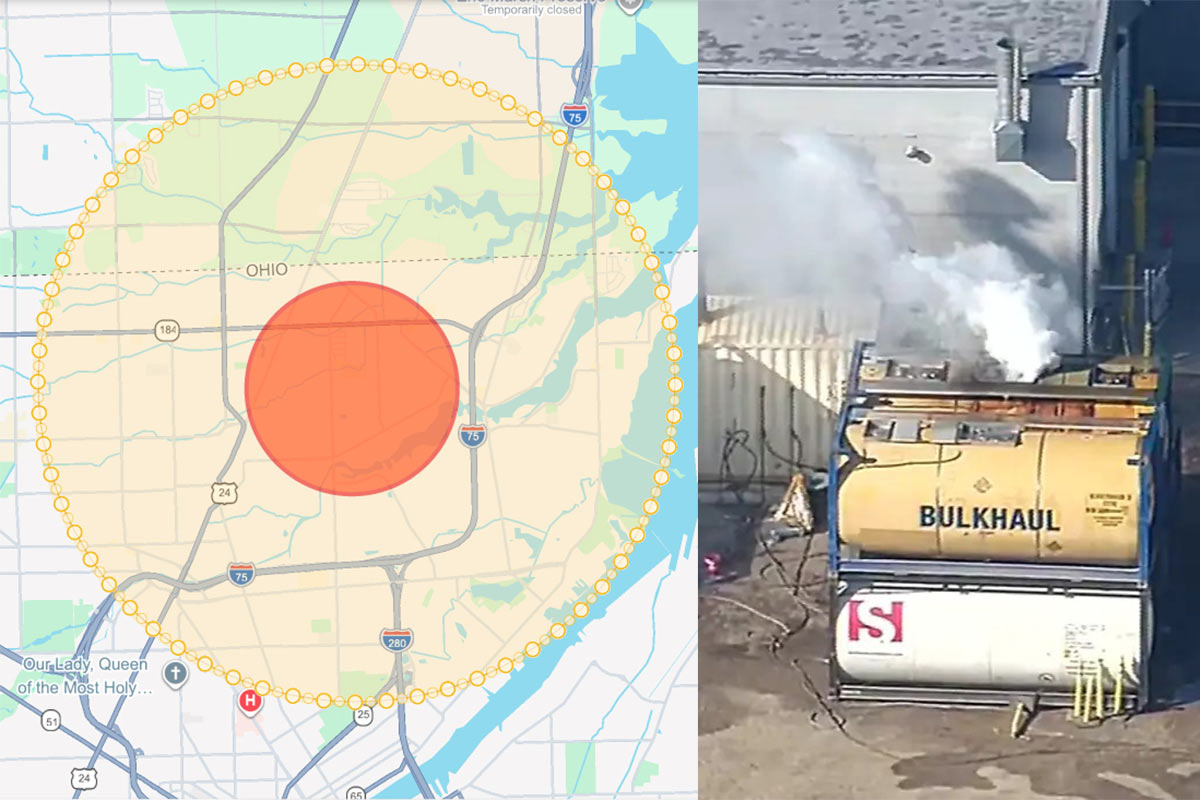
| 8 | 2021-11-23 | PBF Energy | Oregon | Ohio | 50.3 | ||
| 9 | 2021-12-23 | ExxonMobil | Baytown | Texas | 4 | 107 | |
| 10 | 2022-01-19 | Pilgrim's | Canton | Georgia | 2 | ||
| 11 | 2022-01-21 | WR Meadows | Hampshire | Illinois | 1 | 1 | 3.5 |
| 12 | 2022-01-26 | Westlake | Westlake | Louisiana | 9.2 | ||
| 13 | 2022-01-31 | Eastman | Kingsport | Tennessee | 25 | ||
| 14 | 2022-02-01 | Blues City Brewery |
Memphis | Tennessee | 3 | ||
| 15 | 2022-02-17 | Dyno Nobel | Waggaman | Louisiana | 128 | ||
| 16 | 2022-07-09 | ONEOK | Medford | Oklahoma | 930 | ||
| 17 | 2022-08-24 | AdvanSix | Chester | Virginia | 1 | ||
| 18 | 2022-12-24 | HF Sinclair | Tulsa | Oklahoma | 2.9 | ||
| 19 | 2022-12-26 | SABIC | Mt. Vernon | Illinois | 4.6 | ||
| 20 | 2023-03-16 | Himar Cheese | Dalhart | Texas | 1 | ||
| 21 | 2023-04-17 | Delek | Tyler | Texas | 1 | ||
| 22 | 2023-04-19 | Valero | Port Arthur | Texas | 2.3 | ||
| 23 | 2023-05-08 | Delek | El Dorado | Arkansas | 1.27 | ||
| 24 | 2023-07-31 | CITGO | Lemont | Illinois | 1 | ||
| 25 | 2023-08-13 | Southwestern Energy |
Ohio County | West Virginia | 2 | ||
| 26 | 2023-08-26 | Dow | Texas City | Texas | 1 | ||
| 27 | 2024-03-13 | Sasol | Westlake | Louisiana | 187 | ||
| 28 | 2024-05-17 | Advantek | Westhoff | Texas | 1 | 6.94 | |
| 29 | 2024-06-11 | Cornerstone | Waggaman | Louisiana | 1 | 2.5 | |
| 30 | 2025-01-16 | Georgia Pacific | Monticello | Mississippi | 1 | ||
| Total | 2 | 25 | 1,821 |
Here are some of the notable trends:
Five incidents in the report caused over $100 million in property damage.
The costliest was a July 2022 ethane and propane release and explosion at the ONEOK Hydrocarbon facility in Medford, Oklahoma totaling $930 million in damage.
In April 2020, a pulp digester pressure vessel explosion at the Pixelle Specialty Solutions in Jay, Maine caused $350 million in damage and led to the paper mill’s permanent closure.
Additional incidents causing over $100 million in damage included:
Two fatal accidents are included in Volume 3.
One employee was killed and another was seriously injured when a mixing tank at the WR Meadows facility in Hampshire, Illinois exploded in January 2022. The employees were cleaning acrylic resin dust from the top of the tank - which contained a flammable concrete curing compound and was open to the atmosphere inside an enclosed room - using an electric vacuum.
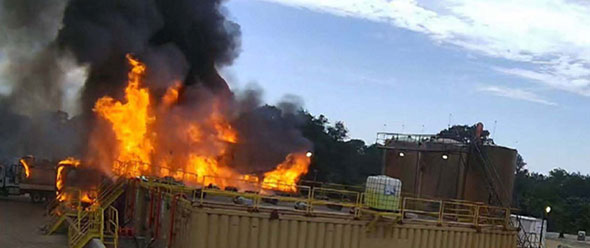
In May 2024, an operator was killed when a truck parked at the Advantech Eagleford oil and gas waste disposal facility in Westhoff, Texas ignited a flammable vapor cloud originating from open-top fluid tanks. The operator was standing on a grated deck above a drilling fluid recovery tank. Advantek’s investigation found fluid unloaded from the tanker truck contained a high concentration of flammable hydrocarbons.
Four incidents in the report involved the release of toxic anhydrous ammonia refrigerant at food & beverage manufacturing facilities, two of which involved Tyson Foods.
In July 2020, a refrigerator technician was sprayed by ammonia while removing bolts from an ammonia strainer on the roof of Tyson Foods 54th Street facility in Enid, Oklahoma. The technician was unable to effectively depressurize ammonia from the system because a drain valve plug was damaged.
In November of the same year, two employees disassembling an out-of-service heat exchanger used in an ammonia refrigeration system at Tyson Foods’ Hutchinson, Kansas facility were sprayed with gaseous ammonia. The company’s investigation found that downstream valves had not been closed and a check valve likely failed, allowing ammonia to backflow into the heat exchanger.
Both workers wore full-face air-purifying respirators when performing the task. OSHA’s investigation found that the two employees suffered inhalation injuries when their respirator cartridges became saturated, preventing the cartridges from effectively purifying the air they breathed.
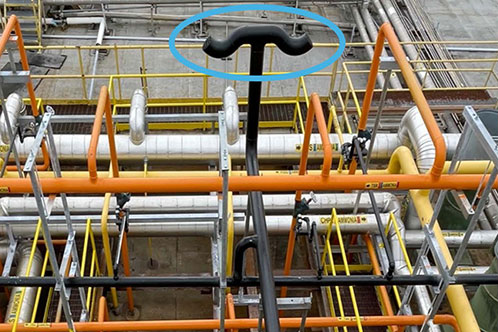
In January 2022, two employees were seriously injured during an ammonia refrigeration compressor restart following a routine sanitation shutdown at the Pilgrim’s Pride Canton Poultry Processing Facility in Canton, Georgia. A compressor slide valve failed, fully loading the compressor while the condenser fans were off. Overpressure opened a pressure-relief valve and discharged ammonia into the ambient air, forming a toxic cloud that hovered outside the compressor building.
The CSB found the design of the pressure-relief system, which discharged ammonia in a way that harmed workers evacuating from the facility, contributed to the severity of the incident. Pilgrim’s Pride redesigned the pressure-relief device so that it now discharges inside a pressure vessel and redesigned the relief system piping to discharge ammonia vapor at a higher location, further away from the compressor room’s exit doors.
In March 2023, an employee was seriously injured while cutting a CPVC pipe with a reciprocating saw, inadvertently cutting into an ammonia vapor pipe at the Hilmar Cheese facility in Dalhart, Texas. Hilmar’s investigation determined that this incident was not considered a line break activity, and a line break permit was not issued.
This task also did not include a job safety analysis, which could have identified the hazards of cutting a pipe near another that contained hazardous materials. Additionally, had the job been classified as a line break, respiratory protection should have been required. In response to the incident, Hilmar required workers to cut CPVC piping with a CPVC cutting tool instead of a reciprocating saw.
Although none of these ammonia refrigerant releases caused property damage or fatalities, each seriously injured employees.
Five incidents in the report occurred during transfers between facility infrastructure and road or rail vehicles, including the fatal fire at Advantech Eagleford.
In September 2020, flammable vapor ignited and exploded at the Silver Eagle refinery near Evanston, Wyoming while a tanker truck was being loaded with diesel fuel. Silver Eagle’s investigation concluded an air-operated vapor recovery valve venting to the refinery’s flare had closed. High winds repeatedly extinguished the flare, automatically stopping loading operations.
The truck and its air compression system were shut off during unloading, causing the system to exhaust its supply and allowing the valve to close. High pressure developed in the truck’s second transport compartment, causing an emergency pressure-relief system to vent vapor into the enclosed loading building, where it ignited.
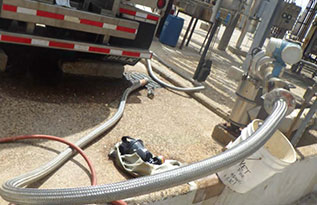
In May 2021, an operator was sprayed with corrosive oleum fuming sulfuric acid while unloading a railroad tank car at the FutureFuel Chemical Company in Batesville, Arkansas. The hose being used for the transfer ruptured likely due to a damaged chemically protective inner fluoropolymer layer.
The hose was purchased seven years prior and had only been used in the week leading up to the incident a total of three times. Because FutureFuel had not identified hose rupture as a potential hazard, the operator’s fire-resistant clothing fibers absorbed the acid, allowing it to contact his skin.
In July 2023, a flash fire occurred while an employee was lowering a sampling device into an open railcar at the CITGO refinery in Lemont, Illinois. The tank previously held heptane - which has a low flashpoint - and was being loaded with mineral spirits.
The practice of loading a low vapor pressure (high-flashpoint) material into a tank that previously contained a high vapor pressure (low-flashpoint) product is called “switch loading.” The CSB found switch loading can cause a static charge to accumulate on liquid surfaces during loading. Static discharge likely ignited the fire as the sample device approached the liquid surface.
In August 2023, an employee was sprayed with vinyl acetate residue while loading a chemical trailer from a storage tank at the Dow Chemical Company facility in Texas City, Texas. After loading the trailer, the operator introduced nitrogen gas through the hose and into the trailer to purge residual liquid, then closed the isolation valve at the rear of the trailer, pressurized it with nitrogen.
The operator missed a procedural step, failing to vent nitrogen from the hose. When the operator disconnected the hose from the trailer, nitrogen gas and some residual liquid vinyl acetate residue were forcefully ejected, blew off some of the operator’s personal protective equipment (PPE), and caused serious chemical burns. No instruments, pressure gauges, or other safety measures were available to alert employees that the hose was still under pressure.
It’s an urban legend that lightning can’t strike the same place twice. And just like lightning, flammable substances always find the quickest route to a spark when accidentally released.
Two fire ignition incidents in the report were caused by maintenance performed by contractors in the industrial city of Westlake, Louisiana.
In January 2022, a one-million-gallon ethylene dichloride storage tank exploded at the Westlake US 2 LLC facility. Westlake’s investigation determined battery-powered reciprocating saws used by contract workers to cut bolts during repair work to the tank’s nitrogen inerting system caused sparks which ignited ethylene and oxygen vapor flowing from an interconnected process unit.
In March 2024, an accidental release of lubricating oil caused a fire at the Sasol Chemicals manufacturing facility, also in Westlake, resulting in $187 million in damage. Contract maintenance workers were removing end caps from a heat exchanger when 300 psi lube oil began spraying from a floating head cover, contacted a 900 degrees Fahrenheit pipe, and ignited. A partially-open three-way lock-out valve allowed pressurized oil to enter the exchanger.
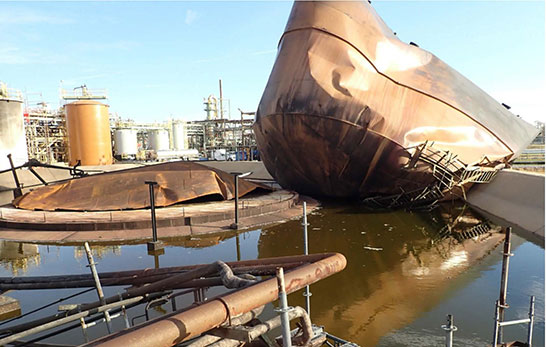
Tyson Foods was not the only company listed twice in the report. Two petroleum refining companies - PBF Energy and Delek - each experienced hydrocarbon releases at two different facilities during the report’s coverage period. Three of those incidents involved hydrocarbon releases or explosions which resulted in fires, and one involved hot hydrocarbons spraying an employee who was waiting to collect a sample from a sampling station.
Since July 2022, under the CSB’s current leadership, the agency has been posting overall data on its website about the incidents reported under the Accidental Release Reporting Rule (ARRR), including the name and location of the chemical facility involved in the incident, the date of the incident, and whether the incident involved a fatality, serious injury, or substantial property damage.
In the five years that the CSB’s reporting rule has been in effect, the CSB said it has received reports of over 500 serious chemical incidents in 43 states.


The U.S. Chemical Safety Board (CSB) is an independent, nonregulatory federal agency that investigates the root causes of major chemical incidents. The Board does not issue citations or fines, but makes safety recommendations to companies,…

Donald Halsing is the Founding Editorial Director of Work Safety 24/7. He was formerly the Associate Editor of Robotics 24/7.
Don's experience spans the supply chain, logistics, and construction industries, having worked in both warehouse operations and land surveying. He is also a professional wedding photographer with his fiancée Ashley.
Join our Safety Briefing newsletter and get safety news across logistics, warehousing, manufacturing, construction, and other high-risk environments. Get the latest regulatory updates, alerts, safety products, equipment and training, and analysis.
Don't miss a single news story, product review or safety resource. Subscribe to our newsletter for the latest safety news, updates, and exclusive offers.