Dedicated to helping businesses and individuals prioritize safety, health, and compliance in the workplace. From small startups to large corporations, safety is essential, and we're here to make it easier.


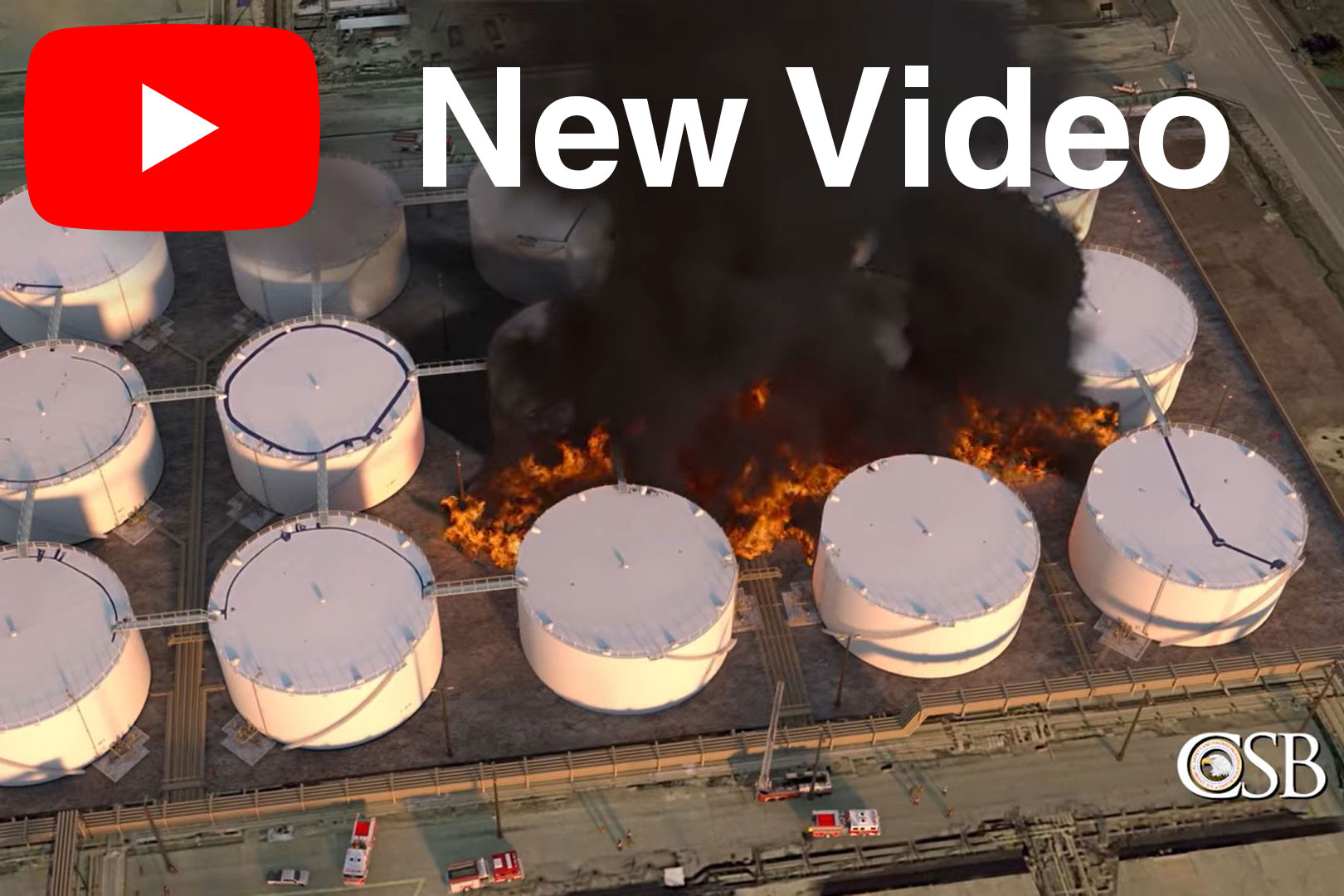
The U.S. Chemical Safety and Hazard Investigation Board (CSB) yesterday released a new video on its investigation into the massive 2019 fire that burned for three days at the Intercontinental Terminals Company (ITC) facility in Deer Park, Texas.
The CSB's new safety video, titled “Terminal Failure: Fire at ITC,” includes an animation of the incident and commentary from Steve Owens, CSB chairperson, along with Crystal Thomas, investigator-in-charge.
The CSB’s final investigation report on the incident was released in July 2023.
At the time of the incident, the ITC facility near Houston housed 242 above ground storage tanks which were used to store petrochemical products for various companies. Each tank could hold up to 80,000 barrels of flammable petrochemical liquids, including naphtha, toluene, xylene, and other gas blends.
On the morning of March 17, 2019, a circulation pump on Tank 80-8 catastrophically failed, allowing a large quantity of a flammable liquid butane and naphtha to escape from the tank and accumulate on the ground around it.
The release went unnoticed and continued for approximately 30 minutes before flammable vapors collecting around the tank ignited, causing a massive fire. Once the fire erupted, ITC was unable to isolate or stop the release.
“The incident at the ITC terminal resulted from several serious failures at the facility,” Owens said in the new video. “In particular, ITC lacked monitors to alert operators that the pump had failed. And ITC had no remotely operated emergency isolation valves that could have safely stopped the release of the flammable liquid. The tank farm’s design also meant that other tanks were highly vulnerable. Once the pump failed, it was too late to prevent a catastrophic fire from happening.”
The video covers five key safety issues from the CSB’s final report that contributed to the incident:
The CSB issued recommendations to ITC regarding each of these issues.
The video also highlights safety recommendations made by the CSB to the American Petroleum Institute (API), the EPA, and OSHA. The CSB recommended changes to standards and regulations updates including
“A serious gap in federal regulations also contributed to the severity of this event,” Owens concluded the video. “We believe that our recommendations - particularly to OSHA and the EPA - to expand regulatory oversight of these kinds of chemicals and facilities will help ensure that a similar incident does not occur in the future.”
The fire burned for three days, destroying 15 of the 80,000-barrel tanks and their contents, causing more than $150 million in property damage at the facility, and leading to several shelter-in-place orders that seriously disrupted the local community.
The incident also significantly impacted the environment. According to the U.S. Department of the Interior’s (DoI) case report, the fire was initially extinguished on March 20, but reignited March 22. Damage to the secondary containment wall around the tank group caused a catastrophic breach.
The breach released an estimated 470,000-523,000 barrels of contaminated fire water, firefighting aqueous film forming foams (AFFF), and remaining benzene, ethylbenzene, naphtha, xylene, toluene, pyrolysis gas (pygas) and other refined base oils from the storage tanks.
The contaminants were released into ditches which led to Tucker Bayou and adjacent waters, sediments, and habitats. Fluid flowed into Buffalo Bayou and was carried out by stream flow and tides into the San Jacinto River, Carpenters Bayou, Old San Jacinto River, Santa Ana Bayou, and eventually the Houston Ship Channel.
The CSB reported a seven-mile stretch of the Channel was closed, along with several waterfront parks in Harris County and the City of LaPorte, due to the contamination.
The U.S. Department of Justice (DoJ) announced in 2024 that ITC agreed to pay over $6.6 million under the Comprehensive Environmental Response, Compensation, and Liability Act (CERCLA) to federal and state natural resource trustees to resolve claims for natural resource damages resulting from the fire.
These agencies included the National Oceanic and Atmospheric Administration’s (NOAA) National Ocean Service, and the DoI through the Fish and Wildlife Service, Texas Commission on Environmental Quality, Texas Parks and Wildlife Department, and Texas General Land Office.
As noted by the DoI, DoJ, and NOAA’s report, trustees determined the hazardous substances released from ITC’s facility impacted an estimated 136 miles of shoreline, causing significant injuries to ecological resources and services, including birds, benthic, marsh, riparian, and beach habitats.
“All companies operating in our state must take the utmost precaution to prevent any such disaster from harming our citizens and our environment,” said Ken Paxton, Texas attorney general.
In addition, hazardous chemicals released into air and water resulted in lost recreational opportunities in the Deer Park area, including temporary closures of multiple state, county, and city parks and the Lynchburg Ferry, as well as the cancellation of an annual historical reenactment at San Jacinto State Park. Air quality impacts forced the closure of roads, schools, parks, and caused shelter in place orders over several days for most of the Deer Park area.
“Clean and resilient waterways are vital to coastal communities and this restoration will especially benefit those who have been disproportionately impacted by pollution,” said Nicole LeBoeuf, assistant administrator of NOAA’s National Ocean Service.
The settlement was used to compensate the public for natural resource injuries, reimburse trustee agencies for the costs of assessment, and fund the restoration planning and oversight process. ITC previously paid about $1 million to reimburse federal and state trustees for their prior assessment costs.
“This settlement will help repair, in part, the devastating environmental damage caused by the release of hazardous substances from ITC’s Deer Park facility,” said Alamdar S. Hamdani, U.S. attorney for the southern district of Texas.
In an earlier related CERCLA enforcement action, the EPA through the DoJ secured an administrative settlement with ITC for $5.25 million to reimburse costs in responding to the contaminant release.


The U.S. Chemical Safety Board (CSB) is an independent, nonregulatory federal agency that investigates the root causes of major chemical incidents. The Board does not issue citations or fines, but makes safety recommendations to companies,…

Donald Halsing is the Founding Editorial Director of Work Safety 24/7. He was formerly the Associate Editor of Robotics 24/7.
Don's experience spans the supply chain, logistics, and construction industries, having worked in both warehouse operations and land surveying. He is also a professional wedding photographer with his fiancée Ashley.
Join our Safety Briefing newsletter and get safety news across logistics, warehousing, manufacturing, construction, and other high-risk environments. Get the latest regulatory updates, alerts, safety products, equipment and training, and analysis.
Don't miss a single news story, product review or safety resource. Subscribe to our newsletter for the latest safety news, updates, and exclusive offers.