Dedicated to helping businesses and individuals prioritize safety, health, and compliance in the workplace. From small startups to large corporations, safety is essential, and we're here to make it easier.


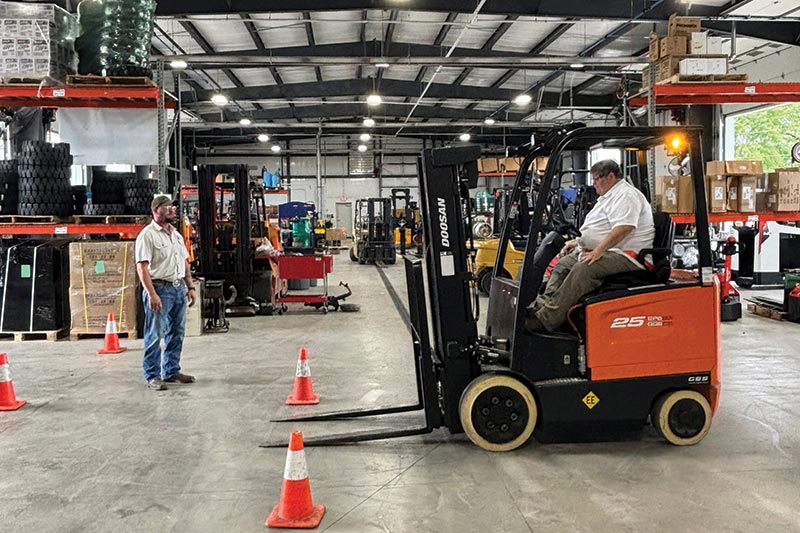
Given the ongoing challenge of finding enough skilled lift truck operators, companies can’t always count on being able to attract highly experienced, certified operators at the drop of a hard hat.
That makes having a highly effective training program more important, since companies will have to regularly train willing new employees, says David Hoover, president of Forklift Training Systems, a provider of operator training and safety solutions.
“Turnover is huge in the industry now, unemployment is low, and it’s hard to find good and qualified people to operate forklifts,” says Hoover. “In the past, it’s been easy to hire people with prior experience, but now qualified candidates are much harder to find, so companies will need to invest far more time and money in getting people to a safe and functional level of training.”
Companies can consider tapping a training services company for help with lift truck operator training resources, but in doing so, it’s crucial to craft a program that aligns with the types of truck classes and pallet handling workflows at a site, which can differ widely from company to company, adds Hoover.
For example, if new types of trucks are added to a fleet, that changes the training needs, since the Occupational Safety and Health Administration (OSHA) rules over lift truck operators state that if an operator needs to run a different type of truck—say a reach truck versus a pallet rider—the curriculum and training needs to be specific to the truck type.
“OSHA requires powered industrial truck training to be site- and lift truck-specific,” says Hoover. “This means that forklift training is not a one-size or type fits all, unlike other safety training such as fire extinguisher training. Materials handling equipment such as sit-down, stand-up reach, orderpicker, pallet jack and telehandler all come with their own safety precautions and operator training.”
The makeup of a training program also depends on the location, adds Hoover. “Operations and safety procedures can look very different for manufacturers, warehouses, retail stores or construction sites. Companies need to tailor their training to what they have, what they do, and where they use it. Buying a video from a forklift manufacturer and showing it to operators will not cut it with OSHA, nor will evaluating operators by moving empty pallets in a parking lot.”
As a result, it’s best to tailor lift truck operator training to client needs depending on the equipment and site workflows, to ensure operators are well trained to avoid potential accidents or incidents, Hoover points out.
However, he adds, it’s also a good idea to educate associates, supervisors and any pedestrians who might enter a facility, to be aware of forklift traffic and safe procedures such as sticking to designated pedestrian routes. It’s simply a best practice to take this broader educational approach when it comes to staying safe around lift trucks, concludes Hoover, based on the traffic patterns of each site.
“Most companies in America know they need to certify their forklift operators under OSHA’s standards, but they provide little to no education to pedestrians,” Hoover says. “One of our manufacturing clients put thousands of employees in our one-hour class about the pedestrian’s role in forklift safety. They shut down production lines to have everyone in the plant attend. I was impressed with the commitment to safety, and they were impressed with the results. The training provided new ideas for safety enhancements at the company while improving forklift operator and pedestrian interactions exponentially.”


Roberto Michel, senior editor for Modern, has covered manufacturing and supply chain management trends since 1996, mainly as a former staff editor and former contributor at Manufacturing Business Technology. He has been a contributor to Modern since 2004. He has worked on numerous show dailies, including at ProMat, the North American Material Handling Logistics show, and National Manufacturing Week. You can reach him at [email protected].
Join our Safety Briefing newsletter and get safety news across logistics, warehousing, manufacturing, construction, and other high-risk environments. Get the latest regulatory updates, alerts, safety products, equipment and training, and analysis.
Don't miss a single news story, product review or safety resource. Subscribe to our newsletter for the latest safety news, updates, and exclusive offers.