Dedicated to helping businesses and individuals prioritize safety, health, and compliance in the workplace. From small startups to large corporations, safety is essential, and we're here to make it easier.



To understand how companies are managing their e-commerce platforms under the weight of this pressure, Honeywell Intelligrated, in collaboration with Modern Materials Handling and the Peerless Research Group, surveyed 171 U.S.-based material handling executives.
The effort culminated in a recently published report, The Impacts of e-Commerce, Fulfillment Challenges and Improvement Priorities.
As expected, the survey results revealed that the majority of MHE executives are actively seeking solutions to combat rapidly escalating fulfillment complexities and new tools to manage mission-critical challenges, such as: labor management; order processing and tracking; and warehouse and distribution costs.
Yet, despite these known issues, many remain slow to adopt the technologies and automation needed to keep pace with increasing demands.
Grasping the extent of e-commerce impacts on DC operations will take time, so we’ll start by summarizing some of the key research findings.
Thirty-five percent of MHE executives reported that fulfilling more orders (faster and at lower costs) was their primary challenge. Reducing errors in order processing/improving order accuracy (28 percent) and obtaining enough labor to support operations (25 percent) were their second and third concerns, respectively.
Not having sufficient workforce to handle e-commerce volumes and lack of available floor space were the top two constraints to operational efficiencies, at 46 percent and 40 percent, respectively. Difficulties adapting inventory workflow on the warehouse floor was cited by 38 percent.
DC managers stated that addressing these challenges will require changes to their current facilities. Deploying more automated systems (44 percent) and adding manpower to their current labor force (37 percent) are their top two growth initiatives. Thirty-three percent reported that employing process improvement strategies and expanding the footprints of current facilities are also planned.
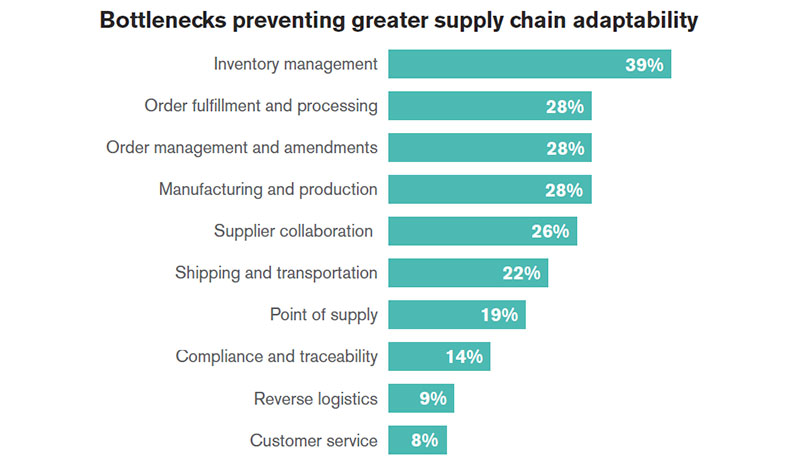
The survey group cited inventory management (39 percent) bottlenecks are the most likely deterrents to supply chain adaptability. Order processing, management and amendments, production challenges and delays brought on by suppliers are also common culprits.
When identifying functional areas ripe for improvements, managers listed many phases of the fulfillment process, including: inventory management (46 percent), order picking (35 percent), order waving/releasing (28 percent) and packing (20 percent).
Even with the awareness of their known operational limitations, many organizations remain slow to automate. While the majority of respondents expressed the criticality of controlling freight/transportation and labor costs (79 percent and 75 percent, respectively), fewer than one in 10 companies has implemented automated labor management processes.
Furthermore, nearly one out of five assert they have no plans to implement labor management technology. Order management, invoicing and shipping visibility are the processes most likely to be automated, although the majority still only rely on partial automation methods.
In lieu of the absence of end-to-end automation across fulfillment operations, it was no surprise to learn that the majority of companies in our survey expect to increase investments in software (58 percent), such as WMS, WCS and WES. Labor management, facility expansion, packaging equipment and materials, and implementing or upgrading automated materials handling systems are also prime areas for upgrades.
It’s probably safe to assume that the majority of you reading this blog (and research report) are relating to the report’s findings. In a follow-up to this blog, we’ll look at some of the ways Honeywell Intelligrated can address these issues.
Related White Papers
The Impacts of e-Commerce: Fulfillment Challenges and Improvement Priorities
As labor shortages, costs and productivity challenges persist, many operators are introducing increasing levels of automation to meet online order volumes. Download Now!


Honeywell Scanning & Mobility manufactures high-performance data collection hardware, including rugged mobile computers and bar code scanners purpose-built for supply chain environments. Our history with warehousing and distribution customers…

Join our Safety Briefing newsletter and get safety news across logistics, warehousing, manufacturing, construction, and other high-risk environments. Get the latest regulatory updates, alerts, safety products, equipment and training, and analysis.

Don't miss a single news story, product review or safety resource. Subscribe to our newsletter for the latest safety news, updates, and exclusive offers.