Dedicated to helping businesses and individuals prioritize safety, health, and compliance in the workplace. From small startups to large corporations, safety is essential, and we're here to make it easier.



This article was written by Jason Trisoline, an Account Manager at Lucas Systems, who specializes in warehouse software automation, boasting over twenty years of dedicated expertise. He’s a seasoned professional committed to revolutionizing supply chain technology solutions and delivering concrete business results. His extensive background includes optimizing warehouse operations, fulfilling e-commerce needs, and driving customer satisfaction.
Warehouse safety has always depended on training, procedures, supervision, and equipment. But as distribution centers become faster and more complex, safety is also shaped by how work is designed.
Pickers, loaders, and lift truck operators work amid moving equipment, time-sensitive orders, congestion, and constant performance pressure. They must verify items, handle products, avoid hazards, and keep pace. Safety, in other words, is not only physical. It is cognitive.
That is where voice-directed work deserves a more operational discussion. For warehouse leaders, the value of voice is not simply that workers hear instructions instead of reading them. It changes execution from screen-driven transaction processing to guided, real-time workflow control: sequencing work, validating actions, supporting exceptions, and reinforcing standard work without pulling attention away from the floor.
That distinction matters in fast-moving facilities. Reading paper lists, checking handheld screens, scanning labels, or entering data can interrupt work and pull attention away from forklifts, pallet jacks, conveyors, racks, totes, and foot traffic. Those interruptions are not just inefficiencies; they are moments where execution quality, situational awareness, and safety can degrade.
Most operations leaders already understand the heads-up, hands-free benefit. The deeper advantage is process discipline. Paper-based processes offer flexibility, but rely on memory, handwritten notes, supervisor follow-up, and after-the-fact reconciliation. RF scanning improves transaction control, but often creates a stop-start rhythm as workers look down, read, scan, type, and resume movement.
Voice creates a different cadence. Workers receive the next instruction while staying oriented to the environment, complete the task with both hands available, and confirm the action verbally. Check digits, quantity prompts, exception paths, and task-specific workflows help enforce process discipline without forcing workers to shift constantly between the system and the physical work.
That matters because warehouse risk rarely comes from one factor. It builds from congestion, material handling, powered industrial trucks, slips and trips, repetitive motion, time pressure, and process variation. Safer workflows reduce unnecessary distraction, handling, travel, interpretation, and rework.
Voice is not the only execution tool available, nor is it always the right answer. Pick-to-light can excel in dense, fixed-slot environments. RF scanning works well when screen-based data capture is essential. AMRs and smart carts can reduce travel, but still require clear human-machine coordination. Vision-based and wearable tools may add useful cues, though they can introduce attention, comfort, or change management tradeoffs.
Voice is strongest where workers need mobility, two-handed handling, real-time validation, and flexible guidance across dynamic workflows: case picking, batch picking, replenishment, loading, putaway, returns, cold-chain environments, large SKU sets, seasonal labor swings, or frequent process variation. In these settings, the value is not just instruction delivery. It is orchestrating work while keeping associates engaged with the task instead of anchored to a screen or document.
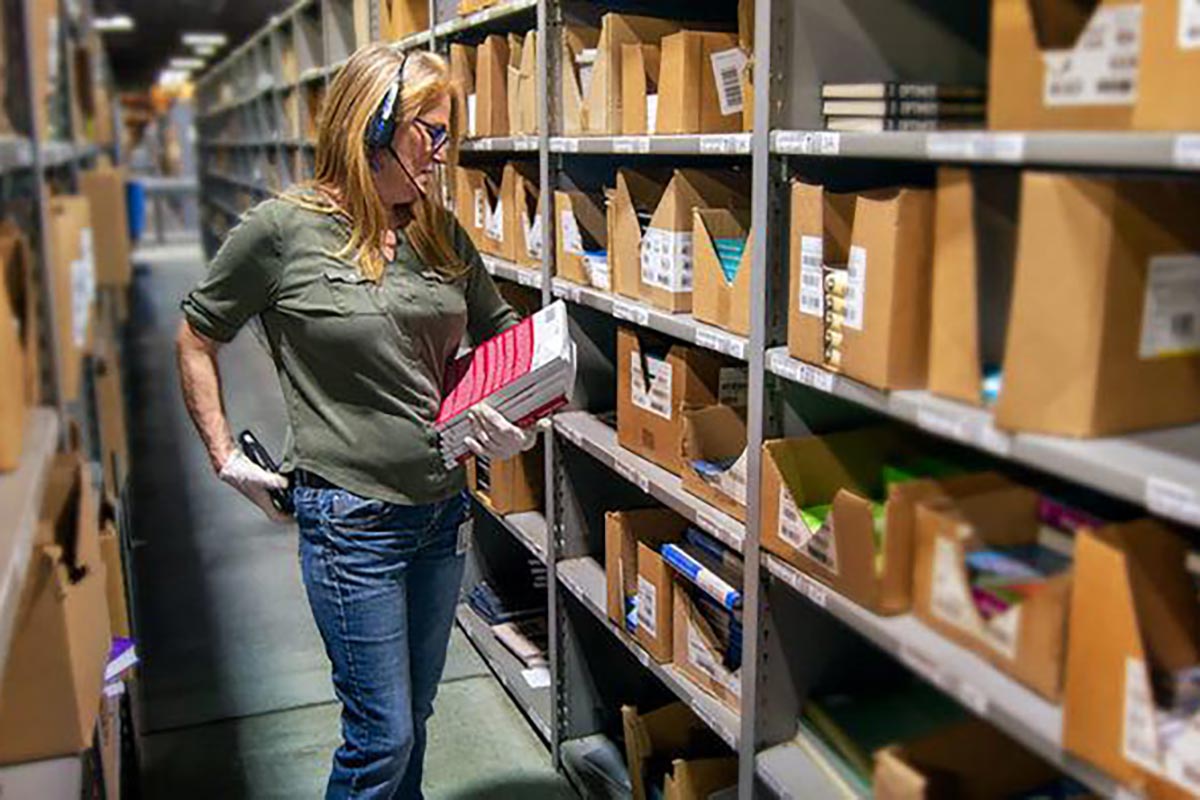
Voice also reduces cognitive load. In a warehouse, mental effort rises when workers must remember clustered picks, switch between pick, short, substitute, replenish, and exception tasks, navigate mixed case, each, batch, and pallet workflows, confirm transactions, and monitor hazards simultaneously.
Voice-directed workflows reduce that burden by breaking work into clear, sequential steps while preserving control. The system tells the worker where to go, what to pick, how many to pick, and how to confirm the action. It can also guide shorts, substitutions, lot capture, catch-weight entry, replenishment triggers, or loading validation without requiring the worker to stop and interpret a screen.
Systems such as Lucas Systems’ Jennifer show how voice, verification, and workflow intelligence can work together through spoken prompts, verbal confirmations, check digits, and workflows that adapt by task type, user experience, language need, or operational priority. The result is a more consistent process that reduces reliance on memory, interpretation, and tribal knowledge.
Safety is also shaped by how workers move. Handheld devices can affect posture, grip, balance, and lifting mechanics as workers alternate between handling product and handling technology.
A hands-free workflow supports more natural material handling. Workers can use both hands to lift, stabilize, and place items while moving through the facility without constantly shifting between a device and the work itself.
New workers face the steepest safety and productivity learning curve. They are learning the building, products, equipment, pace, exceptions, and safest way to perform each task. Seasonal and temporary associates may be productive for only a limited window, which makes process consistency critical.
Voice can make onboarding safer and more scalable by embedding standard work into the flow. Instead of memorizing long procedures, interpreting complex screens, or learning informal workarounds, new associates are guided through the task in real time. That consistency reduces variation across shifts, teams, and experience levels.
Lucas customers have also used Jennifer to simplify training and support workers with different experience levels and language needs, including one warehouse using English, Arabic, Spanish, and French. The lesson is not technology for technology’s sake. Intuitive tools reduce friction and create a more consistent operating environment.
Safety and productivity are often treated as separate goals, or even competing ones. In warehouse execution, they are closely connected. A workflow that reduces travel, unnecessary touches, errors, and mental fatigue also reduces exposure to risk.
Glacier Point Ice Cream provides one example. By moving from paper-based picking and loading to an intelligent, voice-directed process, the operation improved picking accuracy, reduced loading errors, and created better downstream organization. Jennifer guided workers on what to pick and where to place it, validated loading activity, warned if racks or pallets were assigned to the wrong truck, and helped create trailer maps for drivers.
Over 15 years ago, Cengage implemented Lucas Systems' hands-free, voice-directed Jennifer system to replace slow paper-based processes, aiming to boost performance and increase worker safety. The resulting warehouse optimization led to a 15% boost in overall productivity, a 5% increase in order accuracy, and a 10% reduction in required labor. Safety performance reflects many factors, but when workers can keep their eyes on the environment, hands on the work, and attention on the next best action, the workflow itself does more to support safe behavior.
The larger lesson is that warehouse safety is not only about asking workers to be more careful. It is about designing systems that make safe behavior easier to sustain. Workflows that require constant screen checks, memorization, handheld devices, or too many decisions under pressure add risk. Workflows that provide clear guidance, real-time validation, exception support, and standard work help reduce risk at the source.
This is cognitive ergonomics applied to warehouse execution: designing work around both the body and the mind. Voice supports that goal by translating complex work into timely instructions while keeping the system of record aligned with the physical work being performed.
Voice technology will not eliminate every warehouse hazard, and it should not be evaluated as a standalone safety program. Facilities still need training, traffic controls, ergonomic practices, equipment maintenance, supervisor engagement, and a culture that encourages safe decisions. The stronger case for voice is that it can make those efforts easier to execute by changing how workers interact with the job itself.
For experienced warehouse leaders, the most important benefit may be what workers no longer have to do: constantly look down at screens or paper, carry technology in one hand while handling products with the other, memorize multi-step instructions, or split attention between the system and the environment.
By keeping workers heads up, hands free, and mentally focused, voice-directed workflows help create safer, more consistent, and more resilient operations. The value of voice is not simply that it improves picking. It changes the operating rhythm of the floor: fewer interruptions, stronger validation, faster exception handling, and less friction between the system of record and the physical work being performed.

Join our Safety Briefing newsletter and get safety news across logistics, warehousing, manufacturing, construction, and other high-risk environments. Get the latest regulatory updates, alerts, safety products, equipment and training, and analysis.
Don't miss a single news story, product review or safety resource. Subscribe to our newsletter for the latest safety news, updates, and exclusive offers.