Dedicated to helping businesses and individuals prioritize safety, health, and compliance in the workplace. From small startups to large corporations, safety is essential, and we're here to make it easier.


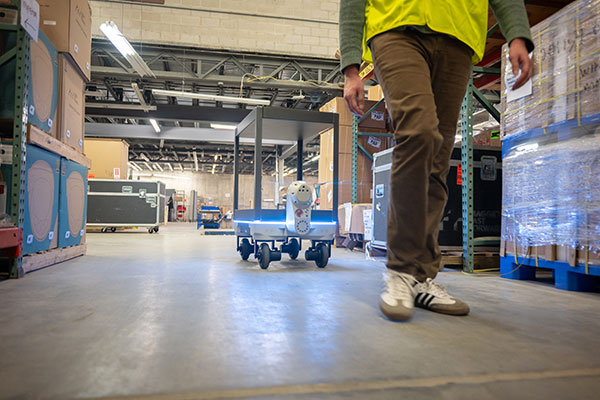
Cargo-carrying cobot developer Piaggio Fast Forward (PFF) recently announced it will debut two autonomous navigation features that aim to significantly augment workforce productivity and ease workload at ProMat 2025 in booth S1063.
The trade show will be held March 17-20 at the McCormick Place Convention Center in Chicago, Ill.
At ProMat 2025, PFF will showcase its new Forward Following technology and Trips functionality on its kilo collaborative autonomous mobile robot (AMR), both designed to enhance collaboration between humans and robots.
PFF also announced its Smart Behaviors Database. Coupled with AI and machine learning (ML), the database helps PFF ensure its cobots operate safely.
Kilo is designed to work alongside humans, reducing the risk of repetitive motion injuries. The four-wheeled robotic flatbed has a payload of up to 300 pounds with a maximum speed of 3 mph, and is designed to enhance material movement in industries such as manufacturing, facilities management, warehousing, and logistics.
Operating directly out of the box, PFF said kilo requires no costly infrastructure or advanced training. It can be outfitted with industry-specific carts or shelving, providing the right platform for any job.
PFF said Forward Following can change the way robots interact with workers. This technology enables kilo robots to follow in front of their leader as easily as they follow behind. Users simply pair with kilo and walk towards or away from the robot to inform the direction of its movement.
This intuitive interaction is familiar to anyone who has pushed or pulled carts, which PFF said can help relieve the physical stresses of twisting, turning, and manually maneuvering a heavy payload.
This user-centric design was created to offer comfort, security, and ease of use, while also addressing feedback that users preferred to have eyes on their robots and the contents they transport. PFF said the ability to move the robot forward or backward without physically touching it provides greater flexibility in the workplace and allows for more efficient handling in complex environments.
The Trips feature allows users to record specific travel paths with their kilo robot and store them in a library for future use. With no limit on the number of trips that can be saved, users can easily send robots on these pre-programmed routes autonomously.
Recording trips is simple - users only need to walk the path with their kilo while recording through the PFF pro app. This new functionality is accessible through the PFF Pro Tools, a cloud-based fleet management software designed to optimize human-robot collaboration.
"Our robotics technology is augmenting workforces around the world," said Greg Lynn, PFF CEO. "Kilo is the newest model offering customizable options with the ability to utilize our latest software tools and data to manage the human-robot relationship. From manufacturing to any industry that relies on the repetitive movement of goods, PFF's autonomous technology allows our robots to safely move with and around workers in complex environments, streamlining workflows and increasing productivity."
PFF's Smart Behaviors Database is a motion capture dataset of people moving with other people and interacting with objects in built environments, with over 10,000 sequences and 22.6 million frames of 3D motion data.
This database, built on human interaction rather than isolated individual motions, allows PFF to ensure its robots operate safely in shared spaces with humans. PFF's use of AI and ML applied to this database helps ensure predictable, tested, and certified robotic behaviors, making it possible to deploy robots safely in dynamic, real-world environments.
"At PFF, we use machine learning and AI to help us sift through millions of frames of actual human interaction in order to call out the features that are most important for both understanding the behavior of others and exhibiting behavior that is expected," said Tyson Phillips, PFF senior manager of smart behaviors. “Better social understanding and more predictable behavior leads to safer interactions between robots and humans at a more personal level.”


Join our Safety Briefing newsletter and get safety news across logistics, warehousing, manufacturing, construction, and other high-risk environments. Get the latest regulatory updates, alerts, safety products, equipment and training, and analysis.

Don't miss a single news story, product review or safety resource. Subscribe to our newsletter for the latest safety news, updates, and exclusive offers.