Dedicated to helping businesses and individuals prioritize safety, health, and compliance in the workplace. From small startups to large corporations, safety is essential, and we're here to make it easier.


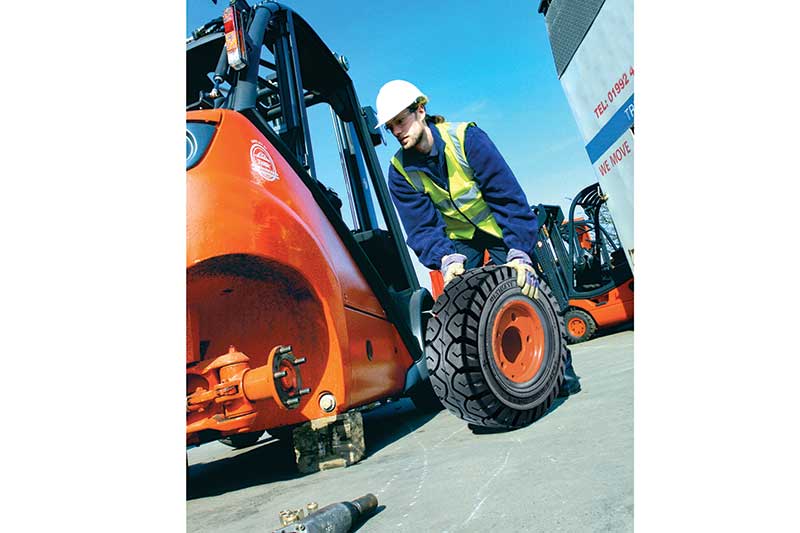
The daily safety checklist process for lift trucks, required to help ensure the safety of operators and others in the facility, overlaps with the objective of effective maintenance to help parts from wearing out or causing fleet downtime. That’s true not only for the key components on the truck itself like its brakes or steering controls, but for other elements that might be easy to overlook.
Elements like attachments and tires should be part of daily checklists, since they are part of what makes the truck work as intended. In short, don’t overlook any part of the overall truck system that’s critical to its safe and productive functioning.
David Norton, vice president of customer solutions and support with The Raymond Corporation, says lift truck tire issues can have a tendency to be overlooked, so it’s important to check tires carefully during the safety checklist process and to take action during a shift if any noticeable issue crops up with tires.
“During inspection, you can look for cracks or signs of damage, and also check to see if small pieces of debris are embedded in them,” says Norton. “During a shift, the operator may actually feel the vibration from an object like a piece of metal getting lodged in the tire, and they can immediately get that serviced. If you continue to operate a truck with debris in the tire, it’s not only harmful to the tire and wheel, it adds vibration to the whole truck and might possibly even damage the floor.”
Attachments also call for careful inspection, says Norton. For example, check the hoses on clamps, and examine for structural integrity of attachments like pick carts on orderpickers. Additionally, it’s important to check the capacity tags on attachments, explains Norton, since an attachment’s weight not only adds to the working weight of a truck, some attachments extend, impacting its center of gravity and capacity when in use. “It’s important to look at those tags to know how much an attachment weighs, and how its use affects the overall capacity of the truck,” says Norton.
Making examination of tires part of the daily checklist is advisable, agrees Dilani Anuruddika, general manager and category head of material handling tires for GRI Tires. “Checking for issues such as tread depth, inflation levels, cuts or uneven wear should become a regular practice,” Anuruddika says.
While qualified technicians should also examine tires periodically and perform necessary maintenance like rotations, operators can check for potential issues on a daily basis. “Also look for any uneven wear on the tires, which could indicate alignment or inflation issues,” Anuruddika says. “And, if there are foreign objects like nails in the tire, remove them to prevent future problems.”
Lift truck tires also benefit from regular cleaning, and from keeping the floor of the facility clean. “Clean tires not only contribute to better performance but also extend their lifespan,” says Anuruddhika.
Lift truck fleet software can help ensure everything that needs to be checked gets checked, adds Norton, since it digitizes the safety checklist for the types of trucks and attachments in the fleet.
While fleet software isn’t mandatory for safety checklists (paper-based meets requirements) fleet software provides a digital audit trail of what was checked, when it was checked, and by whom, building an asset history.
Fleet software can also tie into truck controls to gather use data, and tie into service history and parts costs, providing detailed online knowledge of maintenance costs, adds Norton.
“With our telematics and fleet software, you’re able to know what the cost of ownership of each truck is. You also compare one location to another location and look at why the same trucks at one facility might be costing more to maintain than at another site, to help determine what might be the reason or root cause.” - says Norton.


Roberto Michel, senior editor for Modern, has covered manufacturing and supply chain management trends since 1996, mainly as a former staff editor and former contributor at Manufacturing Business Technology. He has been a contributor to Modern since 2004. He has worked on numerous show dailies, including at ProMat, the North American Material Handling Logistics show, and National Manufacturing Week. You can reach him at [email protected].
Join our Safety Briefing newsletter and get safety news across logistics, warehousing, manufacturing, construction, and other high-risk environments. Get the latest regulatory updates, alerts, safety products, equipment and training, and analysis.
Don't miss a single news story, product review or safety resource. Subscribe to our newsletter for the latest safety news, updates, and exclusive offers.