Dedicated to helping businesses and individuals prioritize safety, health, and compliance in the workplace. From small startups to large corporations, safety is essential, and we're here to make it easier.


Rewind to early February 2025.
Come on in. Sit next to me. We’re at a Modern editorial planning meeting and the next topic is the story about robots for the April issue.
“I think we should do something on special-purpose robots.”
“You mean something other than an AMR or robotic AS/RS?”
“Yeah.”
“Can you be more specific?”
“Kind of.”
And with that, the hunt for special-purpose robots was off and running.
As it turns out, the story of special-purpose robots is much less about the form factor than the function. And the range of functions and tasks they perform is long.
It includes:
Those are just 10 functions. There are plenty more. In fact, Gartner says that it’s tracking about 34 different sub-categories of smart robots just in the logistics and manufacturing area. Including the one you thought was unique.
None are theoretical. All are at work within the four walls. And with that much range, special-purpose robots are all about the special something each one does. No Swiss Army knife in the pack.
However, they do have one thing in common: They replace people in cumbersome, repetitive, manual, annoying and even down-right-unpleasant tasks.
Surely, you have some of those in your facility, which makes special-purpose robots of special interest to you and everyone else. Not to mention their impact on hard-to-find-and-keep labor and related costs.
Dwight Klappich, research vice president and Gartner Fellow, knows that all so well without ever visiting your facility in particular.
Klappich recently did a survey with Modern about robots (running on Page 30 this month), their use and their future in your facility. Here are some of the findings.
Only 96% of companies currently use or plan to use robotics. Not bad.
The other good news-this is not aspirational. Of those, 23% are piloting; 38% are beginning implementation; 28% are in their first deployment; and 8% are fully deployed. Just between us, we’ll see how the “fully deployed” segment plays out.
Once companies deploy their first robot, the vast majority plan to increase their robotic fleets.
The balance plan to increase their robotic fleets. And 95% of those plan to pursue other robot use cases.
If that’s not an open playing field for future development and use of special-purpose robots, what is? And their success is all about the value they deliver.
Klappich offers this definition for the value of special-purpose robots.
“They are a packaged solution for a specific task. They must do one thing and do it really well. Their main benefit is their time to value as a packaged solution. That means you have to know what you want the robot to do upfront to deliver on the business case in short order,” he says.
He goes on to say that being a special-purpose robot is not a design flaw or a bad thing. Instead, it’s necessary to have the right combination of software and hardware designed specifically to solve a particular problem in the right way.
Here’s a closer look at a handful of a few of these solutions. And as you will see, a wide range of robots are at work, solving very specific problems in warehouses and manufacturing.
In retrospect, the “kind of” response in the editorial meeting actually wasn’t as flip as it seemed in the moment.
“Special-purpose robots are all about providing a solution with the tools and support to solve a problem. They’re not about the technology itself,” says Collin Ayres, regional channel manager at Kassow Robots.
Ayres says that means adapting the robot to the process, not the reverse.
To that end, Kassow Robots offers a lightweight, seven-axis, single-arm collaborative robot for workstations, both stationary and mobile. It handles payloads of 5 to 18 kg and a reach of 850 to 1800 mm.
Ayres emphasizes the seven-axis capability of the robot. Unlike those with five- and six-axes, the Kassow Robots’ entry offers an additional joint to access items it needs to handle.
“Not every application requires seven axes. But that extra flexibility is a game changer for some,” says Ayres. Sounds special.
He continues to say Kassow Robots’ are broadly used in manufacturing. And often are mounted on an automatic guided vehicle (AGV) for various handling tasks.
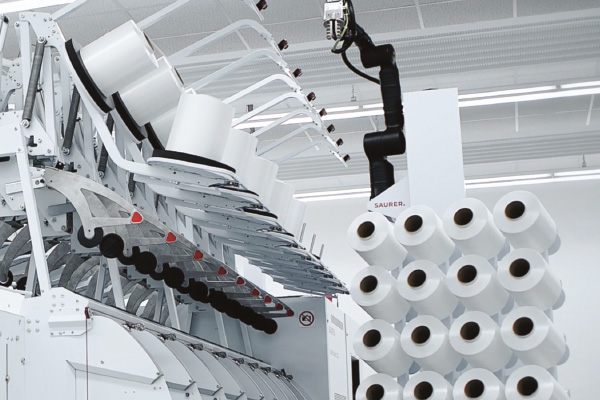
One notable example is the restocking of cabling machines with bobbins (see picture page 36). German manufacturer Saurer Technologies starts with AGVs, each outfitted with a seven-axis robot and magazine of new bobbins.
The magazine is loaded by the robot with bobbins at a replenishment station. The AGV then travels to a designated cabling machine. There, the robot picks a bobbin from the magazine on the AGV, placing it in the empty location on the cabling machine. An onboard camera guides all activities.
Ayres says the new solution eliminates manual replenishment of bobbins. In addition, the automated solution tracks individual bobbins, virtually eliminating the possibility of mixups.
In addition, the “wrist-like” movement of the robot’s seventh axis provides necessary flexibility in the bobbin replacement operation, adds Ayres.
In a year, major eyeglass retailer Zenni Optical sells 6.5 million pairs. Until lately, each pair was manually placed in an eyeglass case and then manually fed into a bagging machine for delivery to the customer.
And while people still manually put glasses in cases, a pick-and-place robot and related software now identify, pick and place each case into an integrated automated bagging machine for shipping. The photo panel above shows how this works.
“The result is a 50% increase in productivity, 80% increase in throughput and 99.9% accuracy,” explains Adi Dalvi, vice president of sales at OSARO. And it all happens at a rate of 410 units an hour per robot.
The solution is actually a combination of a special-purpose picking robot from Fanuc under the direction of OSARO’s pick-and-place software.
Highly integrated, the hardware and software have great flexibility to adapt to changes in product, throughput and processes.
“Artificial intelligence and the software are the most critical piece of the solution,” says Dalvi. He continues to explain AI allows for dynamic changes (within two hours) in the inbound and outbound flow of goods and integration with related processing equipment.
By the way, Dalvi says Zenni is one of as many as 50 companies using the solution to automate bagging of goods for shipment. E-commerce figures prominently in that mix.
Using fixed, single-arm robots, OSARO also offers systems for mixed-case depalletizing as well as kitting for e-commerce.
In all cases, AI figures prominently in the solution’s ability to adapt to process and product changes. In addition, the company’s AI-driven vision software guides the robots to perceive, grasp and perform required tasks.
Who doesn’t love a good case stacker? Especially an automated one. Just ask Jeff Mahler, co-founder and chief technology officer at Ambi Robotics.
“We’re focused on a full range of sorting and stacking operations using a gantry, cartesian robot,” Mahler says. “We have the ability to sort/stack items, typically cases, in various containers such as gaylords as well as on pallets and the floor.”
Just as important, the AmbiStack solution handles a range of handling scenarios. For instance, it handles both single- and mixed-SKU cases simultaneously and in any orientation. It also picks and places multiple cases on multiple pallets simultaneously.
Such flexibility is due to AI and vision system adaptability, says Mahler. Low-cost cameras provide precise dimensions to the AI that guides the gantry robot. “It’s all about reinforcement learning,” adds Mahler.
“The crux of this type of special-purpose robot,” says Mahler, “is to first integrate the machine with existing processes and optimize its performance along the way.”
After all, it’s one challenge to load and unload gaylords with 8-foot tall walls and another to build a pallet load from floor level. However, Mahler says the goals of these special-purpose robots is the same - improve efficiency, reliability and worker safety while reducing costs.
Not every supplier names its special-purpose robots. But Boston Dynamics has.
Let me introduce you to Stretch and Spot.
“Stretch is specifically designed for case handling and can quickly unload trailers and containers,” explains Mike Fair, director, product management at Boston Dynamics.
“Spot is a quadruped robot designed for a variety of tasks including maintenance by autonomously collecting data about facility operations,” Fair adds.
Stretch looks most like an AGV with a powerful robot arm mounted on it. The robot arm has a 6.5-foot extended reach.
Spot, on the other hand, has four legs and looks like a cross between a dog and an insect.
Both are in use by a range of companies.
Stretch is on the job at DHL, Arvato and Otto Group. They’re all interested in “streamlining the inbound process,” says Fair.
Using an advanced vision system, Stretch takes pictures of the boxes inside a trailer at DHL. Then, it uses end effector suction cups on its one-armed robot to pick boxes individually and place each on a takeaway conveyor. The maximum capacity is 50 pounds.
This process happens without any information about the contents of the trailer prior to its arrival. Stretch makes adjustments throughout the unloading process. That includes picking up fallen boxes and placing them on the conveyor.
Spot provides data collection for predictive maintenance as well as condition and environmental monitoring. Users include Michelin, BMW and Anheuser-Busch.
At the AB brewery in Leuven, Belgium, Spot conducts 1,800 inspections a week across 10 packaging lines that produce 50,000 containers of beer an hour. In its first six months of use, Spot found 150 anomalies and helped reduce repair times from months to as little as 13 days.
So, there you have it. A quick look at special-purpose robots that only scratches the surface. There just isn’t room here to get much deeper.
And as you were warned in the editorial meeting, there’s more to special than you might imagine right now.


Gary Forger is an editor at large for Modern Materials Handling. He is the former editorial director of Modern Materials Handling and senior vice president of MHI. He was also the editor of the Material Handling & Logistics U.S. Roadmap to 2030.

Join our Safety Briefing newsletter and get safety news across logistics, warehousing, manufacturing, construction, and other high-risk environments. Get the latest regulatory updates, alerts, safety products, equipment and training, and analysis.

Don't miss a single news story, product review or safety resource. Subscribe to our newsletter for the latest safety news, updates, and exclusive offers.