Dedicated to helping businesses and individuals prioritize safety, health, and compliance in the workplace. From small startups to large corporations, safety is essential, and we're here to make it easier.


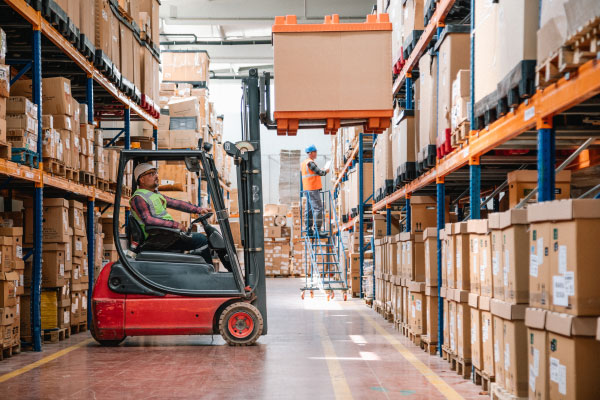
Improving lift truck fleet safety sometimes comes down to investing in more than the standard features. Yes, lights, horns, backup alarms and more advanced technology like sensor or vision-based operator assist systems all create an element of safety for operators, but some risks require additional care.
A lot of hype has been given to object and pedestrian detection technologies, but other equipment like smart dock controls and vehicle restraints, guard rails or pallet guards in front of racks, and lighting systems provide a legitimate approach to make fleet operations safer or at least less prone to risk.
These extra safety measures ensure facilities are covering all their bases when it comes to every possible worst-case scenario, because at the end of the day, safety is about making sure everyone goes home in the same condition they arrived.
“Unfortunately, we work with a lot of companies that will come in here after they’ve had an individual die because of a lack of safety or just a mistake that was made, and they didn’t have the proper safety pieces of equipment,” says Joe Ellestad, director of customer relations and sales support at Rite-Hite.
Instead of relying on bare minimum requirements, taking a proactive approach to safety can not only save lives, but save companies money and maintain a certain level of productivity and security.
“Bottom line, the forklift being so heavy, the impact or an incident involving a forklift can have a much more significant impact or create a lot more harm,” says Pascal Jetté, vice president of sales, business development and an expert in trailer restraint/loading dock equipment at GMR Safety.
The unloading or loading of a truck is one of the most dangerous jobs a lift truck operator is tasked with. Most companies implement best practices and step-by-step safety processes around the loading dock, but even then, mistakes can happen. The best safety equipment should complement and work in tandem with a company’s practices and traffic flow within their facilities.
“The biggest risk is for the truck driver to pull away as the loading or unloading is still happening,” says Jetté.
This can lead to falls from the loading dock edge, operators getting pinned between the dock and a trailer, and sagging or tilting trailers.
Rite-Hite offers a variety of products designed to mitigate these risks. The supplier is most widely known for its dock levelers and vehicle restraints—both critical attachments for loading and unloading goods from trailers.
“If someone makes a human mistake of raising a level or unlocking a dock lock or taking down the restraint before the loading and unloading is complete, that’s when those accidents happen,” says Ellestad. “Having the type of equipment around to minimize those mistakes is key.”
Dock levelers ensure that lift trucks have a level and smooth transition when they go over the bridge from facility floor into a trailer. Rite-Hite has made significant improvements to its legacy product, which it began manufacturing in 1965, such as smoothing out the bumps and humps required to go over the leveler.
“We’ve made it a safer, more comfortable bridge to go over and into that trailer,” says Ellestad. “The design has reduced what we call dock shock, or that whole body vibration with forklift drivers that are on top of the forklifts.”
Looking into the future, this smoother transition is important for autonomous or driverless forklifts that require an obstacle-free driving surface.
“These autonomous guided vehicles will go in, and if they feel any jarring or any movement, they actually stop,” says Ellestad. “The levels that we’ve designed have not only helped with safety with our forklift drivers, human forklift drivers, but also making sure that productivity is at an all-time high with the smooth transition dock levelers.”
Vehicle restraints offer another additional layer of safety at the loading dock for both forklift operators and over-the-road truck drivers.
Originally created to stop trailers from pulling away from the warehouse before the loading or unloading was complete, restraints have become an OSHA-compliant alternative to traditional wheel chocks, which have been a minimal OSHA requirement since the 1970s.
Often a simple wood or plastic wedge placed under a wheel, wheel chocks don’t restrain the trailer, they only keep it from moving or rolling. Wheel chocks also require a level of trust and involvement that the truck driver is actually putting the chock in place.
“You don’t have any control on making sure that the driver actually did what you asked him to do,” warns Jetté. “And if he wants to pull away, he can just easily pull away over that small rubber chock at the end.”
Rite-Hite’s vehicle restraint, the Dock Lock, not only restrains the trailer but includes an automated system that eliminates the need to physically chock a wheel to keep the truck from rolling away.
“You can simply push a button from the inside of the building, and a rotating hook is going to get up and over the ICC bar (or the Interstate Commerce Commission bar), now called the rig bar or the rear impact guard,” says Ellestad. “Getting up and over that back bar on the tail end of trailers is really important so that we’re stopping or minimizing the possibility of that trailer getting away too soon.”
GMR Safety takes a different approach to vehicle restraint using its Power Chock restraint system, which doesn’t rely on the ICC bar, but is attached like a traditional chock at the wheel.
“The best way to make sure the vehicle does not pull away in the loading and unloading process is to make sure you restrain the vehicle with the wheel,” says Jetté. “What we’ve done with the Power Chock is we took it to a whole other level.”
The Power Chock combines a steel wheel chock and a ground-anchored restraining plate, which can be automatically positioned in front of a vehicle’s wheel without driver intervention.
To avoid incident, the dock door or dock leveler can only be operated if the chock has been properly set and the correct position is confirmed by a sensor on the chock. Visual indicators and audible alarms alert workers and lift truck drivers in the warehouse and the driver outside about the position of the chock and the availability of the loading dock.
“With the Power Chock, we actually make sure we cover all the bases,” says Jetté. “If safety is not engaged, we’ve got the lights, we’ve got the controls, we’ve got the alarms. If safety is not engaged, we’ll make sure that you know you won’t have power to your dock plate.”
Inside the warehouse, barrier systems are especially important in protecting lift truck drivers and the product being stored. Rack guard, for example, protects from incidents of forklift versus rack, which can cause a whole section of storage to come tumbling down.
“If that rack falls from damage, it’s going to cause more catastrophic damage than potentially just the product in it and the rack itself, it could bring down the whole system,” says Jim Augustyniak, regional sales manager at Steel King Industries. “It could fall on employees in the workplace. It could fall on the lift truck driver, so it kind of goes two ways—you’re protecting the product in the rack, but at the same time, you’re doing that so it doesn’t fail and cause more catastrophic damage.”
Steel King offers a line of safety products, including the Guard Dawg, which wraps around the front column of racking to provide front impact protection. This low profile reduces the damage to the forklift if it hits or scrapes it.
Like other safety equipment, rack guard and barrier systems account for the human element in a facility, acting as a preventative measure to human error.
“No one’s perfect,” says Ellestad. “Where you just take a misstep and someone makes a mistake, that’s where having a barrier system in or something to really help physically segregate the pedestrians and the forklifts, or forklifts and forklifts, is really important.”
This is especially critical for facilities experiencing a lot of turnover in forklift drivers.
“That’s usually an indication that you have to protect your facility more because you have people learning on the job, so they’re going to make mistakes,” says Augustyniak.
It is also useful as a preventive measure in narrow spaces where there is more chance for damage or areas that require more speed.
“If it’s an area that you know you want to have some speed in picking or efficiency but it’s a dangerous situation, then you might want to throw some guarding or protection in there so you can get in and out without causing any issues,” says Augustyniak.
Ellestad adds: “They have not made a paint thick enough for a person not to step over it, or a forklift tire not to roll over that paint, so we always say: Let’s raise the painted line with barrier systems.”

Steel King is the nation’s only single-source manufacturer of pallet racks, drive in rack, flow rack, pushback rack, pick modules, mezzanines, cantilever racks, portable racks, industrial containers, custom shipping racks, and industrial safety…

Amy Wunderlin is a freelance supply chain and technology writer. She has written for several weekly and daily newspapers, in addition to trade publications such as Supply & Demand Chain Executive, Food Logistics and Building Operating Management, among others. She is a 2013 graduate of the University of Wisconsin-Whitewater, where she earned her B.A. in journalism.
Join our Safety Briefing newsletter and get safety news across logistics, warehousing, manufacturing, construction, and other high-risk environments. Get the latest regulatory updates, alerts, safety products, equipment and training, and analysis.
Don't miss a single news story, product review or safety resource. Subscribe to our newsletter for the latest safety news, updates, and exclusive offers.