Dedicated to helping businesses and individuals prioritize safety, health, and compliance in the workplace. From small startups to large corporations, safety is essential, and we're here to make it easier.


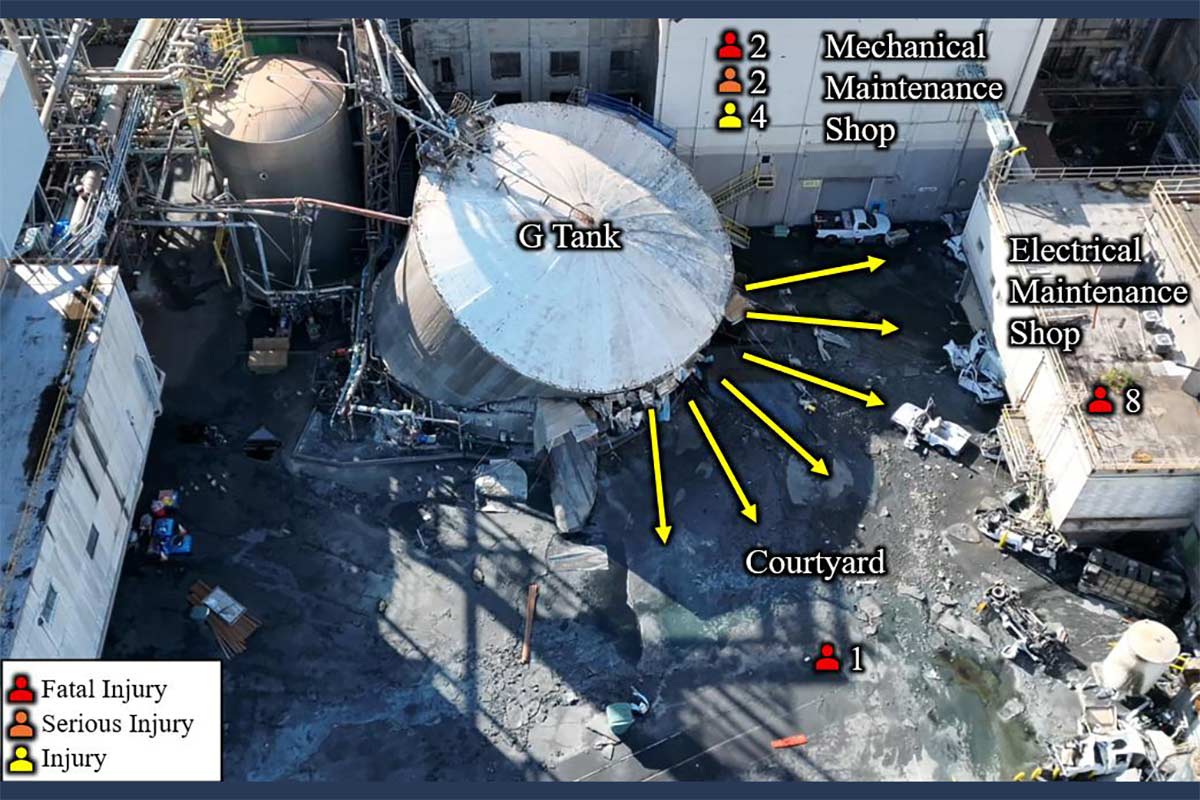
The CSB today released an update on its investigation into the deadly May 26 catastrophic failure of a 1.2 million gallon atmospheric storage tank at the Nippon Dynawave Packaging Company, LLC (NDP) pulp and paper mill in Longview, Washington.
The tank - identified as G Tank - released approximately 900,000 gallons of extremely hot, highly-caustic white liquor, killing 11 NDP employees and seriously injuring three others.
“Although the CSB’s investigation is still ongoing, we are greatly concerned that the tank was not promptly removed from service or properly repaired after the clear findings in the inspection report.”
— Steve Owens, CSB Chairperson
The CSB’s investigation found an inspection of G Tank’s exterior shell conducted in July 2025 - approximately 10 months before the incident - identified significant portions of the tank’s carbon-steel shell had thinned below the calculated minimum safe thickness.
“The minimum safe thickness is the amount of material necessary for an atmospheric storage tank to safely contain its contents. G Tank’s shell had areas thinner than the minimum thickness required for continued service at its typical operating conditions.”
— Drew Sahli, CSB Investigator-in-Charge
The inspection contractor’s report recommended that NDP internally inspect and repair the identified thinned areas of G Tank’s shell. The inspection report also stated G Tank was “[n]ot fit for continued service” unless it was repaired and that there was a “[h]igh likelihood/consequence of failure.”
Despite the inspection’s findings, G Tank remained in service until it catastrophically failed on May 26.
NDP conducted additional external inspections of G Tank in October 2025 and February 2026. Both inspections also determined substantial portions of G Tank’s shell remained thinner than the calculated minimum safe thickness.
Even after these additional inspections, NDP still did not internally inspect or repair the tank shell, remove it from service, or reduce its operating conditions before it failed.
“The inspection identified significant tank-wall thinning below the minimum safe thickness months before the failure. Our investigation is examining why the tank remained in service without either being repaired, or operated under reduced conditions.”
— Mark Wingard, CSB Supervisory Investigator
On the day of the incident, a process upset required NDP to stop sending white liquor from G Tank to the digestor at the mill where it would have been used to produce pulp from wood chips.
However, even though no white liquor was leaving G Tank, white liquor continued to enter the tank from the recausticizing process at the mill, causing the tank level to rise to approximately 90% full by 6:22 a.m.
As shown in recently-released surveillance footage, at approximately 7:09 a.m. G Tank catastrophically failed, rapidly releasing approximately 900,000 gallons of the scalding hot (200 degrees Fahrenheit) highly-corrosive liquid, flooding the surrounding courtyard and nearby buildings where employees were gathered for morning meetings.
Eleven NDP employees were killed, and three were seriously injured by the release. Five additional NDP employees and one firefighter sustained injuries but did not require inpatient hospitalization.
“The CSB’s investigation will determine the events that led to the tank remaining in service and our investigation will seek to determine how future incidents can be prevented.”
— Sylvia Johnson, CSB Board Member
The CSB continues to investigate the causes and contributing factors associated with the failure, including:


The U.S. Chemical Safety Board (CSB) is an independent, nonregulatory federal agency that investigates the root causes of major chemical incidents. The Board does not issue citations or fines, but makes safety recommendations to companies,…
Join our Safety Briefing newsletter and get safety news across logistics, warehousing, manufacturing, construction, and other high-risk environments. Get the latest regulatory updates, alerts, safety products, equipment and training, and analysis.
Don't miss a single news story, product review or safety resource. Subscribe to our newsletter for the latest safety news, updates, and exclusive offers.