Dedicated to helping businesses and individuals prioritize safety, health, and compliance in the workplace. From small startups to large corporations, safety is essential, and we're here to make it easier.


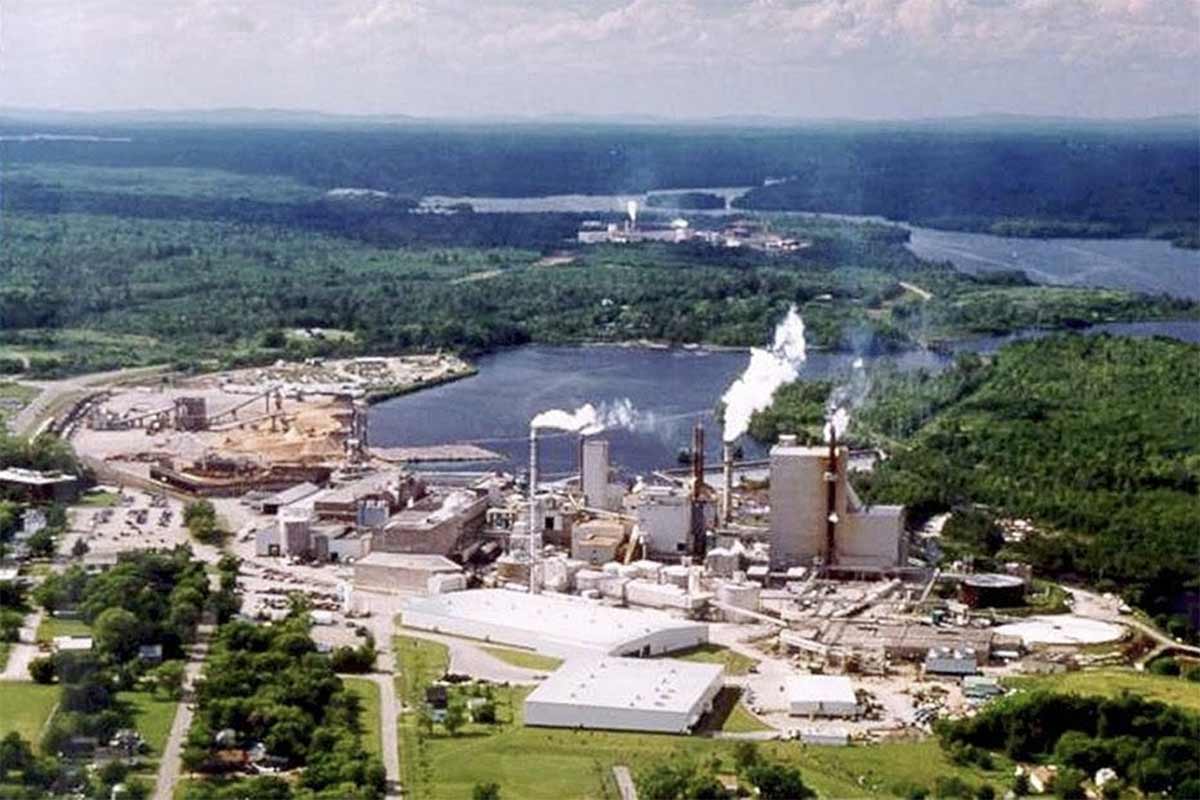
The CSB today released an update on its ongoing investigation into the fatal Jan. 27 hydrogen sulfide gas release at the Woodland Pulp mill in Baileyville, Maine.
The incident killed a 20-year-old co-op chemical engineering student and a 26-year-old chemical engineer who had only recently joined the company. Ten additional employees were also exposed to the highly-toxic gas.
“Although our investigation is still ongoing, it already is clear that this terrible tragedy should never have happened. The two young employees who died were not provided with personal hydrogen sulfide monitors that would have alerted them to the presence of the toxic gas, and there were no hydrogen sulfide detectors installed in the building where the release occurred. The company also did not keep track of who was in the building and where they were during this horrible event. As a result, the two young employees were not found until hours after the release ended, leaving them exposed to the highly toxic gas without assistance.”
— Steve Owens, CSB Chairperson
At the Woodland Pulp mill, wood chips are chemically processed into pulp for papermaking in an area of the facility called the “Bleach Plant,” which is located in a building at the facility called the “Kraft Mill.”
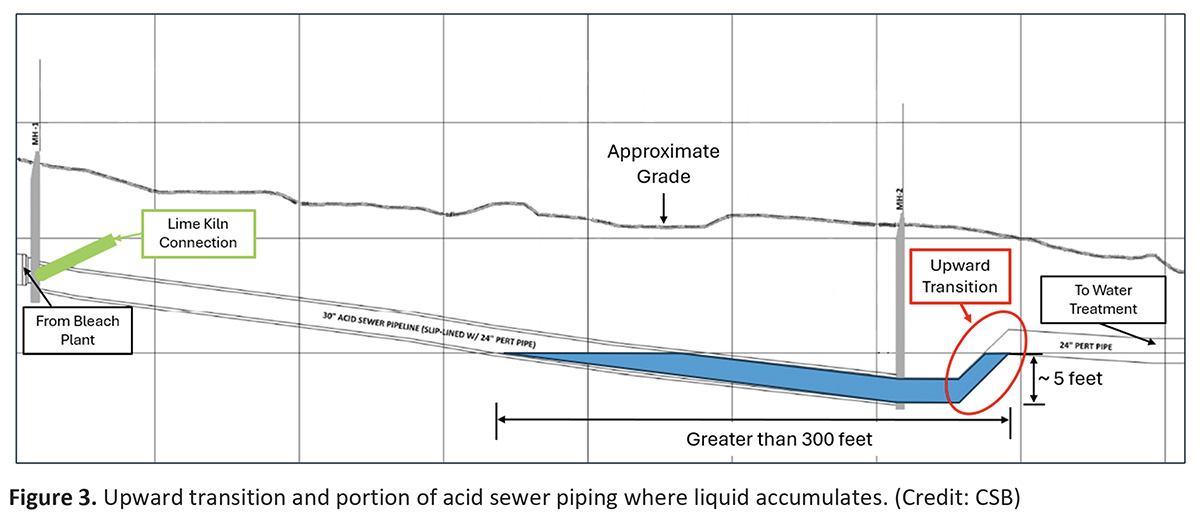
From the Bleach Plant, an acid sewer pipe over 1,000-feet-long collects liquid waste from multiple areas of the mill before flowing by gravity to the facility’s Wastewater Treatment Plant. A portion of the pipe, called an “upward transition,” flows upward, causing liquid to accumulate in the acid sewer at that point.
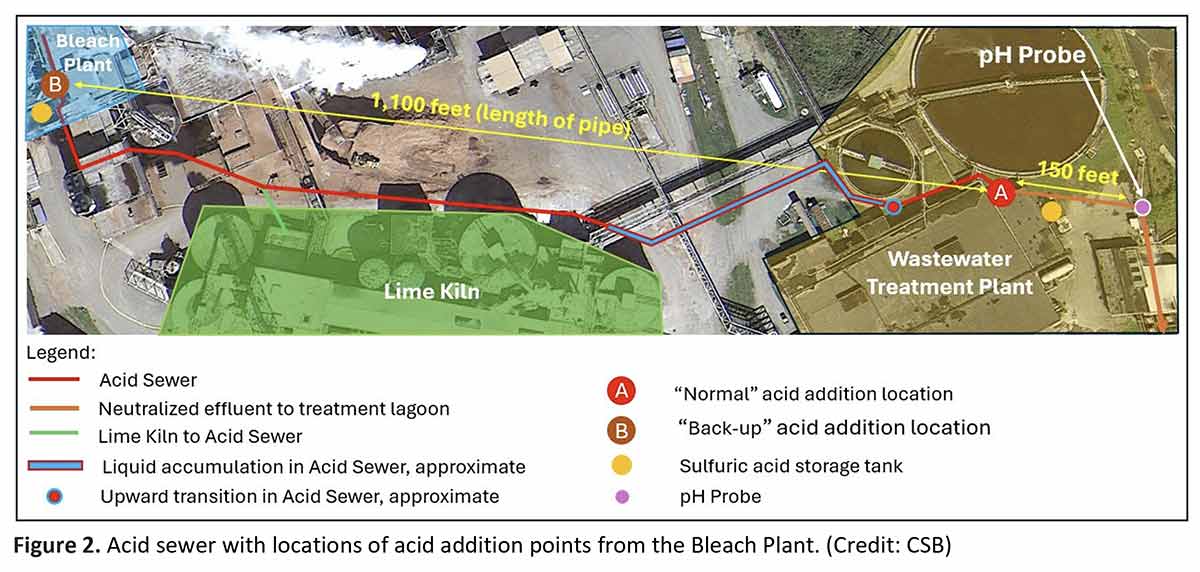
The discharges collected in the acid sewer pipe often contain alkaline, (also called “basic” or “high-pH”) process fluids that can contain sulfur compounds.
Woodland Pulp sometimes adds sulfuric acid to the acid sewer pipe to control the pH of the discharge. However, when sulfuric acid is combined with high-pH process fluids that also contain sulfur, the substances react to produce highly-toxic hydrogen sulfide gas. Typically, if a small amount of hydrogen sulfide gas is produced within the acid sewer pipe, the toxic gas is removed by a scrubber in the Bleach Plant before it can be released to the atmosphere.
On Jan. 26 - the day prior to the incident - managers at Woodland Pulp decided to shut down most of the mill due to a large increase in the price of natural gas, which caused significantly higher operating expenses.
Between about 12:30 and 2:30 a.m. on Jan. 27, operators began shutting down and draining equipment in the Bleach Plant. As a result, process fluids with a high pH and containing sulfur compounds flowed into the acid sewer pipe.
A pH probe at the Wastewater Treatment Plant detected a high pH and triggered an automatic increase in sulfuric acid to the acid sewer pipe beginning around 4:00 a.m.
During the shutdown, some process fluid was fed to the acid sewer, increasing the time it took for the liquid to flow past the upward transition and reach the pH meter, which was located a significant distance downstream.
As liquid accumulated in the pipe transition, the pH probe near the Wastewater Treatment Plant continued to detect a high pH and called for additional sulfuric acid, which reacted with the sulfur compounds in the acid sewer piping and generated toxic hydrogen sulfide gas.
At approximately 11:40 a.m., the scrubber fan in the Bleach Plant was turned off as part of the shutdown operations. As a result, the toxic hydrogen sulfide gas that was formed inside the acid sewer was not removed from the piping in the Bleach Plant.
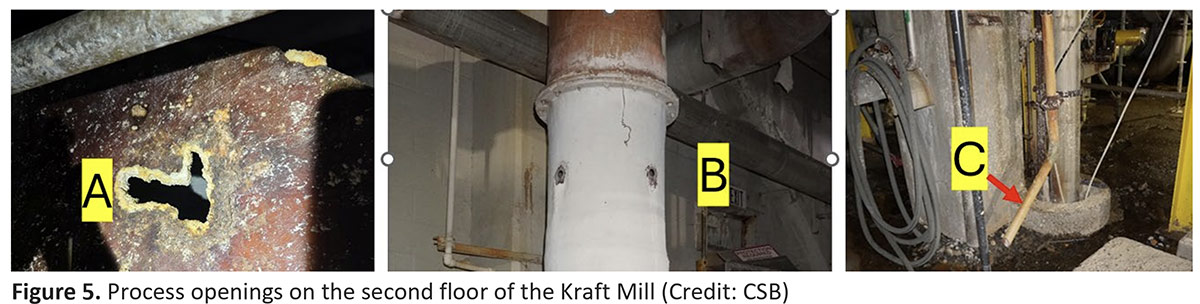
Instead, the hydrogen sulfide gas flowed through piping connected to the scrubber into two process vessels located elsewhere in the building. From those process vessels, the toxic gas was able to flow and escape through various holes and process openings in equipment within the Kraft Mill.
The two fatally-injured employees were located on the second floor of the Kraft Mill, likely working on an equipment drawing project unrelated to the shutdown. The equipment involved in their project was located near multiple release points for the escaped hydrogen sulfide gas. Both employees collapsed to the floor.
Ten other employees in the Kraft Mill also were exposed to the gas, some experienced symptoms such as burning eyes, burning throat, and headache.
When Woodland Pulp employees discovered the high hydrogen sulfide gas levels in the building, they began an emergency response - closing the manual emergency shut-off valve at the sulfuric acid supply tank and opening a manual water flush valve to the acid sewer pipe, which flushed the accumulated chemicals past the upward transition.
The remaining toxic hydrogen sulfide gas in the building dissipated by 3:00 p.m., roughly three hours after the Bleach Plant’s scrubber fan had been turned off and the release began.
At approximately 6:15 p.m., more than three hours after the remaining toxic hydrogen sulfide gas had dissipated from the building, the two collapsed employees were found on the second floor. The co-op chemical engineering student died the next day, on Jan. 28. The chemical engineer passed away on Feb. 16 after he was taken off life support.
The CSB’s investigation update notes that at Woodland Pulp:
“Our investigation update notes that Woodland Pulp was aware of the hazards associated with hydrogen sulfide gas forming in the acid sewer piping, but despite this knowledge, the company did not have adequate systems in place to monitor or mitigate the hazards. This safety gap likely led to the severity of this tragic incident.”
— Sylvia Johnson, CSB Board Member
The CSB’s investigation is ongoing as investigators continue to gather facts and analyze several key areas related to the incident, including:
Complete findings, analyses, and recommendations, if appropriate, will be detailed in CSB’s final investigation report.


The U.S. Chemical Safety Board (CSB) is an independent, nonregulatory federal agency that investigates the root causes of major chemical incidents. The Board does not issue citations or fines, but makes safety recommendations to companies,…
Join our Safety Briefing newsletter and get safety news across logistics, warehousing, manufacturing, construction, and other high-risk environments. Get the latest regulatory updates, alerts, safety products, equipment and training, and analysis.
Don't miss a single news story, product review or safety resource. Subscribe to our newsletter for the latest safety news, updates, and exclusive offers.