Work Safety 24/7

Dedicated to helping businesses and individuals prioritize safety, health, and compliance in the workplace. From small startups to large corporations, safety is essential, and we're here to make it easier.

Study predicts industries where automation could reduce injuries

Lamber Goodnow forecast workplace injuries will decrease by 5.9%, 161,000 by 2030

Study predicts industries where automation could reduce injuries
Source: Lamber Goodnow
A new report from Lamber Goodnow forecast workplace injuries will decrease by 5.9%, or 161,000 annually, by 2030 as a result of 20-40% automation and AI adoption, depending on industry.
By Work Safety 24/7 Staff 
November 21, 2025

A new report from Lamber Goodnow examined industries that could see the most significant reductions in workplace injury rates from increased automation.

The injury law firm examined U.S. Bureau of Labor Statistics (BLS) workplace injury averages for 2020-2024 and 2030 sector-level automation forecast data from the World Economic Forum (WEF).

Industry-specific automation predictions were drawn from multiple sources including DHL, McKinsey, and EIT Health.

Healthcare, manufacturing, retail could see biggest improvements

By 2030, WEF predicts 30% of tasks will have been automated, with some sectors seeing automation and AI usage as high as 40%, while every industry is forecast to become at least 20% more automated than it is today.

Lamber Goodnow forecast workplace injuries will decrease by 5.9% by 2030, preventing approximately 161,000 injuries annually within five years.

  1. Prediction models suggested automation and AI use in private healthcare will lead to the most significant drop in injury numbers of any sector, with the injury incidence rate expected to fall by 6.3%, preventing nearly 30,000 injuries annually.
  2. Manufacturing is predicted to have the second-largest drop in injuries of 18,143 or 5.5%.
  3. Retail trade is predicted to have the third-largest drop in injuries of 16,405 or 4.9%.

Nationally, figures suggest workplace injuries will fall from 2.43 per 100 workers to 2.29 per 100 by 2030.

State-run & residential healthcare, final-mile delivery could maintain high injury rates

Per 100 workers, state-run nursing and residential care currently has the second-highest workplace injury rate (8.9 per 100 workers), behind only spectator sports (including professional athletes), where more than 40% are injured at least once per year.
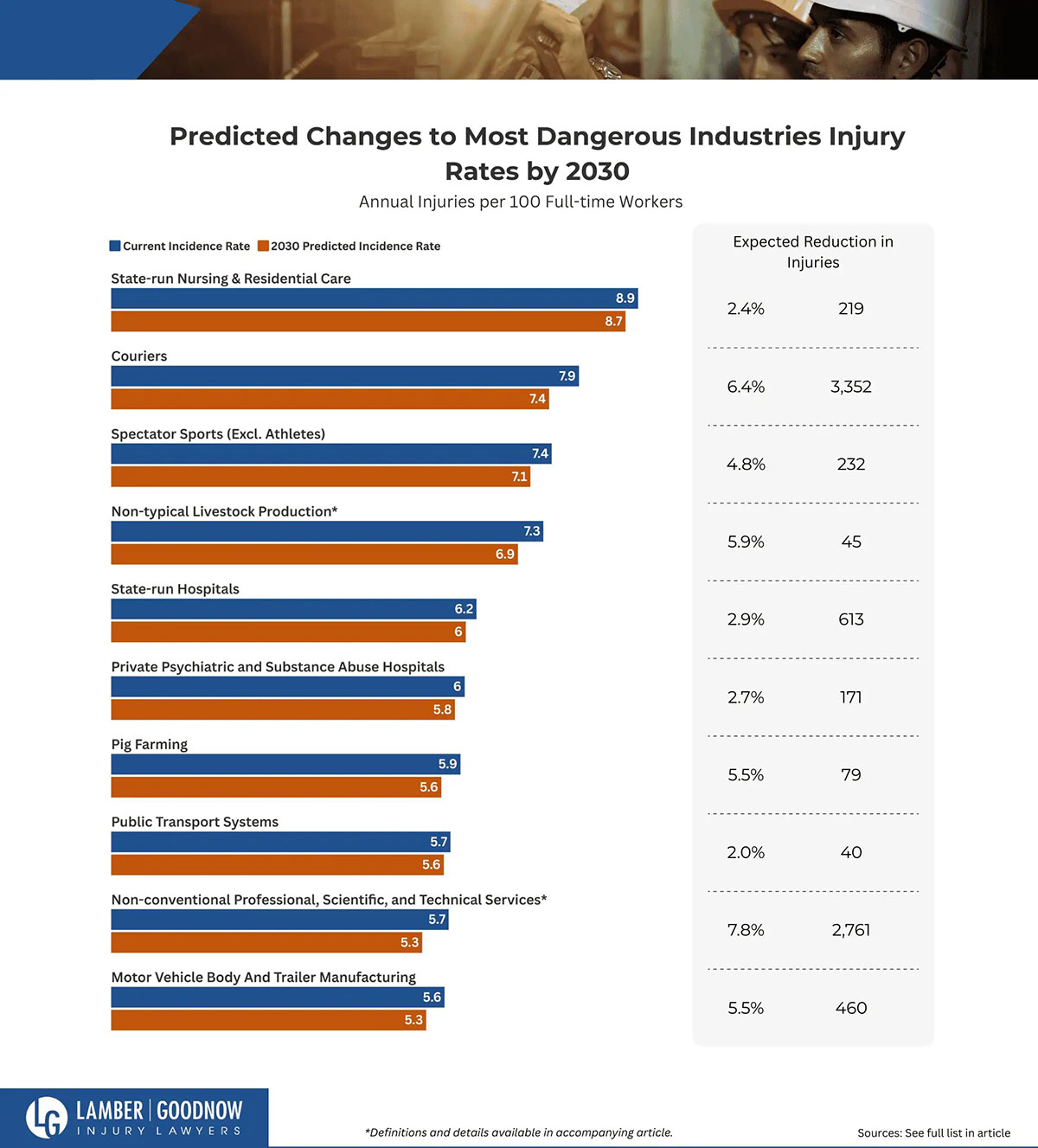
Industries with high automation potential, including couriers and scientific professional services, are expected to see significant reductions in injuries. Source: Lamber Goodnow

While automation and AI are predicted to take on 32% of tasks within state-run nursing and residential care by 2030, prediction models suggest injury rates will fall to just 8.7 per 100, keeping incident rates close to four times higher than the predicted national average.

Couriers are predicted to maintain the second-highest injury rate per 100 workers, falling from 7.9 to 7.4. This represents a 6.4% decline and 3,352 incidents annually by 2030, but is still close to three times the national average rate.

Of the ten industries expected to retain the highest injury rates per 100 workers, scientific professional services ranks seventh but sees the steepest drop in annual injuries after the forecasted adoption of automation. By 2030, injury rates are expected to fall 7.8%, from 5.7 to 5.3 per 100 workers, reducing incidents per year by 2,761.

Hospitals, schools, restaurants, stores could continue high injury counts

Lamber Goodnow predicted the top five industries forecast to have the highest numbers of injuries even after automation.
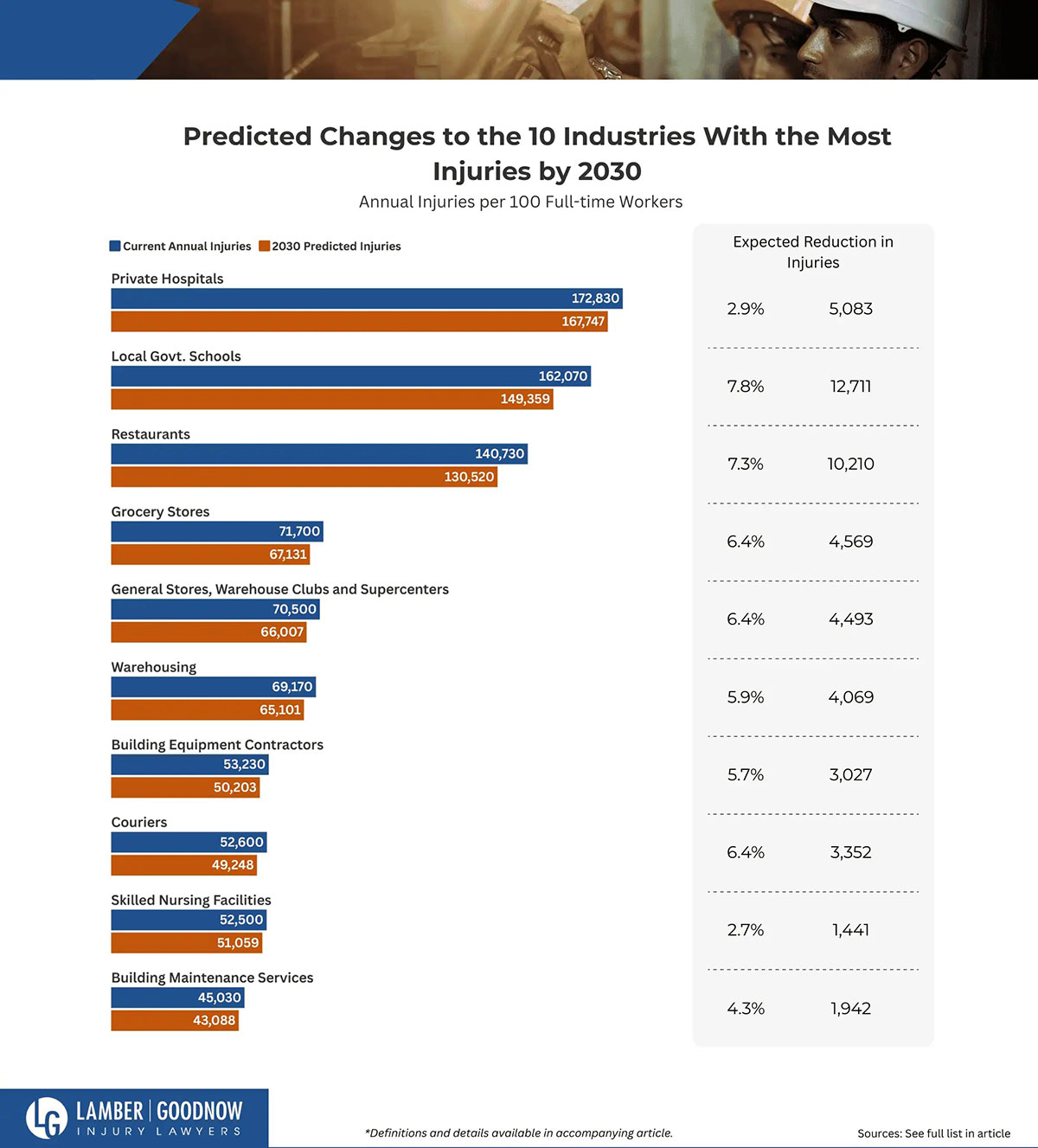
Schools and restaurants are predicted to automate far more than other industries on this list, and each is expected to see 10,000 fewer injuries annually by 2030. Source: Lamber Goodnow
  1. Private hospitals - the single largest source of workplace injuries - are predicted to see a reduction of injuries from 172,830 per year to 167,747 by 2030, a decrease of 5,083 or 2.9%.
  2. Schools are predicted to have the second-highest numbers of injuries, but are forecast to see workplace injuries decline from 162,700 to 149,359 by 2030, an annual decrease of 12,711 or 7.8%.
  3. Restaurants are predicted to have the third-highest number of injuries, but as an industry will see incidents fall from 140,730 to 130,520 by 2030, a decrease of by 10,210 or 7.3%
  4. Grocery stores are predicted to have the fourth-highest number of injuries, but forecast to fall from 71,700 to 67,131, an annual decrease of 4,569 or 6.4%.
  5. General stores are predicted to have the fifth-highest number of injuries, but as an industry will see incidents fall from 70,500 to 66,007, a decline of 4,493 or 6.4%.
 

More about Lamber Goodnow

Related Topics

Software & Technology   Artificial Intelligence   Automation   News   Press Release   BLS   DHL   Hospitals   Injuries   Lamber Goodnow   Last Mile Delivery   Research and Markets   Restaurant   All topics
 

Subscribe

Subscribe to our FREE magazine, FREE email newsletters or both!

Join our Safety Matters newsletter and get safety news across logistics, warehousing, manufacturing, con­struc­tion, and other high-risk environments. Get the latest regulatory updates, alerts, safety products, equipment and training, and analysis.
Subscribe today


Editors’ Picks

U.S. Appeals Court denies claim against OSHA citation of affiliated entity
The U.S. Court of Appeals denied UHS of Delaware’s petition against the OSHRC because it shared a common worksite and integrated safety operations under the same…
NHTSA recalls over 5,000 new USPS trucks for missing brake pin
After a USPS Next Generation Delivery Vehicle lost brake function, NHTSA and Oshkosh recalled all NGDVs produced because the brake pedal mounting pin and retaining…
MSHA issues alerts for ammonia & autotransformers
The Mine Safety and Health Administration encourages operators to examine all equipment with autotransformers currently in service and review safe handling of and…
Dangerous wildfires, sub-zero windchill, and winter weather across U.S. and…
The U.S. National Weather Service (NWS) and Environment Canada have issued warnings for high winds, wildfires, dust storms, heavy snowfall, freezing rain, and…