Dedicated to helping businesses and individuals prioritize safety, health, and compliance in the workplace. From small startups to large corporations, safety is essential, and we're here to make it easier.


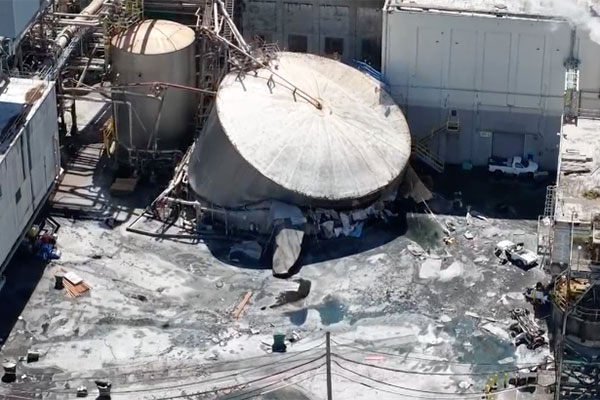
The chemical storage tank that failed last month at a Washington paper mill, killing 11 workers, was not subject to routine state or federal inspections, according to safety experts and early reporting on the incident.
The tank ruptured on May 26 at the Nippon Dynawave Packaging mill in Longview, Washington, during a shift change when workers were gathered near the area. The collapse released more than 500,000 gallons of white liquor, a highly corrosive chemical mixture used in paper manufacturing.
Seven other workers were injured in the incident, including employees who suffered burns and inhalation injuries. One firefighter was also hurt responding to the scene.
The explosion and tank failure is now considered the deadliest industrial accident in modern Washington state history.
According to experts interviewed by regional media outlets, the above-ground tank did not fall under mandatory recurring inspection requirements from state or federal agencies.
"Because this is above ground, because this is white liquor, it really falls in a more regulatory gray space," said Dr. Marissa Baker, an associate professor of occupational health sciences at the University of Washington and director of UW's Northwest Center for Occupational Health and Safety, told KING5 in Washington. "They don't have those kind of increased process safety management regulations. They don't have a Department of Ecology. The local fire department in the county would know what chemicals are being used on site, but no one is really going to come on, knock on their door and say, 'Let me look at your tank.'"
Baker said underground storage tanks and tanks used in oil and gas industries are subject to stricter oversight and inspections. But tanks like the one involved in the Longview disaster generally rely on company-run maintenance and inspection programs.
That meant responsibility for inspecting and maintaining the tank rested with the company itself.
White liquor is commonly used in pulp and paper manufacturing to break down wood chips during pulping. The chemical mixture contains sodium hydroxide, sodium sulfide, and sodium carbonate.
Investigators have not yet determined what caused the tank to fail.
“When you see some big kind of industrial incident or catastrophe like this, you really have to think that it's going to be a systems-level kind of failure. It's not necessarily one individual person or thing that went wrong. It's going to be due to kind of many different factors. So it could be that the facility was not well maintained,” Baker said.
State and federal investigators continue examining the scene. Cleanup efforts are also ongoing after the chemical release flooded parts of the facility and nearby drainage systems.

Join our Safety Briefing newsletter and get safety news across logistics, warehousing, manufacturing, construction, and other high-risk environments. Get the latest regulatory updates, alerts, safety products, equipment and training, and analysis.
Don't miss a single news story, product review or safety resource. Subscribe to our newsletter for the latest safety news, updates, and exclusive offers.