Dedicated to helping businesses and individuals prioritize safety, health, and compliance in the workplace. From small startups to large corporations, safety is essential, and we're here to make it easier.


Everybody loves to ship hazard class chemicals, right?
You know, regulated liquids and solids that are DOT Class 3, 4, 5, 6, 8 and 9. Also known as toluene, methanol, isopropanol and the like.
Ok, maybe not “love.” But for many, this is part of everyday business. Beyond shipment carriers, the list here includes chemical manufacturing, petroleum products, drug manufacturers and agriculture products producers.
For the longest time, FedEx, UPS and others have shipped hazmat chemicals in “paint cans.” At least that’s what they look like and are called for that matter. You know, the 1-gallon cans that are DOT certified and hold a maximum of 1 quart of contents. The DOT certification is a Special Permit to ensure safety during shipment.
Well, there’s a new DOT-certified container that’s a definite update on shipping. That includes eliminating the need to hammer the can’s lid in place.
It’s called Capsuloc, explains John Glaser, director of packaging strategy at DGeo, the Packaging Division at Labelmaster.
“Capsuloc is a reusable, plastic shipping container that provides a less expensive, lighter, safer and more sustainable hazmat secondary containment solution,” Glaser explains.
The capsule carries the necessary DOT Special Permit and is also accepted as exemption for both FedEx and UPS shipment. It was also recently awarded the IoPP 2024 AmeriStar award in the Industrial and Commercial category.
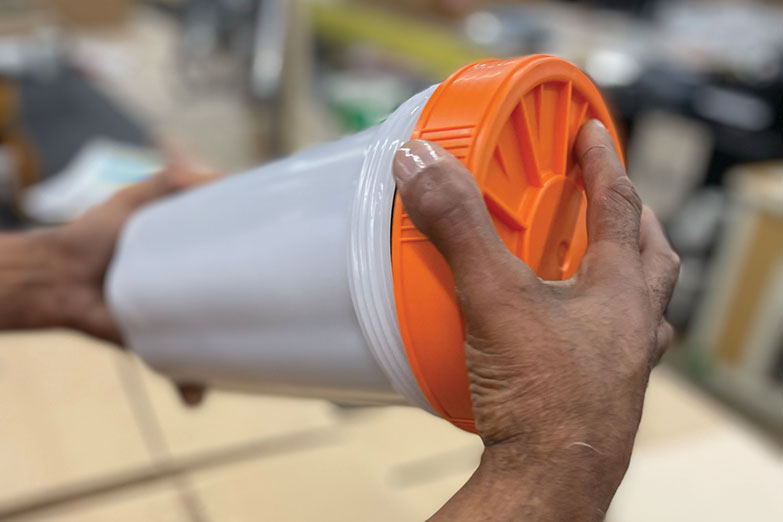
As the photo shows (above), Capsuloc couldn’t be much different from a paint can. The body of the 10.5-inch tall high density polyethylene (HDPE) capsule is 5.5 inches wide. A screw-on cap is made of polypropylene (PP).
To be more specific, the new container is 32% lighter than the cans. Its manufacture produces 7.4 kg less of carbon dioxide. Furthermore, the capsules smaller size allows twice as many to be loaded on a standard pallet than the paint cans.
The new package design is not all that’s new here.
Just a couple of years ago, Glaser was at a chemicals manufacturer that relied heavily on the cans to ship chemicals. Today, he’s a champion of Capsuloc.
When Glaser arrived at DGeo, development of the new package was well underway. Six months of design testing was completed. And DGeo had just received the DOT Special Permit, allowing it to enter the marketplace.
That was the middle of last year and it was DGeo time. Since then, Capsuloc has been adopted at more than 20 companies.
Here’s what some customers have to say about it.
“These are so easy to use.”— A global chemicals distributor.
“It’s probably one of the best hazmat containers I’ve seen out there. It’s a very secure package.”— Global life science research company.
“What’s not to like about Capsuloc? It’s easier, less expensive, and I don’t need to worry about dented paint cans anymore.” — Provider of United Nations packaging for the waste industry.
“My team will have a hard time destroying these, which is great.”— Shipping manager at a major refinery.
All in all, not a bad start for some out-of-the-can thinking.


Gary Forger is an editor at large for Modern Materials Handling. He is the former editorial director of Modern Materials Handling and senior vice president of MHI. He was also the editor of the Material Handling & Logistics U.S. Roadmap to 2030.
Join our Safety Briefing newsletter and get safety news across logistics, warehousing, manufacturing, construction, and other high-risk environments. Get the latest regulatory updates, alerts, safety products, equipment and training, and analysis.
Don't miss a single news story, product review or safety resource. Subscribe to our newsletter for the latest safety news, updates, and exclusive offers.