Dedicated to helping businesses and individuals prioritize safety, health, and compliance in the workplace. From small startups to large corporations, safety is essential, and we're here to make it easier.



Drone-powered inventory monitoring is one new approach.

While it’s rare to think of drones flying autonomously inside distribution centers, it might be time to rethink. Sankalp Arora tells the story of an operations manager at a million-square-foot DC who did just that and found $1 million worth of misplaced inventory in short order.
Arora is the CEO and co-founder of Gather AI, a drone-powered inventory monitoring startup. And not only did a small fleet of drones find that inventory, it found much more than the company thought it had misplaced.
“Three drones can photograph 900 pallet locations an hour and upload that inventory data to a Web dashboard,” explains Arora. He says that’s roughly 15 times faster than manual bar code scanning of inventory during a cycle count. “It’s not uncommon for the drones to reduce the time needed to take inventory from three months to 2.5 days,” he adds.
“This is robotics-as-a-service. The end user is paying for data not drones. Gather AI owns the drones and programs them to fly autonomously in the DC. The data they collect is what the end user receives to update inventory databases,” Arora explains.
While the photos can be viewed by staff, artificial intelligence and machine learning are central to determining what’s in the right place and what’s not. By the way, the drones used are off-the-shelf from a store such as Best Buy.
He says the company grew eight-fold last year and is now in nearly 20 warehouses. And the business continues to build rapidly with as many drone flights in Q1 of this year as in all of 2022.
“In the end, it’s all about accountability and greater transparency. And that allows inventory monitoring to take on newfound importance,” says Arora.

One alternative can trim cardboard costs 30%.

“Cardboard is king for a reason. It’s simple to use, durable and priced right. And so shipping logistics is built around cardboard,” says Mike Newman, CEO of Returnity.
That said, it doesn’t mean cardboard is the brighter lightbulb all the time. And so, Newman launched what he calls The Last Box.
This plastic fabric box is a reusable container that can reduce packaging expenses as much as 30%. In addition, it saves up to 30 seconds in unpacking products. And in a 25 roundtrip use cycle, it can save up to 50 cardboard boxes and 300 feet of packaging tape.
But even Newman says The Last Box is the right alternative only in certain packaging loops. He describes them typically as within a facility or between company facilities, or for retailers such as Vuori and Happy Returns by PayPal, which have a standard shipping/delivery path between the retailer and consumer.
As you would expect, Newman touts the reuse and recyclability of Returnity. But even he says, “sustainability is great, but you’ve got to lead with your CFO hat on to justify this approach to supply chain packaging. Last Box has to make business sense or cardboard is the better way to go.”
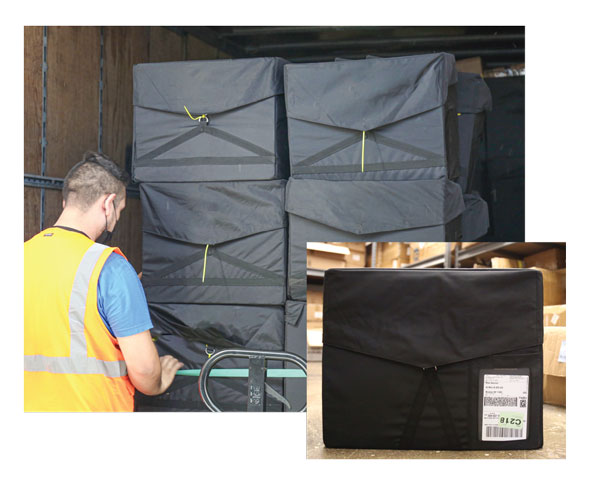
In less than two years, Returnity has lined up 10 retailers including New Balance with another 10 in pilots right now.
“This year is our pivot year. For the first time, we now have retailers and others coming to us to see how the concept might work for them,” says Newman.
With a 3D printing platform, time and inventory waste drops dramatically.

There’s no understating the importance of the footwear you select for an upcoming conference or trade show. You know the drill. However, Elias Stahl has a different drill than you do. Guaranteed.
Stahl is the CEO and co-founder of HILOS, an on-demand, 3D printing platform for footwear. And for the recent footwear conference he spoke at, Stahl designed his shoes on Friday and wore them on stage Tuesday. Better yet, his feet didn’t hurt that night.
“What we do is digital product creation and fulfillment without the traditional supply chain,” explains Stahl. There is no delay of 18 to 24 months from design release to manufacturing and delivery to stores or directly to consumers. He says a typical cycle is 90 days. Or over the weekend when he needs a pair for himself.

“With this platform, we can move from a design to a concept in minutes, from the concept to the product in hours and from product to market in weeks. It’s a digitally native product and entirely recasts the time and inventory profiles of global supply chains,” says Stahl.
The HILOS platform is responsible for everything from the digital design to subcontracting production and onto demand fulfillment. And while HILOS is focused on footwear with some help from former Nike executives, what the company does can be applied to many other products.
Stahl adds that it took two years to build out the platform and HILOS has been in product launch mode for the past 18 months. Along the way, HILOS won the SXSW award for most innovative world technology and best in show.
The company also teamed up with Yale’s Center for Business along with BASF Forward AM, HP and AMT to produce an environmental assessment of 3D printed footwear. It found that the HILOS platform cuts carbon emissions 48% and water usage by 99%.
Or to paraphrase the old song, these boots were made for walking right on over old supply chains.
A patented, modular design optimizes packaging for every product.

When it comes to totes and containers, right-sizing is a positive not a negative.
Just ask Elliott Eckert, vice president at modular reusable tote supplier Evolve Packaging. He’s quick to point out the value of optimizing packaging for specific parts both inside the four walls and for transport of inventory between facilities.
Right-sizing the container can increase pack density as much as 25%, reducing handling and storage space as well as space on over-the-road trailers.
Both maximize cubic efficiency. Inside the four walls, the containers reduce the storage footprint. The latter lowers freight costs and gets more inventory on every trailer, reducing the number of trailers needed and the related environmental impact.
Evolve’s solution revolves around a patented bin design with plastic corrugated walls cut to the precise height for the product stored in it. Properly sized extruded corner posts and injection molded tops and bottoms maximize protection of the bin’s contents.
The Evolve tote is not a commodity, points out Eckert, and is always sized to the parts it will carry and protect. “That’s the value of the patent to end users,” he adds.
“In addition, we believe the proper packaging for a product should be discussed early in product development. Every part deserves optimized packaging,” says Eckert.
Since its launch in 2020, Evolve has been involved in consulting, designing and supplying reusable packaging early in the product development process. For instance, Eckert cites a robotics company looking for a precision tote for a specific product that its robots will place parts into as part of an assembly process. The patented design maximizes flexibility to size the tote in all dimensions for those parts handled by the robot.
It’s not often that a modular tote comes with a patent, so this might be a value proposition worth considering.
Video and artificial intelligence team up to protect people.

Reduce workplace risk and injury.
There’s hardly a company that doesn’t say that simple objective is top of mind. But is it, really?
Josh Butler, CEO and founder of CompScience, says the words don’t always line up with actions out on the floor. And unfortunately, opportunities for safety risk range from ergonomics (No. 1 source) to slips, trips and falls as well as struck-by and caught-in incidents.
For instance, the average recordable injury rate at a delivery company was so high it led to a cancellation of its insurance policy. But how did that happen?
Enter CompScience’s safety platform. By recording video of worker activities and analyzing it with artificial intelligence, the platform detected an average of 20 risky ergonomic moves an hour per worker. In addition, the platform identified more than 3,200 risky forklift events over two weeks.
Changes included new traffic patterns and lift truck speed policies as well as the addition of powered dock doors. The company’s average recordable injury rate dropped 23% over six months. And the company not only got its insurance back, but saved $300,000 in premiums by demonstrating its safety improvements.
“People do unsafe things because of the environment they work in. And even those companies that collect safety data often do nothing with it except delete it after 30 days,” says Butler.
Following his father-in-law’s debilitating construction accident four years ago, Butler set out to “use AI for the betterment of humanity.” His background in the autonomous vehicle field helped a lot.
He then spent two years building out the platform. While the video is recorded at the facility, all AI-powered analysis and recommendations are made by the company’s Intelligent Safety Platform in the Cloud. The subscribing company then receives a report and is in a position to make safety improvements.
Last year, the platform resulted in a 66% reduction in workplace hazards. “The platform doesn’t track individuals, but it does identify systemic risks and allows companies to engineer those risks out of their processes,” says Butler. That’s how you reduce workplace risk and injury.


Gary Forger is an editor at large for Modern Materials Handling. He is the former editorial director of Modern Materials Handling and senior vice president of MHI. He was also the editor of the Material Handling & Logistics U.S. Roadmap to 2030.
Join our Safety Briefing newsletter and get safety news across logistics, warehousing, manufacturing, construction, and other high-risk environments. Get the latest regulatory updates, alerts, safety products, equipment and training, and analysis.
Don't miss a single news story, product review or safety resource. Subscribe to our newsletter for the latest safety news, updates, and exclusive offers.