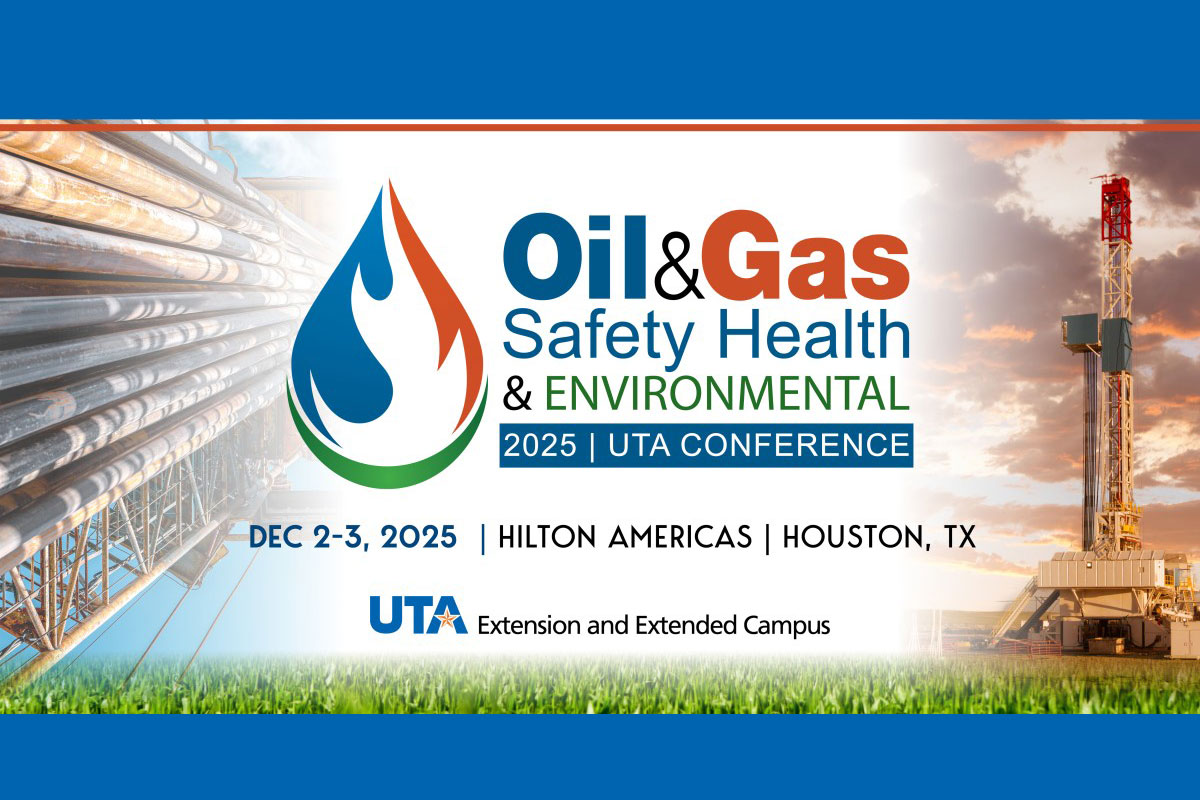
The University of Texas at Arlington (UTA) will host its 2025 Oil & Gas Conference Dec. 2-3 at the Hilton Americas in Houston, Texas from 8 a.m. to 5 p.m..
The purpose of the conference is to educate attendees on two regulated segments - safety & health, and environmental - within the oil and gas industry.
The conference is a collaboration among UTA, OSHA, EPA, and industry professionals including the Texas Oil & Gas Association (TXOGA), American Petroleum Institute (API), and Onshore Safety Alliance (OSA).
CEU and registration information
Attendees can earn up to 1.3 Continuing Education Units (CEUs) and/or 13 contact hours issued by the UTA Extension and Extended Campus - Region VI OSHA Education Center. CEUs for the pre and post-conference sessions are issued separately from the general session.
Registration is $645, or $395 for government employees with ID.
Those with questions or who require help registering should call the UTA Extension and Extended Campus at 817-272-2581, or email [email protected].
Sessions include safety, health, and environmental tracks
NASA Astronaut, U.S. Navy SEAL, CEO and President of the National Medal of Honor Museum Chris Cassidy will present the keynote address. Cassidy’s talks explore the habits of effective leaders and how they can motivate their teams to overcome the obstacles in front of them, foster a high-performing culture of trust, and thrive in clutch moments when everything is on the line.
UTA said the conference will bring together decision makers within management and executive positions to cultivate a better understanding of how industry and regulators can work together. Participants will be able to share ideas, experiences, products, and services.
The conference will provide a platform to exchange new ideas and concepts related to the oil and gas industry, all with the overarching goals of achieving better safety and environmental operations along with regulatory compliance.
Session topics include:
Pre-conference
Safety & Health
Behavior-Based Safety
- How complacency and distractions can cause accidents
- Risk Homeostasis: Why smart technology, proximity alert systems, and automation cause workers to take more risks
- Quantifying and measuring psychological safety
Drilling & Well Control/Well Servicing & Completions
- Workover rig equipment misuse potential and inspection controls
- Guidelines for collaboration in casing running to prevent SIFs
- API recommended practice 16WS cased hole well control training and certification
Engineering Controls & Process Safety, Events, & Mitigation
- Building a strong process safety culture
- Ultrasound gas leak detection
- Hazard identification and controls for combustion in natural draft heaters
- Computer vision and AI technologies to enhance existing safety efforts
- Case studies and immediate strategies to improve scaffolding safety
- Hazard analysis and emergency response preparation for hydrogen sulfide (H2S) storage tank leaks
- OSHA’s process safety management (PSM) standard and EPA’s risk management program
Organizational Effectiveness
- AI for daily operational risk management and compliance planning
- Management of organizational change programs
- Establishing a dependable, real-time safety reporting system
OSHA Regulatory/Industrial Hygiene
- Perspectives on the OSHA informal conference process
- OSHA accident investigations
- Real-world examples and strategies for creating and integrating effective checklist discipline
- OSHA presentation: Same Tank Cleaning Company, Three Workplace Fatalities in Five Years
- OSHA’s new 1910.156 Fire Brigade regulation and NFPA-related standards
- OSHA's Multi-Employer Citation policy and OSHRC's interpretation of that policy
- OSHA’s General Duty Clause
- An H2S Survival Story: If Only I Had Used Stop Work Authority
- OSHA Subpart D ladder safety
Target Topics/Other
- NIOSH’s Total Worker Health agenda and psychosocial risks
- Best practices in program implementation for mental health
- Strategies to reduce substance abuse risk through ongoing drug testing
- Under the Influence, Attitudes at Work
- Strategies for improving shift workers' physical and mental health
- Heat mitigation and body temperature control, even while wearing PPE
- Psychosocial risks that impact injury and recovery
Environmental
Air Permitting & Compliance
- EPA NSPS OOOOb methane regulation updates
- Oil and gas regulatory activities in Texas
- Five key permitting steps for oil and gas sites
- Proposed EPA Greenhouse Gas Reporting Program (GHGRP) Subpart W revisions
ESG
- Considerations that affect monetization of methane mitigation
- Process hazards associated with carbon capture and sequestration
Managing Waste
- Certifications and upcoming regulations for minimizing greenhouse gases
- State regulations on naturally occurring radioactive material (NORM) and technologically enhanced NORM (TENORM)
Water/Land
- Current regulations following the Waters of the US rule
- EPA Spill Prevention, Control, and Countermeasure (SPCC) and stormwater management compliance
Safety, Health, & Environmental
Education & Training
- Leadership safety coaching
- Lockout/tagout training through industry-academic collaboration
- GPT AI approach for safety, health, and environmental (SHE) training
- Soft leadership skills to influence best practice, risk reduction, and regulatory compliance
- Preparing emergency response teams beyond minimum requirements
- Gamification to improve engagement and information retention in classroom training
- Replacing “safe enough” attitudes with proactive safety culture
- Environmental regulations, including DOT shipping, RCRA training, and reporting obligations
- Advancing competency through accredited programs and safety alerts
- Incident command leadership
- Portable worker training courses
Management, Leadership, & HSE Management Systems
- Leveraging AI agents to navigate safety data
- Contractor safety management
- Examination of practical ways organizations have addressed a rise in SIFs
- IoT, ML, and AI trends impacting safety professionals
- Pipeline safety management systems (SMS)
- Real-world examples and strategies for the evolution of an SIF program
- Enhancing field team safety engagement and buy-in
- Predictive safety analytics to improve safety
- Relevant upstream KPI selection derived from API RP 754 and IOGP 456
Risk Management/Human Organizational Performance (HOP)
- Integrating human hair testing into HOP and risk strategies
- Near miss data and survivorship bias
- Scaling HOP across global operations to drive operational learning
- Reducing the risk of SIF in supply chains
- Digital decision-support tools to empower fatigue risk management
- Seven natural principles of human performance
- Case studies of HOP of success and learning
- Leadership coaching to embed HOP in the field
Stakeholder/Community Outreach and Engagement
- Texas Voluntary Marginal Conventional Well Plugging Program (TxMCW)
- Environmental regulatory outlook for the oil and gas industry
- Subcultures for safety excellence
Transportation & Vehicle Safety
- Graduated Driver's License (GDL)
- People of the State of Colorado v. Jesus Puebla Case Study
Post-conference
- TXRRC vs TCEQ turf for oil and gas waste management in Texas
- OSHA 7105 Evacuation and emergency planning