Dedicated to helping businesses and individuals prioritize safety, health, and compliance in the workplace. From small startups to large corporations, safety is essential, and we're here to make it easier.


Sponsored
The Poweramp TPR® truck positioned vehicle restraint is designed to automatically position itself and secure a trailer’s Rear Impact Guard (RIG) to reduce the likelihood of premature trailer separation during the loading/unloading process.
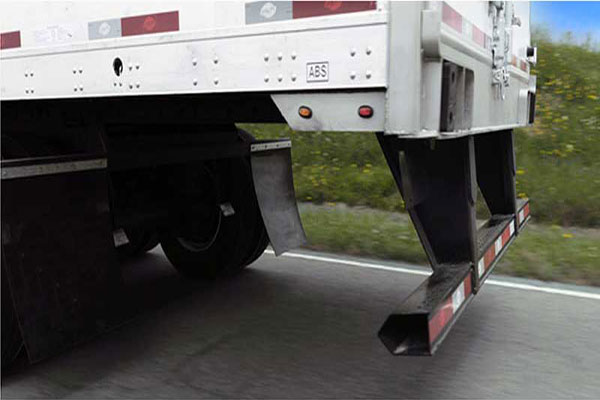
A truck trailer’s Rear Impact Guard (RIG), also known as an ICC bumper, helps prevent closely following passenger cars from riding under the rear of a semi-trailer if it must stop quickly from a high speed. Truck trailer manufacturers are continuously modifying designs of their trailers’ RIGs to improve safety based on impact testing, though engagements with loading docks should also be considered.
In North America these modifications are also due to changes in regulations from both the Canada Motor Vehicle Safety Standard (CMVSS) and Federal Motor Vehicle Safety Standards (FMVSS) in the US. Both require RIGs to maintain protection from a certain degree of impact. Furthermore, as of January 11, 2023 the National Highway Traffic Safety Administration (NHTSA) modified a requirement that any new trailers with a gross vehicle weight rating of at least 10,000 lbs to be equipped with a RIG bar that can withstand an impact of 35 mph from a passenger car, up from 30 mph.
In the past the most common design of a trailer’s RIG bar was a simple 4-sided square or rectangle shape. For reinforcement, some truck trailer manufacturers also added a vertical center plate to those RIGs.
However, for truck trailer manufacturers to comply with (or even exceed) new safety regulations, the industry started to see some RIG bars with a 5-sided pentagonal design that comes to a point in the front. Soon after, others appeared with a notched center section presumably lending itself to be more easily restrained at a loading dock. Since then, several other large truck trailer manufacturers have announced that they would also be adopting this new pentagonal RIG design, many of which also decided to increase the bar depth to as much as 7-8”.
The primary objectives of a RIG that exceeds safety standards should include:
While improving the safety of a truck trailer is of course an important matter, the industry must also consider the impact designs have on helping to prevent early trailer separation and the effectiveness of vehicle restraints at loading docks.
Hundreds of thousands vehicle restraints are installed at loading docks throughout North America. The purpose of these restraints is to secure a truck trailer to a dock position during loading/unloading. This engagement helps enhance safety by preventing the truck from prematurely departing, or from the trailer creeping forward and separating from the dock.
These vehicle restraints have historically been designed to engage a trailer’s traditional 4-sided square RIG bar that have been included on trailers for many years. However, with recent RIG design changes, such as the new 5-sided pentagonal design, the effectiveness of existing vehicle restraints at loading docks may be impacted. As an example, facilities might have older vehicle restraints that aren’t designed for the increased depth of a new RIG, or have a hook/arm that wasn’t designed to wrap around the point of a new RIG.
Manufacturers of loading dock equipment, such as Poweramp, constantly evaluate the designs of their vehicle restraints and make modifications in response to customer needs to ensure the restraints are as effective as possible.
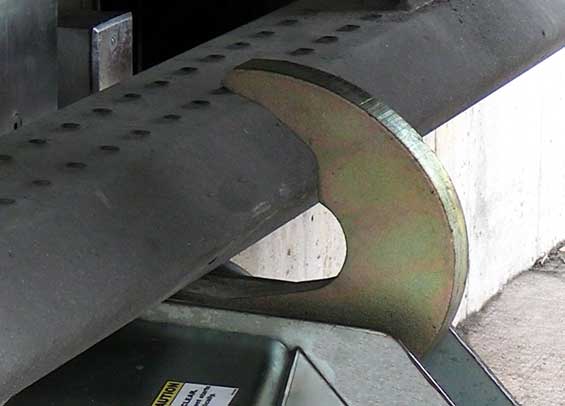
An example is a trailer-positioned restraint, common in the industry. This has been for years, and continues to be, an effective and reliable truck restraint. However, in response to new RIG designs, Poweramp and other manufacturers modified the hook profile of this style restraint to be even more effective when securing the new pentagonal RIG design on some trailers. Similar modifications have been made to other types of restraints as well, most of which can be retrofitted if needed.
Facilities should continuously evaluate the type of truck trailers they’re servicing at their loading docks and the compatibility of their current restraints. If the facility is beginning to see trailers with the new RIG design, they should consider either retrofitting or replacing their existing restraints with a more recent hook/arm modification that is designed to improve the engagement on many new RIGs.
For those companies with a captive fleet, or contracts with trailer manufacturers, be sure to consider the design of the trailers’ RIGs and the impact it will have on any existing or future vehicle restraints that may be used. Safety should always be evaluated for both the trailer, as well as the loading dock.
Poweramp has been a leading manufacturer of loading dock equipment and vehicle restraints for many years. For facilities that want a more universally effective restraint, the UniLock® Vehicle Restraint has a locking mechanism to prevent the hook from being forced down. These restraints also have a unique patented cam design that can help prevent RIG wedge and perform as a more reliable restraint.
For more information, visit Poweramp.com.
The Poweramp TPR® truck positioned vehicle restraint is designed to automatically position itself and secure a trailer’s Rear Impact Guard (RIG) to reduce the likelihood of premature trailer separation during the loading/unloading process.

Join our Safety Briefing newsletter and get safety news across logistics, warehousing, manufacturing, construction, and other high-risk environments. Get the latest regulatory updates, alerts, safety products, equipment and training, and analysis.
Don't miss a single news story, product review or safety resource. Subscribe to our newsletter for the latest safety news, updates, and exclusive offers.