Work Safety 24/7

Dedicated to helping businesses and individuals prioritize safety, health, and compliance in the workplace. From small startups to large corporations, safety is essential, and we're here to make it easier.

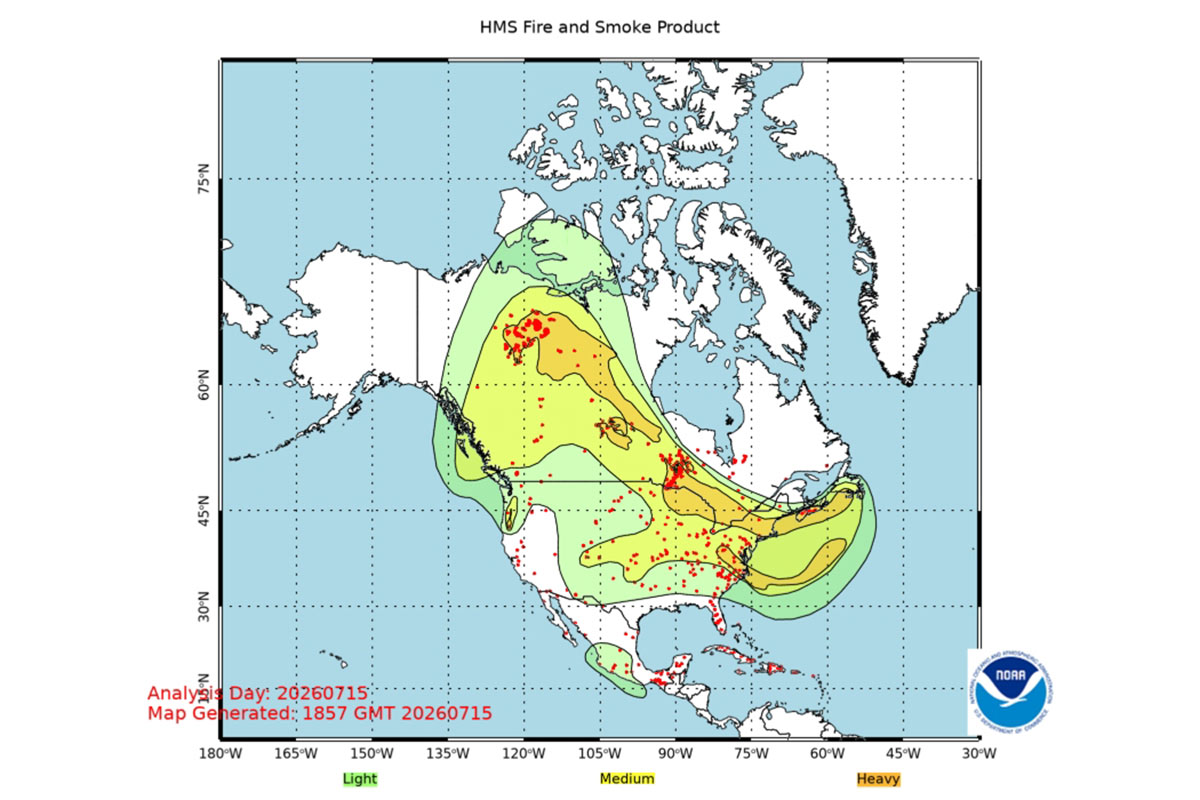
Wildfires generating smoke across Canada & northern U.S.

Reduce or eliminate outdoor work, be prepared for dense smoke

Wildfires generating smoke across Canada & northern U.S.
Source: U.S. National Oceanic and Atmospheric Administration
The National Weather Service and Environment Canada advise reducing or eliminating outdoor work and wearing respirators to filter out fine particles as dense smoke drifts eastward.
By Donald Halsing 
July 15, 2026

The U.S. National Weather Service (NWS) and Environment Canada have issued watches, warnings, and advisories for wildfires and resulting smoke across Canada and the northern U.S.

These bulletins include air quality alerts, dense smoke advisories, fire weather watches, and red flag warnings.

Dense smoke from multiple fires combining

According to U.S. National Oceanic and Atmospheric Administration (NOAA) satellite imagery observations issued July 9 and 10:

  • Fires burning in the Northwest Territories and Ontario are generating moderate-density smoke plumes moving southeast.
  • Fires burning in Colorado and Utah are generating light to moderate-density smoke plumes moving east.
  • Both smoke plumes merged and dispersed across the eastern U.S. and Canada.
  • Moderate to light smoke extends across much of the contiguous U.S. and Canada.

Actions to address wildfire smoke exposure

National, provincial, and state public health agencies have issued air quality and dense smoke alerts with recommendations to address wildfire smoke exposure.

If you are able, postpone outdoor work until air quality improves.

  1. When indoors, keep windows and doors closed as much as possible.
  2. When there is an extreme heat event occurring with poor air quality, prioritize keeping cool.
  3. Protect your indoor air from wildfire smoke. Actions can include using the highest-quality air filter that your ventilation system can handle and/or a certified portable air cleaner that can filter fine particles.

If you must work outside:

  1. Limit time outside, and limit strenuous outdoor physical activities as much as possible.
  2. Take breaks to spend time indoors in a space with cleaner air.
  3. A well-constructed, well-fitting and properly worn respirator-type mask (such as a NIOSH-certified N95 or equivalent respirator) can reduce your exposure to the fine particles in the smoke.

Reduce or eliminate activities that contribute to air pollution, such as outdoor burning.

Mariners across the Great Lakes should proceed with caution, ensure all running lights are on, use proper fog signals, and use navigational aids including radar can compass.

See active alerts in your area

Visit the National Weather Service website to see active alerts: https://www.weather.gov/

Visit the Environment Canada website to see active alerts: https://weather.gc.ca/index_e.html

USA Today provides a map to track current and past wildfires across the U.S. and Canada.


More about National Weather Service

About Donald Halsing

Donald Halsing

Donald Halsing is the Founding Editorial Director of Work Safety 24/7. He was formerly the Associate Editor of Robotics 24/7.

Don's experience spans the supply chain, logistics, and construction industries, having worked in both warehouse operations and land surveying. He is also a professional wedding photographer with his fiancée Ashley.
Follow Work Safety 24/7
on Facebook
on Linkedin

Related Topics

PPE   Respiratory Protection   News   Safety Alerts   Dust Control   Environment Canada   Heat Safety   National Weather Service   NIOSH   Weather   All topics
 

Subscribe

Subscribe to our FREE magazine, FREE email newsletters or both!

Join our Safety Matters newsletter and get safety news across logistics, warehousing, manufacturing, con­struc­tion, and other high-risk environments. Get the latest regulatory updates, alerts, safety products, equipment and training, and analysis.
Subscribe today


Editors’ Picks

Wildfires generating smoke across Canada & northern U.S.
The National Weather Service and Environment Canada advise reducing or eliminating outdoor work and wearing respirators to filter out fine particles as dense smoke…
OSHA & MSHA open applications for $13 million in training grants
OSHA’s Susan Harwood Training Grants applications are due July 31. MSHA’s Brookwood-Sago Mine Safety Grants are due Aug. 31. Learn more about the opportunities…
Should safety knives be considered PPE?
Jarrod Streng, President and CEO of Safety Products Global, explains why formally classifying cutting tools as PPE could help reduce laceration injuries in the…
WorkSafe Washington updates Ergonomics Risk Assessment app
WorkSafe Washington’s new-and-improved ErgoApp app provides short, self-paced training modules on safe lifting techniques that can be integrated into onboarding…